



- Home
- /
- Supreme court
- /
- CCS Pension Rules | Gratuity Can Be...
CCS Pension Rules | Gratuity Can Be Withheld During Pendency Of Criminal Or Disciplinary Proceedings Against Employee : Supreme Court
Yash Mittal
8 April 2026 5:30 PM IST
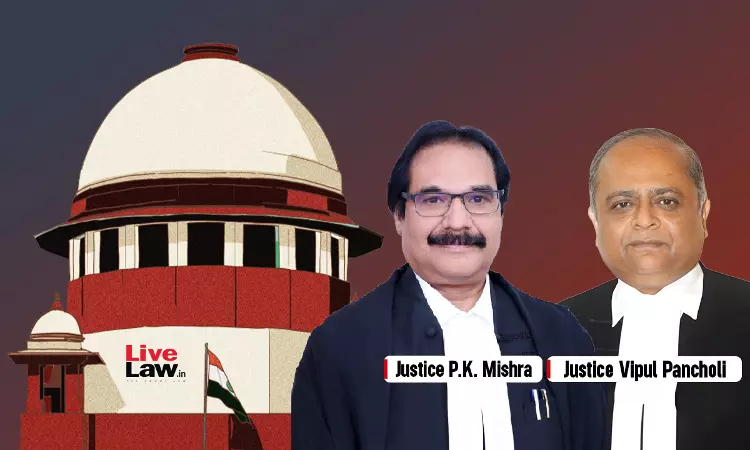
The Supreme Court has observed that an employer is entitled to withhold the payment of gratuity to an employee against whom a judicial or disciplinary proceeding is pending. A bench of Justice Prashant Kumar Mishra and Justice Vipul M. Pancholi dismissed an appeal filed by an ex-Himachal Pradesh Road Transport Corporation Clerk, whose gratuity was withheld by the transport corporation because...
This is a premium content
Available exclusively to
Our subscribers
Subscribe Premium 
INR 1099+GST
Your support helps us to bring you more content at
an affordable subscription scheme !!!
All payment options available
The Supreme Court has observed that an employer is entitled to withhold the payment of gratuity to an employee against whom a judicial or disciplinary proceeding is pending.
A bench of Justice Prashant Kumar Mishra and Justice Vipul M. Pancholi dismissed an appeal filed by an ex-Himachal Pradesh Road Transport Corporation Clerk, whose gratuity was withheld by the transport corporation because of the pendency of criminal proceedings against him.
Post-superannuation, the Appellant's gratuity was withheld by the Respondent department as a result of the pendency of a criminal proceeding against him for his alleged involvement in the leak of the question paper of the Combined Pre-Medical Test, 2006.
At the same time, disciplinary proceedings were ongoing. In the meantime, the Appellant was acquitted in the criminal case due to a lack of sufficient evidence. He argued that his gratuity should not be withheld, contending that Rule 69(1)(c) of the Central Civil Services (Pension) Rules, 1972 (Pension Rules) does not intend to deny gratuity where the employee has been acquitted in either the criminal or disciplinary proceedings.
The Himachal Pradesh High Court refused to interfere with the Respondent's decision, justifying the withholding of the gratuity, prompting the ex-employee to appeal to the Supreme Court.
Affirming the impugned order, the judgment authored by Justice Mishra referred to Rule 69(1)(c) of the Pension Rule to note that payment of gratuity can be withheld until the conclusion of the departmental or judicial proceedings and issue of final orders thereon.
Rule 69(c) reads :
"No gratuity shall be paid to the Government servant until the conclusion of the departmental or judicial proceedings and issue of final orders thereon:
Provided that where departmental proceedings have been instituted under Rule 16 of the Central Civil Services (Classification, Control and Appeal) Rules, 1965, for imposing any of the penalties specified in Clauses (i), (ii) and (iv) of Rule 11 of the said rules, the payment of gratuity shall be authorized to be paid to the Government servant.”
The Appellant's interpretation of Rule 69(1)(c) of the Pension Rules that the Rule must be construed to mean that gratuity becomes payable upon the conclusion of either set of proceedings, was rejected by the Court, indicating that gratuity shall not be paid so long as either departmental or judicial proceedings are pending.
“Such a submission totally misapprehends the nature of the Rule. As the learned Single Judge had rightly noted at the first instance, Rule 69(1)(c) operates as an 'embargo' or a statutory bar, not as an enabling provision. The use of the ordinary disjunctive “or” expands the scope of this bar, indicating that gratuity shall not be paid so long as either departmental or judicial proceedings are pending.”, the court remarked in response to the Appellant's submission regarding Rule 69(1)(c) of the Pension Rules.
“If the appellant's interpretation were accepted, an employee could contend that once any one set of proceedings against him/her stands concluded, the embargo stands lifted and gratuity must be released. This would altogether defeat the purpose of the provision, which is to safeguard the financial interests of the State.”, the court added.
Resultantly, the appeal was dismissed.
Headnote
Central Civil Services (Pension) Rules, 1972 – Rule 69(1)(c) – Withholding of Gratuity during pendency of proceedings – Interpretation of "Departmental or Judicial proceedings" – Held: Rule 69(1)(c) operates as a statutory bar or "embargo" on the payment of gratuity - The use of the disjunctive "or" in the provision indicates that gratuity shall not be paid so long as either departmental or judicial proceedings are pending against the government servant - The appellant's contention that gratuity becomes payable upon the conclusion of any one set of proceedings (e.g., exoneration in departmental inquiry while criminal trial is pending) is rejected as it would defeat the purpose of safeguarding the financial interests of the State.
Central Civil Services (Pension) Rules, 1972 – Rule 9(1) – Right to withhold or withdraw pension – Interplay with Rule 69 – Held: Rule 9 is "downstream" in its operation - It applies at the stage where an employee has been found guilty of grave misconduct - It cannot be invoked to justify the release of gratuity during the interregnum of pending proceedings on the premise that recovery could be effected later if a conviction occurs.
Service Law – Disciplinary Proceedings vs. Criminal Trial – Standard of Proof – Held: Even when proceedings stem from identical allegations, their nature, scope, and standards of proof are fundamentally different (preponderance of probabilities vs. proof beyond reasonable doubt) - An acquittal in a criminal case is not automatically determinative of departmental liability, and the pendency of a criminal trial remains a valid statutory bar to the release of gratuity under Rule 69(1)(c). [Relied on Babu Manmohan Das Shah & Ors. vs. Bishun Das (1967 [1] SCR 836); Paras 12-16]
Cause Title: BIKRAM CHAND RANA VERSUS HIMACHAL PRADESH ROAD TRANSPORT CORPORATION
Citation : 2026 LiveLaw (SC) 344
Click here to download judgment
Appearance:
For Petitioner(s) : Mr. Karan Bharihoke, AOR
For Respondent(s) Mr. Himanshu Tyagi, AOR Mrs. Poonam Sharma, Adv. Mr. Kunal Tyagi, Adv. Mr. Shivam Tyagi, Adv.
Tags

Yash Mittal
Yash Mittal is a Correspondent with LiveLaw, covering the Supreme Court of India

