



- Home
- /
- Supreme court
- /
- Contract Denying Interest On...
Contract Denying Interest On Security Deposit Not Against Public Policy: Supreme Court
Yash Mittal
14 July 2026 11:24 AM IST
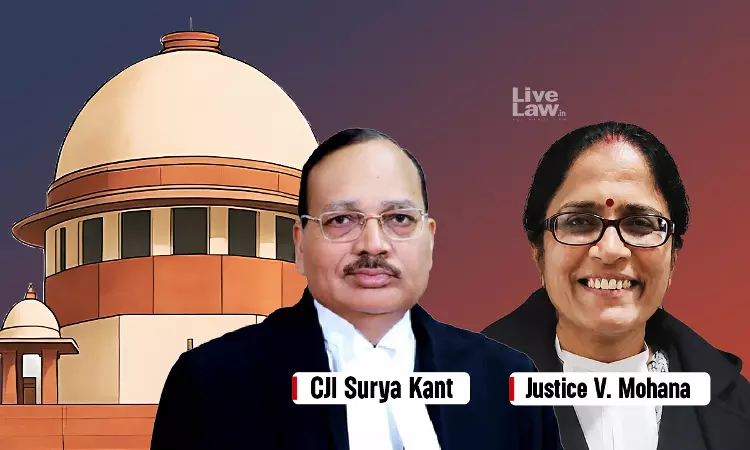
The Court observed that 'no interest' stipulation in a contract is neither immoral nor unlawful.
The Supreme Court on Monday (July 13) observed that a clause in a commercial contract cannot be declared against the law and public policy merely because it does not stipulate payment of interest on a security deposit. A bench of Chief Justice Surya Kant and Justice V. Mohana set aside the Punjab and Haryana High Court's judgment, which declared the clause in a commercial contract to be...
This is a premium content
Available exclusively to
Our subscribers
Subscribe Premium 
INR 1099+GST
Your support helps us to bring you more content at
an affordable subscription scheme !!!
All payment options available
The Supreme Court on Monday (July 13) observed that a clause in a commercial contract cannot be declared against the law and public policy merely because it does not stipulate payment of interest on a security deposit.
A bench of Chief Justice Surya Kant and Justice V. Mohana set aside the Punjab and Haryana High Court's judgment, which declared the clause in a commercial contract to be contrary to public policy as it doesn't stipulate payment of interest on the security deposit.
The issue was “whether the amount of security deposit given by the Respondent-contractor will carry interest despite there being a contract to the contrary between the Appellant and the Respondent.”
Answering in the negative, the judgment authored by Justice Mohana observed:
“The public policy cannot be pressed into service to set at naught the commercial contract which expressly denies interest on security deposit. Such a stipulation is neither immoral nor unlawful nor can it be classified as unsustainable in the legal sense. The Respondent as a commercial entity had participated in open auction and emerged as the highest bidder and executed the standard statutory Form-L with full knowledge and furnished an undertaking to abide by the same. Once parties have voluntarily accepted a contract they cannot turn around and assail the same as oppressive after major part of the contract period has gotten over. The reasoning of the High Court that when State charges interest on belated instalment they should pay interest on the security does not stand scrutiny.”
The case arose from a mining contract awarded by the State of Haryana for extraction of Yamuna sand from the Bega Murthal Sand Zone. M/s. Jai Durgaa Finvest Pvt. Ltd. emerged as the highest bidder in an auction held in April 1998 and entered into a three-year agreement with the State on November 30, 1998.
Clause 19 of the statutory Form-L agreement specifically provided: "The security deposited by the Contractor/Contractors shall not carry any interest. It shall be refunded to the Contractor within three months from the date of expiry or sooner determination of the contract."
The contractor later defaulted in making monthly payments. Following notices issued under the agreement, the Director of Mines and Geology terminated the contract on March 9, 2000, and ordered forfeiture of the security deposit.
The Punjab and Haryana High Court eventually declared Clause 19 "unsustainable in law" and directed the State to refund the security amount with interest at 9% per annum from the date of deposit. The State challenged that decision before the Supreme Court.
Allowing the State's appeal, the Court reiterated that the Courts are not empowered to rewrite the contractual terms contrary to what agreed upon between the parties to the contract. Providing interest on the security deposit, contrary to the agreement, the Court observed amounted to re-writing of an agreement by the High Court.
“It is well settled that in matters of contract between the parties the function of a Court is to interpret and enforce the terms as has been agreed between parties. The Court will not re-write the terms howsoever reasonable the substituted term may appear to be. In matters of commercial contracts where the parties stand on equal footing and have committed to certain unambiguous terms, the language of the contract is to be clearly looked into and parties are bound by the same. Once the parties with their eyes open without any protest whatsoever and with free will accept certain terms of a contract they cannot afterwards be permitted to go back on the same merely because at a later point of time the stipulation proves to be onerous.”, the Court observed.
“…it is held that Clause 19 is a valid binding term of the agreement and the finding of the learned Single Judge as affirmed by the Division Bench that Clause 19 is unsustainable in law and opposed to public policy is set-aside.”, the Court held.
However, the Bench clarified that Clause 19 had to be read as a whole. While the clause excluded interest on the security deposit, it also required the State to refund the amount within three months of the expiry or earlier termination of the contract. Therefore, the State could not retain the deposit indefinitely without consequences.
Interpreting the clause harmoniously, the Court ruled that no interest was payable for the first three months after termination of the contract. But if the State retained the security deposit beyond that period, the contractor would be entitled to interest.
Since the contract had been terminated on March 9, 2000, the Court held that the contractor would be entitled to simple interest at 9% per annum from June 9, 2000, until the date on which the security deposit was adjusted towards outstanding dues or refunded. The direction of the High Court awarding interest from the date of deposit was accordingly set aside, while the rate of 9% interest for the delayed period was maintained.
Headnote
Punjab Minor Minerals Concession Rules, 1964 — Rule 33 and Form-L (Clause 19) — Security Deposit — Entitlement to Interest — Contractual Terms vs. Judicial Interpretation — Writ Jurisdiction - The function of the Court in contractual matters is to interpret and enforce the agreed terms, not to rewrite them, howsoever reasonable a substituted term may appear to be - In commercial contracts where parties stand on an equal footing and accept unambiguous terms with free will and open eyes, they cannot later assail a clause as unconscionable or oppressive merely because it proves to be onerous.
Punjab Minor Minerals Concession Rules, 1964 — Form-L (Clause 19) — Interpretation of "No Interest" Clause on Security Deposit — Two Limbs of a Clause to be Read Harmoniously - Clause 19 of Form-L consists of two interdependent limbs: (i) the security deposit shall carry no interest, and (ii) it shall be refunded within three months from the date of expiry or sooner determination of the contract - The correct interpretation is that the deposit earns no interest during the currency of the contract and up to the stipulated period for refund - The State cannot retain interest-free money in perpetuity - If the State fails to refund or adjust the security deposit within three months from the date of determination of the contract, the contractor becomes entitled to interest for the period of delay beyond the specified three months - The High Court erred in declaring Clause 19 as unsustainable in law and granting interest from the initial date of deposit. [Relied on National Highways Authority of India v. Ganga Enterprises And Another, (2003) 7 SCC 410; Shri Hanuman Cotton Mills and Others Vs. Tata Aircraft Limited, (1969) 3 SCC 522; Venkataraman Krishnamurthy And Another v. Lodha Crown Buildmart Private Limited, (2024) 4 SCC 230; Rajasthan State Industrial Development & Investment Corpn. v. Diamond & Gem Development Corporation Ltd, (2013) 5 SCC 470; Shree Ambica Medical Stores v. Surat People's Coop. Bank Ltd., (2020) 13 SCC 564; Paras 23-31].
Cause Title: STATE OF HARYANA & ORS. VERSUS M/S. JAI DURGAA FINVEST P. LTD.
Citation : 2026 LiveLaw (SC) 671
Click here to download judgment
Appearance:
For Appellant(s) : Mr. Akshay Amritanshu, AOR Mr. Sarthak Srivastava, Adv.
For Respondent(s) :Mrs. Lalita Kaushik, AOR Mr. Manoj Joshi, Adv. Ms. Shikha John, Adv.
Tags

Yash Mittal
Yash Mittal is a Correspondent with LiveLaw, covering the Supreme Court of India

