



- Home
- /
- Supreme court
- /
- Court Cannot Substitute Its...
Court Cannot Substitute Its Decision In Place Of Authority's Discretion : Supreme Court Sets Aside Direction To Governor
Yash Mittal
10 April 2026 10:19 AM IST
Even when the authority refuses to take a decision, the Court's direction should be to decide.
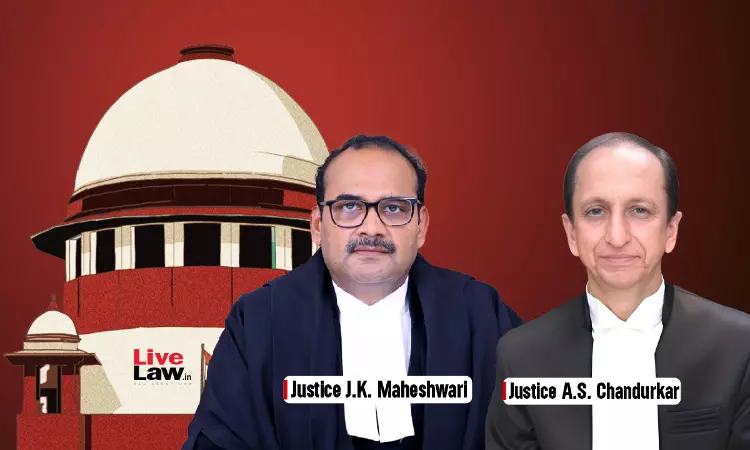
The Supreme Court on Thursday (April 9) held that the grant of an extraordinary pension under the Uttar Pradesh Civil Services (Extraordinary Pension) Rules, 1981, is subject to the discretion of the Governor. A bench of Justice JK Maheshwari and Justice Atul S. Chandurkar set aside the Uttarakhand High Court's decision, which had ordered the state government to grant an extraordinary pension...
This is a premium content
Available exclusively to
Our subscribers
Subscribe Premium 
INR 1099+GST
Your support helps us to bring you more content at
an affordable subscription scheme !!!
All payment options available
The Supreme Court on Thursday (April 9) held that the grant of an extraordinary pension under the Uttar Pradesh Civil Services (Extraordinary Pension) Rules, 1981, is subject to the discretion of the Governor.
A bench of Justice JK Maheshwari and Justice Atul S. Chandurkar set aside the Uttarakhand High Court's decision, which had ordered the state government to grant an extraordinary pension to the widow of the deceased doctor, who died during harness. The Court said that when the Governor had not examined the issue of grant of an extraordinary pension, then it was impermissible for the High Court to assume the discretionary authority of the Governor to grant a benefit to the Respondent No.1.
“Under Rule 4, award of extraordinary pension under the Rules of 1981 is only with the sanction of the Governor…the High Court by the impugned judgment itself proceeded to take a decision in the matter of grant of extraordinary pension without the Hon'ble Governor having an occasion to exercise discretion and take a decision in accordance with the Rules of 1981. For these reasons, we find that the exercise of jurisdiction by the High Court in issuing a writ of mandamus and directing the appellants to grant extraordinary pension to the first respondent is unwarranted and thus, deserves to be interfered with.”, the court observed.
The case centres on the death of a paediatrician in 2016, while discharging his duties at the Community Health Centre (CHC) in Jaspur, Uttarakhand.
Following his death, his widow sought relief under the Uttar Pradesh Civil Services (Extraordinary Pension) Rules, 1981 (as adopted by Uttarakhand). While the State initially provided ₹1 lakh in compensation, a contractual job for her son, and government housing, the family argued this was insufficient given the Chief Secretary's earlier proposal of ₹50 lakhs.
In 2018, the Uttarakhand High Court took a stern view of the State's delay. It calculated a compensation package of ₹1.99 crore and directed the State to pay an extraordinary pension, citing that the doctor died while performing "risky" official duties. The State challenged this before the Supreme Court, arguing that a doctor's profession does not fall under the defined "posts of risk" and that the Governor's mandatory sanction was missing.
Allowing the State's appeal, the judgment authored by Justice Chandurkar holds the grant of extra ordinary pension to be improper, as no Governor's sanction was involved.
The Court said that when the statutory rules grant a discretionary power to the Governor to take a call on the grant of an extraordinary pension, it was impermissible for the High Court to substitute its decision in place of the decision required to be taken by the Governor in exercise of its discretion. (See State of West Bengal Vs. Nuruddin Mallik, 1998)
“On a complete reading of the Rules of 1981, it is clear that in the matter of award of extraordinary pension, the sanction of the Hon'ble Governor is necessary. Such sanction is expected to be granted by the Hon'ble Governor after examining all relevant aspects referred to in the Rules of 1981. Thus, grant of sanction to the award of extraordinary pension is pursuant to an exercise of administrative power conferred on the Hon'ble Governor. It is, therefore, obvious that at the first instance it is for the Hon'ble Governor to consider whether a case has been made out for granting sanction to the award of extraordinary pension. It may be stated that where an authority has been conferred with discretionary powers that have to be exercised while taking an administrative decision and the considerations to be taken into account while exercising such discretion are duly enumerated, it would always be preferable that such authority itself takes such decision. In such a scenario, the Court would be slow to itself take such decision especially when the authority on whom the power has been conferred to take such decision has had no occasion to examine the matter and exercise its discretion in accordance with law. It would be a different matter if such authority has either refused to take any decision for a reasonable period of time or the decision taken is found to be wholly arbitrary or suffering from non-application of mind. Even in such situations, normally, a direction to the authority concerned to take a decision afresh would follow. Ordinarily, the Court would not substitute its decision in place of the decision required to be taken by the concerned authority in exercise of its discretion.”, the court observed.
In light of the aforesaid, the Court allowed the appeal and set aside the impugned order, with liberty to the Respondent No.1 to make a representation to the Governor for the grant of an extraordinary pension.
“The first respondent is permitted to make an application for grant of extraordinary pension under the Rules of 1981 within the period of four weeks from today. If such application is duly made, the Competent Authority shall consider the same in accordance with the Rules of 1981 and determine the entitlement of the first respondent to receive extraordinary pension. This be done after giving due opportunity to the first respondent. The decision in this regard be taken within a period of twelve weeks from the date of receipt of such application and the outcome thereof be communicated to the first respondent.”, the court ordered.
Headnote
Service Law – Extraordinary Pension – Uttar Pradesh Civil Services (Extraordinary Pension) Rules, 1981 – Mandatory Sanction of the Governor – Writ of Mandamus – Substitution of Discretion – The Supreme Court set aside the High Court's direction to pay extraordinary pension to the widow of a doctor shot dead while on duty - held that under Rule 4 of the 1981 Rules, no award of extraordinary pension can be made except with the sanction of the Governor, which involves the exercise of administrative discretion.
Administrative Discretion – Judicial Review – Held that ordinarily, the Court will not exercise the power of statutory authorities or substitute its own decision for that of the authority conferred with discretionary powers - noted that since the Governor had no occasion to examine the request or exercise discretion under the Rules, the High Court's issuance of a writ of mandamus was unwarranted. [Relied on Union of India Vs. S.B.Vohra and Ors. (2004 INSC 5); Paras 10-16]
Cause Title: THE STATE OF UTTARAKHAND VERSUS SARITA SINGH AND ORS.
Citation : 2026 LiveLaw (SC) 353
Click here to download judgment
Appearance:
For Petitioner(s) : Mr. Gaurav Bhatia, Sr. Adv. Mr. Sudarshan Singh Rawat, AOR Ms. Anubha Dhulia, Adv. Mr. Neelmani Guha, Adv. Mr. Sunny Sachin Rawat, Adv. Mr. Shivam Wadhwa, Adv. Mr. Pranshu Dwivedi, Adv. Mr. Saakshi Singh Rawat,Adv.
For Respondent(s) : Mr. Vijay Hansaria, Sr. Adv. Ms. Kavya Jhawar, Adv. Ms. Nandini Rai, Adv. Mr. Aashay Shukla, Adv. Ms. Sneha Kalita, AOR Mr. Sarvesh Singh Baghel, AOR Mr. Shaurya Krishna, Adv. Ms. Shivranjani Ralawata, Adv. Mr. Vikramjeet Banerjee, A.S.G. (Not Present) Mr. Shashwat Parihar, Adv. Mr. Chinmayee Chandra, Adv. Mr. Krishna Kant Dubey, Adv. Mr. Piyush Beriwal, Adv. Mr. S K Gupta, Adv. Mokshita Sharma, Adv. Mr. Raj Bahadur Yadav, AOR Mr. Prateek Bhatia, AOR Mr. Dhawal Mohan, Adv. Mr. Manish Kumar, AOR Mr. Kumar Saurav, Adv.
Tags

Yash Mittal
Yash Mittal is a Correspondent with LiveLaw, covering the Supreme Court of India

