



- Home
- /
- Supreme court
- /
- Courts Cannot Re-Adjudicate Settled...
Courts Cannot Re-Adjudicate Settled Issues In Contempt Jurisdiction, Can Only Examine Compliance : Supreme Court
Yash Mittal
13 April 2026 3:27 PM IST
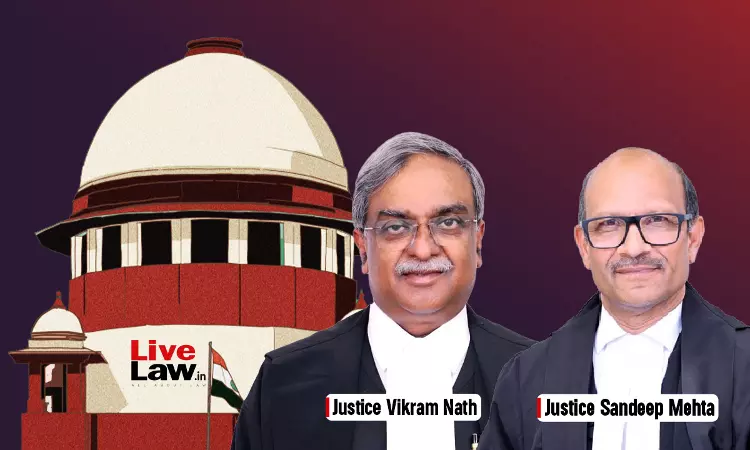
The Court set aside the Allahabad High Court's order passed in contempt jurisdiction, observing that it had effectively nullified a binding judgment instead of ensuring its enforcement.
The Supreme Court has observed that, while exercising contempt jurisdiction, it is impermissible for the concerned courts to transgress their limits by re-adjudicating issues already decided in the original proceedings, and they must confine themselves to ensuring compliance with binding directions. “The jurisdiction in contempt proceedings is confined to examining compliance with...
This is a premium content
Available exclusively to
Our subscribers
Subscribe Premium 
INR 1099+GST
Your support helps us to bring you more content at
an affordable subscription scheme !!!
All payment options available
The Supreme Court has observed that, while exercising contempt jurisdiction, it is impermissible for the concerned courts to transgress their limits by re-adjudicating issues already decided in the original proceedings, and they must confine themselves to ensuring compliance with binding directions.
“The jurisdiction in contempt proceedings is confined to examining compliance with the directions issued and does not extend to re-adjudication of issues which stand concluded.”, observed a bench of Justice Vikram Nath and Justice Sandeep Mehta.
The Bench was hearing a matter where the appellant–employee, despite having secured a favourable order from the Allahabad High Court granting full salary and benefits for the suspension period, was not paid his retiral dues, compelling him to initiate contempt proceedings before the High Court. However, instead of limiting its inquiry to ensuring compliance with its earlier directions, the High Court dismissed the contempt petition by re-adjudicating the issues and holding the appellant ineligible for retirement benefits.
In effect, the High Court, while exercising contempt jurisdiction, reversed its own earlier decision granting salary and retirement benefits to the appellant.
Challenging the High Court's decision, the employee appealed to the Supreme Court.
Setting aside the impugned order, the Court held that the scope of contempt jurisdiction is limited to examining compliance with earlier directions and does not permit re-adjudication of issues already settled.
When the earlier order had examined the questions of eligibility, absorption, or qualifications, then it was impermissible to be re-adjudicated in contempt jurisdiction, the court said.
“…it was impermissible for the High Court, while exercising its contempt jurisdiction, to expand the scope of inquiry by re-examining issues relating to regularisation or absorption of the appellant in a Class-III post.”, the court observed.
“The High Court, therefore, fell in error in entering into such questions, instead of enforcing its own directions requiring the respondent-Bank to pay the arrears of salary and emoluments due to the appellant up to the date of his retirement, together with all post-retiral dues and benefits attached to the post of Cooperative Supervisor or an equivalent post.”, the court added.
Accordingly, the appeal was allowed.
Apart from restoring the benefits, the Court also ordered the grant of Rs. 1 lakh to the Appellant towards compensation for the prolonged and unnecessary litigation undertaken by the respondent-Bank.
Headnote
Contempt Jurisdiction – Scope of Inquiry – Re-adjudication Prohibited – Held that exercising contempt jurisdiction, the Court must confine its inquiry to the compliance of the operative directions contained in the original order - The jurisdiction is limited to examining compliance and does not extend to the re adjudication of issues that have already attained finality between the parties – Noted that the High Court, in its earlier order dated 1st March 2019, unequivocally directed the respondent-Bank to pay the appellant arrears of salary and post-retiral benefits for the post of Cooperative Supervisor or an equivalent post, regardless of whether the post formally existed or whether the appellant possessed Intermediate qualifications - This order attained finality as it was not assailed by the Bank.
Impugned Order Erroneous – In the subsequent contempt proceedings, the High Court erred by expanding the scope of inquiry to re-examine the appellant's eligibility for Class-III posts and his lack of Intermediate qualifications - Such re examination was impermissible as it effectively reopened issues concluded by the final order of 1st March 2019 - The Supreme Court set aside the High Court's judgment dismissing the contempt petition - Supreme Court directed the respondent-Bank to pay the appellant gratuity of ₹2,28,000/- with 8% interest per annum from the date of retirement (31st October 2009) - awarded ₹1,00,000/- as compensation to the appellant for the prolonged and unnecessary litigation forced by the Bank. [Paras 10-17]
Cause Title: JALIM SINGH VERSUS NAND KISHORE & ORS.
Citation : 2026 LiveLaw (SC) 364
Appearance:
For Petitioner(s) : Mr. Raghavendra S. Srivatsa, Sr. Adv. Ms. Komal Mundhra, AOR Mr. Hari Vishnu Tiwari, Adv. Mr. Ashutosh Singh Rana, Adv. Ms. Laxita Upadhyay, Adv.
For Respondent(s) : Mr. Anurag Singh, Adv. Mr. Rajiv Kumar, Adv. Ms. Neelakshi, Adv. Mr. Anil Kumar Mishra, AOR Mrs. Rachna Gupta, AOR Ms. Shradha Narayan, Adv. Mr. Anil Kumar Sinha, Adv.

Yash Mittal
Yash Mittal is a Correspondent with LiveLaw, covering the Supreme Court of India

