



- Home
- /
- Supreme court
- /
- Crime Scene Re-Enactment Won't...
Crime Scene Re-Enactment Won't Violate Right Against Self Incrimination In All Situations: Supreme Court
Yash Mittal
21 May 2026 12:41 PM IST
Unless the accused is led to disclose incriminating acts, a crime scene re-enactment won't be hit by Article 20(3) or Sections 25, 26 of the Evidence Act.
Noting that the technique of crime scene re-enactment is gaining prominence in heinous crime investigations, the Supreme Court has ruled in favour of this technique, holding that the re-enactment of the crime scene cannot be rejected outright as unconstitutional merely because it involves participation of the accused. The Court clarified that the accused's participation in the crime...
This is a premium content
Available exclusively to
Our subscribers
Subscribe Premium 
INR 1099+GST
Your support helps us to bring you more content at
an affordable subscription scheme !!!
All payment options available
Noting that the technique of crime scene re-enactment is gaining prominence in heinous crime investigations, the Supreme Court has ruled in favour of this technique, holding that the re-enactment of the crime scene cannot be rejected outright as unconstitutional merely because it involves participation of the accused.
The Court clarified that the accused's participation in the crime scene re-enactment would violate Article 20(3) of the Constitution (fundamental right against self-incrimination) only when it compels the accused to disclose incriminating facts based on personal knowledge, and not when it is merely a directed physical demonstration for scientific analysis.
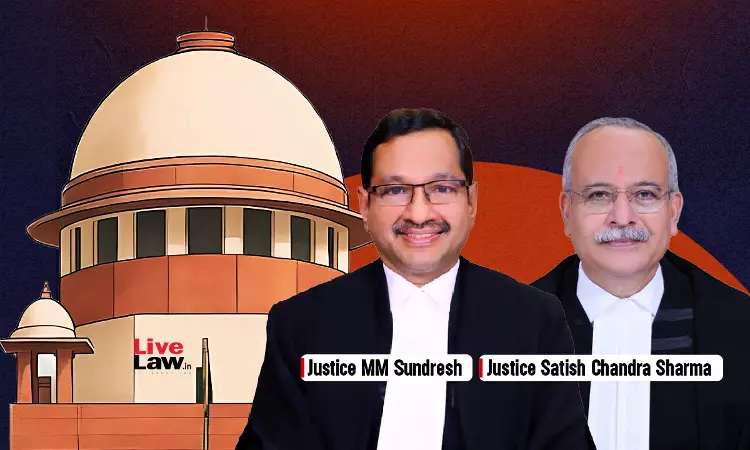
“…it cannot be held as a general proposition that every re-enactment or demonstration of a crime scene per se amounts to personal testimony of the accused. If the re-enactment is merely based on a direction to walk or to act a certain way or to imitate a visual sequence, it does not necessarily involve any physical manifestation or disclosure of the personal knowledge of the accused. In that sense, it does not amount to any personal testimony. However, if the accused is somehow led into demonstrating the incriminating acts committed by him from his own knowledge, the same would amount to testimonial compulsion and would be squarely hit by Section 25 and 26 of Evidence Act.”, observed a bench of Justice M.M. Sundresh and Justice Satish Chandra Sharma.
“…it would be dangerous to lay down a general rule against the admissibility of evidence based on re-enactment or demonstration of the occurrence, as it would effectively kill a potent and scientific investigative technique. The right approach is to tread a proportionate path and see whether the re-enactment is merely a directed demonstration to analyse physical attributes of the suspects or a manifestation of the personal knowledge of the accused.”, the court added.
Background
The case arose from the murder of a woman whose body was discovered near a water body in Tamil Nadu. The prosecution alleged that the accused had sexually assaulted and murdered the victim before disposing of her body. During the investigation, the police relied heavily on CCTV footage obtained from cameras installed near the crime scene and surrounding roads.
Since the CCTV footage captured only the accused's movement and gait, the investigating agency conducted a crime scene re-enactment after the accused was arrested. During this exercise, the accused was allegedly directed to walk and move like the individual visible in the CCTV footage. The re-enactment video was then forwarded for forensic gait analysis in order to compare the accused's walking pattern with the person captured in the original CCTV recordings.
Before the High Court, the accused challenged the entire exercise by arguing that compelling him to participate in a re-enactment violated Article 20(3) of the Constitution, which protects an accused from being compelled to become a witness against himself.
Accepting this argument, the Madras High Court had held that asking an accused to re-enact the occurrence amounted to testimonial compulsion because the accused would effectively be communicating facts based on personal knowledge of the crime. The High Court therefore treated the re-enactment as equivalent to a confession made in police custody.
The State challenged the High Court's finding before the Supreme Court.
Decision
Setting aside the High Court's ruling, the judgment authored by Justice Satish Chandra Sharma observed that the High Court erred in accepting the Respondents-accused contention about their violation of right against self-incrimination to discard the entire crime scene re-enactment.
The Court clarified that crime scene re-enactment is not substantive evidence of guilt by itself. Instead, it is merely “recreated evidence” intended to assist courts in understanding surrounding circumstances such as movement patterns, physical attributes, or visual evidence captured in CCTV footage.
The Court explained that since the accused was simply directed to walk, imitate movements visible in CCTV footage, or demonstrate physical attributes for scientific comparison, no testimonial compulsion is involved because the accused is not communicating personal knowledge of the offence. Thus, the Court acknowledged the gait expert analysis, which was merely a physical attribute of the accused, rather than the personal testimony.
“On the basis of such re-enactment, expert analysis such as gait analysis is carried out, which gives rise to a distinct piece of evidence, with distinct implications. Such expert evidence is not based on the personal testimony of the accused and is merely an analysis of the physical attributes of the accused, which could be used for the purpose of identification during trial. Thus, the thin line between 're-enactment' and 'evidence based on re-enactment' needs to be acknowledged.”, the court observed.
In essence, it was only when the accused was compelled to demonstrate how he committed the crime from his own memory that such an exercise would become inadmissible under Article 20(3) as well as Sections 25 and 26 of the Evidence Act, the court clarified.
Resultantly, the appeal was allowed.
Headnote
Evidence Act, 1872 – Section 25, 26, 27 & 161 – Code of Criminal Procedure, 1973 – Section 161 & 162 – Approver/Accomplice Evidence – Use of Previous Statement for Contradiction - The Supreme Court held that a non-confessional statement of an accused recorded by an Investigating Officer during investigation qualifies as a statement under Section 161 Cr.P.C - If the accused subsequently turns into an approver and steps into the witness box as a prosecution witness, such a statement can be put to him for the purpose of contradiction under Section 162 Cr.P.C - A confessional statement made while in police custody remains strictly barred by Section 25 of the Evidence Act and cannot be used for any purpose other than what is permissible under Section 27.
Criminal Trial – Appreciation of Approver's Evidence – Object of Granting Pardon - The Supreme Court observed that the testimony of an approver must be evaluated with caution and requires due corroboration on material particulars - the High Court adopted an infirm approach by rejecting the approver's testimony on the sole ground that it contradicted his previous statement given to the police when he was an accused - The very object of granting pardon under the law is to elicit a "true and full disclosure" in aid of the prosecution, which inherently acknowledges that the individual had concealed the truth prior to the pardon - Rejection of post-pardon testimonies based mechanically on pre-pardon contradictions would effectively frustrate the statutory purpose of pardon in criminal trials. [Relied On: Sarwan Singh v. State of Punjab, AIR 1957 SC 637; Paras 39, 64-67]
Constitution of India – Article 20(3) – Evidence Act, 1872 – Sections 25 & 26 – Crime Scene Re-enactment – Right Against Self-Incrimination - The Supreme Court corrected the High Court's finding that compelling an accused to re-enact a crime scene per se violates the right against self-incrimination under Article 20(3) of the Constitution or constitutes an inadmissible confession under Sections 25 and 26 of the Evidence Act - The core test is whether the exercise compels the disclosure of incriminating information from the personal knowledge of the accused, or merely requires him to mimic a visual sequence or perform physical movements - A directed re-enactment staged by the Investigating Officer to analyze physical attributes does not amount to a personal testimony - While a re-enactment is merely "created evidence" and not substantive proof of the actual crime, expert assessments derived from it—such as gait analysis—are admissible as corroborative evidence of identity. [Paras 86-90]
Evidence Act, 1872 – Section 65-B – Call Detail Records (CDRs) – Mode of Proof and Chain of Custody - The Supreme Court upheld the rejection of Call Detail Records (CDRs) filed by a Cyber Unit Police Officer who took printouts of data sent via email by telecom service providers and certified them under Section 65-B - Because the officer was merely a recipient and not the person having lawful control over the computer systems that generated the original records, he was incompetent to prove their contents - The prosecution's failure to examine the concerned Nodal Officers of the telecom companies or to produce the routing emails created a fatal gap in the chain of custody of the electronic data. [Paras 80, 81]
Expert Evidence – Forensic Science – Gait Analysis – Admissibility and Reliability Standards - The Supreme Court noted that while gait analysis is an evolving scientific technique useful for corroborating a suspect's identity and physical attributes, its validity relies entirely on a comparison between two independently admissible and reliable pieces of visual evidence - Where the original hard disk and DVR of a CCTV system were mishandled, delayed in extraction, and ultimately corrupted or destroyed by the investigating agency, a gait analysis report prepared by a private laboratory using an unverified backup copy cannot be safely relied upon. [Paras 91-93, 95-102]
Cause Title: THE STATE OF TAMIL NADU v PONNUSAMY AND ORS.
Citation : 2026 LiveLaw (SC) 519
Click here to download judgment.
Also From Judgment: Dr Subbiah Murder | Supreme Court Sets Aside Madras HC's Acquittals; Gives Life Sentence To 7 Convicts, Allows 2 To Seek Pardon
Appearance:
For Appellant(s) Mr. Siddharth Luthra, Sr. Adv. Mr. M.F. Philip, Adv. Ms. Purnima Krishna, AOR Mr. Kartikeya Dang, Adv. Mr. Aadarsh Joshi, Adv. Mr. Karamveer Singh Yadav, Adv. Mr. Togin M. Babichen, Adv. Mr. S. Islam, Adv. Mr. Kartik Seth, Adv. Ms. Shilpa Saini, Adv. Mr. Raghav Sharma, Adv. Mr. Kunwar Vikramaditya Shah, Adv. Mr. Lakshmi Kant Srivastava, Adv. Mr. K.m. Abish, Adv. Mr. Minesh Joshi, Adv. Mr. Ragib, Adv. Ms. Shaesta Irshad, Adv. M/s Chambers Of Kartik Seth, AOR
For Respondent(s) Mr. R. Basant, Sr. Adv. Mr. N. Sai Vinod, AOR Ms. Kanu Garg, Adv. Mr. Raunak Arora, Adv. Mr. Kavinesh Rn, Adv. Dr. Yug Mohit Chaudhary, Adv. Mr. Siddhartha, Adv. Mr. S. Prabu Ramasubramanian, Adv. Mr. Bharathimohan M., Adv. Ms. V. Swetha, Adv. Mr. Vairawan A.s, AOR Mr. M.F.Philip, Adv. Ms. Purnima Krishna, AOR Mr. Karamveer Singh Yadav, Adv. Mr. Togin M. Babichen, Adv. Mr. Navneet Dugar, AOR Mr. Gopal Shankarnarayan, Sr. Adv. Mr. S Prabu Ramasubramaniyan, Adv. Mr. Vishal Sinha, Adv. Mr. Aayushman Aggarwal, Adv. Mr. Bharathimohan M, Adv. Mr. Prashant Padmanabhan, AOR Mr. M. Sathyanarayanan, Sr. Adv. Mr. Lakshman Rajat, Adv. Ms. Anindita Mitra, AOR Mr. Vishal Sinha, Adv. Ms. Payoshi Roy, Adv. Mr. Kaushal Kishore, Adv. Mr. Amit Pratap Shaunak, Adv. Mr. Achintya Tiwari, Adv. Mr. Priyanshu Maheshwari, Adv. Ms. Shivangi Chaturvedi, Adv. Mr. M. Srinivasan, Adv. Mr. C. Solomon, AOR Mr. Shri Singh, Adv. Ms. Arshiya Ghose, Adv. Mrs. Arunima Nair, Adv. Mrs. Varuni Aggarwal, Adv. Mr. Nayan Nishchal, Adv. Mr. S. Parthasarathi, AOR Mr. Jayanth Muth Raj, Sr. Adv. Ms. Shivani Vij, AOR Mr. Shrutanjaya Bhardwaj, Adv. Mr. Yash Tayal, Adv. Ms. Siddhi Nagwekar, Adv. Mr. Nizam Pasha, Adv. Mr. E K Kumaresan, Adv. Mr. Mushtaq Salim, Adv. Mr. Lzafeer Ahmad B. F., AOR Mr. Sidharth Kaushik, Adv. Mr. Arif Ali, Adv
Tags

Yash Mittal
Yash Mittal is a Correspondent with LiveLaw, covering the Supreme Court of India

