



- Home
- /
- Supreme court
- /
- Deed Cannot Be Reinterpreted Based...
Deed Cannot Be Reinterpreted Based On Parties' Later Conduct When Terms Are Clear & Unambiguous: Supreme Court
Yash Mittal
26 Feb 2026 7:56 PM IST
The Supreme Court has cautioned against reliance on the ex-post facto conduct of parties to reinterpret a lease deed when the terms of the document are clear and unambiguous, holding that a lease validly established on the face of the deed cannot be altered or diluted by reference to the parties' subsequent conduct. “…courts must exercise far greater restraint when inferring the...
This is a premium content
Available exclusively to
Our subscribers
Subscribe Premium 
INR 1099+GST
Your support helps us to bring you more content at
an affordable subscription scheme !!!
All payment options available
The Supreme Court has cautioned against reliance on the ex-post facto conduct of parties to reinterpret a lease deed when the terms of the document are clear and unambiguous, holding that a lease validly established on the face of the deed cannot be altered or diluted by reference to the parties' subsequent conduct.
“…courts must exercise far greater restraint when inferring the parties' intention from circumstances arising after the creation of the terms. For, the conduct may not be in tandem with either the literal expression or the purpose of the document.”, the court observed.
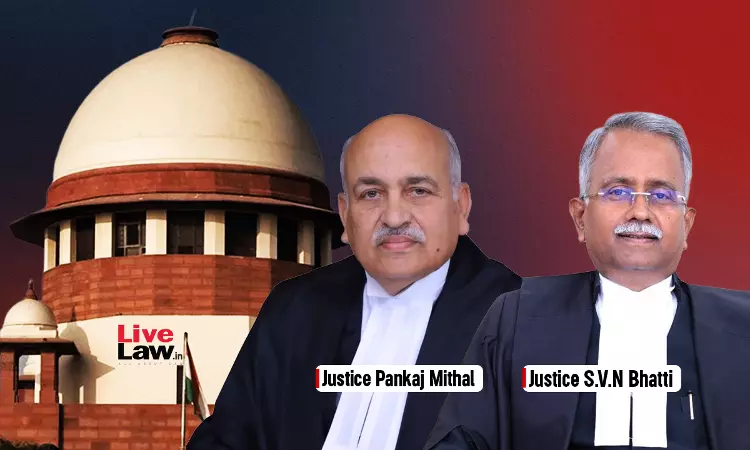
A Bench of Justice Pankaj Mithal and Justice S.V.N. Bhatti was hearing a matter in which the Orissa High Court, relying on the subsequent conduct of the parties, particularly statements made during cross-examination suggesting that the lessor retained effective control and possession over the property, had concluded that the registered lease deed was in fact a licence.
Disagreeing with the High Court's decision, the Court said that when the terms of the deed was clear and unambiguous establishing it as a lease deed, the High Court committed an error in altering the nature of the deed based on the subsequent conduct of the parties without adverting to the text and the context of the deed which established the deed as a lease deed.
“There is no doubt that the nomenclature alone of the document is not the decisive factor of the nature of a document; it is the text and the context that point to the obligations undertaken by the parties to a written document.”, the court said.
Background
The dispute concerned a property at Baripada, Odisha, originally owned by the late Anima Bose. On March 23, 1998, Bose executed a registered deed in favour of Vivekananda Kendra granting rights over the property for 99 years at an annual rent of ₹1,000. The document repeatedly used expressions such as “demise,” “lease,” “to hold for 99 years,” and provided for succession to heirs and permitted assigns.
In December 2003, Anima Bose unilaterally cancelled the registered lease deed and subsequently issued a notice asking Vivekananda Kendra to vacate. The Kendra contested this action, asserting its leasehold rights, and filed a civil suit after its possession was disturbed in 2005. During the pendency of the suit, the property was sold in January 2006 to the Respondents.
The Trial Court and the First Appellate Court both held that the document was a lease, that its unilateral cancellation was illegal, and that the purchasers were bound by the doctrine of lis pendens. However, the Orissa High Court, in second appeal, reversed these findings, prompting Kendra to move to the Supreme Court.
Setting aside the impugned decision, the judgment authored by Justice Bhatti said that the subsequent conduct of the parties would not be a decisive factor to determine the nature of the deed, but the text and context in which the deed was executed.
Since the deed vested exclusive possession with the Appellant for 99 years, the Court ruled out the possibility of a license deed. It referenced Associated Hotels of India Ltd. v. R.N. Kapoor, AIR 1959 SC 1262, where the Court sets out the ingredients of a lease and a licence, as well as the distinction between these two conceptual legal terms.
“if the document creates an interest in the property, it is a lease; but, if it only permits another to make use of the property, of which the legal possession continues with the owner, it is a licence.”, the court said in Associated Hotels of India Ltd. v. R.N. Kapoor.
“In the case at hand, the document's nomenclature, text and context lead to only one conclusion: that Defendant No. 1 entered into a 99-year lease deed. Thus, the unilateral cancellation, in the facts and circumstances of this case, is illegal, and it should be understood as having interfered with the right of the Plaintiff to remain in possession of the Plaint Schedule Property for 99 years. Therefore, the prayers, as made, are available and are rightly granted by the Trial and First Appellate Courts.”, the court held.
Accordingly, the appeal was allowed.
Headnote
Transfer of Property Act, 1882; Section 105 and Section 108 — Indian Easements Act, 1882; Section 52 — Lease vs. Licence — Interpretation of Deeds — The Supreme Court set aside a High Court judgment that had re-characterized a registered 99-year lease deed as a licence - held that when the nomenclature, text, and context of a document clearly indicate a "lease simpliciter," courts should not resort to purposive construction or ex-post facto circumstances to infer a different intention - A unilateral cancellation of such a registered lease deed, without bilateral agreement or meeting conditions under Section 111 of the Transfer of Property Act, is illegal and non-est.
Construction of Documents — Literal Rule vs. Purposive Construction — Supreme Court emphasized that a contract must first be constructed in its plain, ordinary, and literal meaning - If the words are clear, the intention of the parties must be derived directly from the text. Reliance on the ex-post facto conduct of parties (such as the lessor continuing to occupy a portion not demised) is unnecessary and improper when the literal expression is unambiguous – Appeal allowed. [Relied on Associated Hotels of India Ltd. v. R.N. Kapoor, AIR 1959 SC 1262; Paras 15-21]
Cause Title: THE GENERAL SECRETARY, VIVEKANANDA KENDRA VERSUS PRADEEP KUMAR AGARWALLA AND OTHERS
Citation : 2026 LiveLaw (SC) 204
Click here to download judgment
Appearance:
For Petitioner(s) :Mr. Rutwik Panda, AOR Ms. Nikhar Berry, Adv. Ms. Anshu Malik, Adv.
For Respondent(s) : Mr. Ashok Panigrahi, Sr. Adv. Mr. R. Chandrachud, AOR Mr. Dhuli Venkata Krishna, adv. Mr. Surajit Bhaduri, Adv. Mr. Aryan Singh, Adv. Mr. Piyush Negi, Adv.

Yash Mittal
Yash Mittal is a Correspondent with LiveLaw, covering the Supreme Court of India

