



- Home
- /
- Supreme court
- /
- Demolition Of Private Property Must...
Demolition Of Private Property Must Be Based On Clear Statutory Grounds & Consideration Of All Factors : Supreme Court
Yash Mittal
29 Jan 2026 7:50 PM IST
Holding that a demolition order affecting property rights under Article 300-A of the Constitution must be founded on clear, cogent, and site-specific evidence of illegality, the Supreme Court on Thursday (January 29) set aside the Calcutta High Court's direction to demolish a fully constructed residential building in Santiniketan, after finding that no material had been placed on record...
This is a premium content
Available exclusively to
Our subscribers
Subscribe Premium 
INR 1099+GST
Your support helps us to bring you more content at
an affordable subscription scheme !!!
All payment options available
Holding that a demolition order affecting property rights under Article 300-A of the Constitution must be founded on clear, cogent, and site-specific evidence of illegality, the Supreme Court on Thursday (January 29) set aside the Calcutta High Court's direction to demolish a fully constructed residential building in Santiniketan, after finding that no material had been placed on record to establish that the construction stood on “khoai” land.
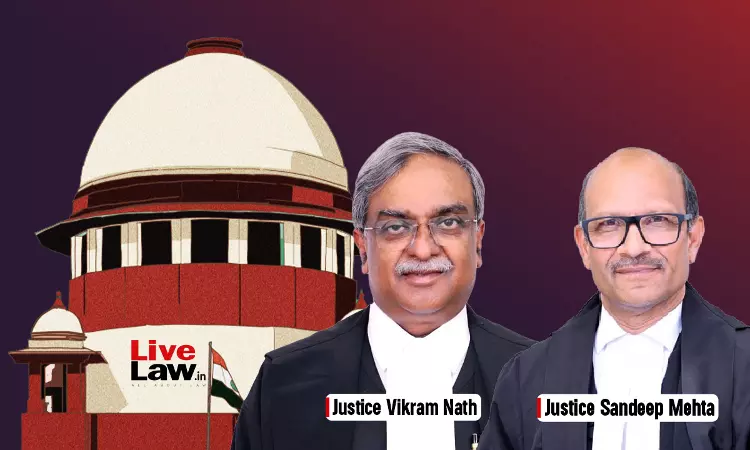
“Any interference with privately owned property, including by way of demolition or deprivation of its beneficial use, must therefore rest on a clear statutory foundation and be preceded by due consideration of all relevant factual and legal circumstances, which exercise, appears not to have been undertaken in the present case.”, observed a bench of Justices Vikram Nath and Sandeep Mehta, adding that the public interest litigation cannot be filed on mere conjectures, and surmises, rather a cogent scientific evidence is necessitated to seek demolition of an illegal structure.
“The District Magistrate's report is based merely on conjectures and surmises and was submitted without the concerned official even bothering to undertake a proper site inspection or getting a spot verification done through an expert. Hence, in the absence of reliable scientific material establishing the “khoai” character of the subject plot, the foundational premise on which the High Court proceeded to issue the directions (for demolition) cannot be said to be conclusively borne out from the record…In the absence of clear, specific, and contemporaneous scientific evidence establishing that the subject plot was of “khoai” nature, the invocation of public interest jurisdiction to assail the construction undertaken by Aarsuday Projects cannot be sustained, particularly where similarly situated constructions within the same tract of land were left unchallenged.”, the court observed.
A Public Interest Litigation was filed before the High Court, challenging the legality of a housing project constructed on a 0.39-acre plot in Mouza Ballavpur, near Visva-Bharati University, Santiniketan.
The High Court in 2013 had ordered demolition of the building, directed payment of ₹10 lakh as compensation for restoration of the area, imposed costs, and ordered initiation of proceedings against officials of the Sriniketan Santiniketan Development Authority (SSDA) and the local Gram Panchayat. The High Court had concluded that the construction was illegal as it stood on “khoai” land, an ecologically sensitive geological formation, and that permissions had been granted by incompetent authorities, leading to an appeal before the Supreme Court.
Allowing the appeals filed by Aarsuday Projects, the SSDA, and affected flat purchasers, the Supreme Court held that the very foundation of the demolition order was legally unsustainable.
The judgment authored by Justice Mehta rejected the High Court's finding that the construction stood on protected “khoai” land, instead it observed that no conclusive or scientific evidence had been produced to establish this crucial fact.
The report of the West Bengal Pollution Control Board merely stated that the adjoining area was colloquially known as “khoai” and did not certify that the subject plot itself was “khoai” land.
“a pertinent finding emerging from the survey material collected by WBPCB is that “khoai” formations were noticed on the land adjacent to the subject plot on which Aarsuday Projects has raised the disputed construction. This finding assumes significance, as it clearly negates the assumption that the subject plot itself was of “khoai” nature.”, the court observed.
Headnote
Public Interest Litigation (PIL) - Property Rights - The Supreme Court set aside a Calcutta High Court judgment that had ordered the demolition of a residential building constructed by the appellant near Visva-Bharati University – Noted that the High Court had initially ruled the construction illegal on the grounds that it was raised on preserved "khoai" land and lacked approval from the competent authority (Panchayat Samiti) - Supreme Court found that the High Court's conclusions were based on conjectures rather than scientific evidence and failed to account for the appellant's right to property under Article 300A of the Constitution - Key Legal Issues & Findings – i. Burden of Proof in PIL and Disputed Facts: The Court emphasized that in a PIL, the burden lies squarely on the petitioners to provide clear, cogent, and reliable material - held that writ jurisdiction should not be invoked to resolve contested factual issues—such as the geological nature of land—which cannot be determined solely on affidavits; ii. Nature of "Khoai" Land - noted that "khoai" is not a recognized category under West Bengal revenue laws but a colloquial term for geological formations - Reports from the District Magistrate and the West Bengal Pollution Control Board (WBPCB) failed to provide objective or scientific evidence that the specific subject plot was "khoai" land; iii. Procedural Irregularities vs. Substantive Illegality - held that even if the Gram Panchayat was not the competent authority to sanction the building plan (vesting instead with the Panchayat Samiti), such a lapse constituted a "minor procedural irregularity" that was curable, especially since the plan had been vetted by the higher-tier Zilla Parishad - This did not warrant the "draconian consequence" of demolition; iv. Procedural Irregularities vs. Substantive Illegality - held that even if the Gram Panchayat was not the competent authority to sanction the building plan (vesting instead with the Panchayat Samiti), such a lapse constituted a "minor procedural irregularity" that was curable, especially since the plan had been vetted by the higher-tier Zilla Parishad - This did not warrant the "draconian consequence" of demolition; v. Bona Fides and Concealment of Facts: Noted that the PIL lacked bona fides as several writ petitioners owned existing residential structures within the same tract of land, a fact they failed to disclose - The petition "selectively targeted" the appellant's construction while ignoring similar surrounding structures - set aside the High Court's demolition order, and expunged adverse remarks against the Sriniketan Santiniketan Development Authority (SSDA). Due to the lack of bona fides and non-disclosure of material facts, the Court imposed costs of ₹1,00,000 on the writ petitioners. Appeals allowed. [Relied on Sushanta Tagore and Ors. v. Union of India and Ors., (2005) 3 SCC 16; Chairman, Grid Corporation of Orissa Ltd. (GRIDCO) v. Sukamani Das, (1999) 7 SCC 298; Shubhas Jain v. Rajeshwari Shivam, (2021) 20 SCC 454; Paras 36, 45 - 47, 49 – 52, 58]
Cause Title: M/S AARSUDAY PROJECTS & INFRASTRUCTURE (P) LTD VERSUS JOGEN CHOWDHURY & ORS.
Citation : 2026 LiveLaw (SC) 90
Click here to download judgment
Appearance:
For Appellant(s) : Mr. Ranjan Mukherjee, AOR Mr. Siddharth Bhatnagar, Sr. Adv. Mr. Nirnimesh Dube, Adv. Mr. Ankur S. Kulkarni, Adv. Mr. Pratham Mehrotra, Adv. Ms. Pracheta Kar, Adv. Mr. Nadeem Afroz, Adv. Ms. Priya S. Bhalerao, Adv. Ms. Divyansha Gajallewar, Adv. M/s Lex Regis Law Offices, AOR Mr. Prasenjit Keswani, Sr. Adv. Mr. Amol Chitale, Adv. Ms. Shweta Singh Parihar, Adv. Mrs. Pragya Baghel, AOR Mr. Sarthak Sharma, Adv.
For Respondent(s): Mr. Siddharth Bhatnagar, Sr. Adv. Mr. Nirnimesh Dube, Adv. Mr. Ankur S. Kulkarni, Adv. 1 Mr. Pratham Mehrotra, Adv. Ms. Pracheta Kar, Adv. Mr. Nadeem Afroz, Adv. Ms. Priya S. Bhalerao, Adv. Ms. Divyansha Gajallewar, Adv. M/s Lex Regis Law Offices, AOR Mr. Nikilesh Ramachandran, AOR M/S. Plr Chambers And Co., AOR Mr. Sanjay Kumar Visen, AOR Mr. G.arudhra Rao, Adv. Mr. Abhijit Sengupta, AOR Mr. Paras Chauhan, Adv. Mr. Balmiki Prasad, Adv. Mr. Birendra Kumar, Adv. Mr. N.maylsamy, Adv. Mr. S.prasada Rao, Adv. Mr. Vishal Arun, AOR Mr. Jaideep Gupta, Sr. Adv. Mr. Partha Sil, AOR Mr. Chirag Joshi, Adv. Mr. Utkarsh Dwivedi, Adv. Mr. Srijit Datta, Adv. Mr. Kunal Mimani, AOR Ms. Shraddha Chirania, Adv. Ms. Astha Sharma, AOR Mr. Ranjan Mukherjee, AOR Mr. Rana Mukherjee, Sr. Adv. Mr. Manoj, Adv. Mr. Paritosh Sinha, Adv. Mr. Amitava Mitra, Adv. Mr. Naman Agarwal, Adv. Ms. Aparna Sinha, AOR
For Intervenor(s) Mr. C.A. Sundaram, Sr. Adv. Mr. Udayaditya Banerjee, Adv. Mr. Samrat Sengupta, Adv. Mr. Soumya Dutta, AOR Mr. Siddhant Jaiswal, Adv. Mr. Siddhant Upmanyu, Adv. Mr. Abhijit Pandey, Adv.

Yash Mittal
Yash Mittal is a Correspondent with LiveLaw, covering the Supreme Court of India

