



- Home
- /
- Supreme court
- /
- Dismissal Of Suit For Default Not...
Dismissal Of Suit For Default Not Res Judicata, But Party May Still Be Denied Relief For Abandoning Earlier Proceedings : Supreme Court
Yash Mittal
27 March 2026 6:54 PM IST
A litigant who elects not to pursue a claim cannot be permitted to revive the same dispute at a later stage, particularly in collateral proceedings, the Court stated.
The Supreme Court held that dismissal of a suit for default does not operate as res judicata since there is no adjudication on merits. However, the Court clarified that a litigant who had an opportunity to pursue a claim but allowed proceedings to be dismissed repeatedly may still be denied relief on equitable principles, as such conduct can amount to abuse of the process of court.A bench...
This is a premium content
Available exclusively to
Our subscribers
Subscribe Premium 
INR 1099+GST
Your support helps us to bring you more content at
an affordable subscription scheme !!!
All payment options available
The Supreme Court held that dismissal of a suit for default does not operate as res judicata since there is no adjudication on merits. However, the Court clarified that a litigant who had an opportunity to pursue a claim but allowed proceedings to be dismissed repeatedly may still be denied relief on equitable principles, as such conduct can amount to abuse of the process of court.
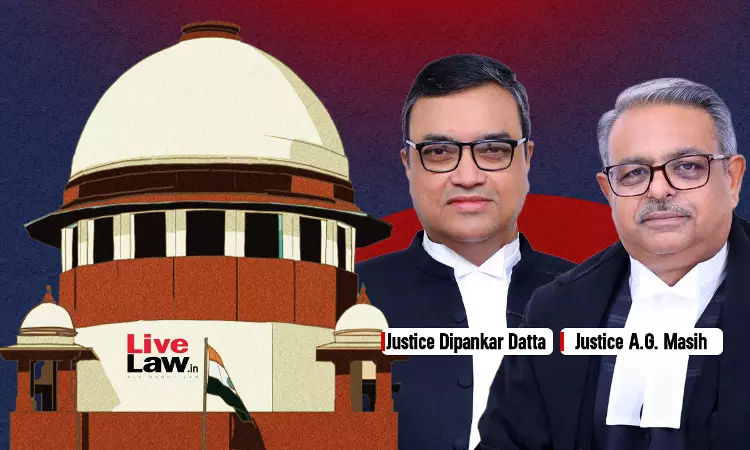
A bench of Justice Dipankar Datta and Justice Augustine George Masih dismissed an appeal in a property dispute, holding that although res judicata was not attracted, the appellants' conduct in abandoning earlier suits precluded them from enforcing the decree through execution proceedings.
Factual Background
The appellants before the Supreme Court were the original plaintiffs and decree-holders in a suit for specific performance filed in 1988. They had entered into an agreement for sale dated December 15, 1986 with the owner's son in respect of a portion of immovable property in Hyderabad and sought enforcement of that agreement when the seller allegedly failed to perform his obligations.
The trial court decreed the suit for specific performance in October 1998, directing execution of the sale deed and enabling delivery of possession. The decree attained finality, and the plaintiffs initiated execution proceedings to obtain possession of the property.
At the execution stage, certain third parties, who were not parties to the original suit, resisted delivery of possession by filing objections claiming independent title to portions of the same property on the basis of sale deeds executed in July 1990. They asserted that their title derived from an alleged oral gift made by the original owner and contended that the decree obtained by the plaintiffs was not binding on them.
Significantly, the plaintiffs (who later became the appellants before the Supreme Court) had earlier filed separate suits seeking cancellation of those very sale deeds. However, both suits were dismissed for default due to non-appearance, and even their applications for restoration were dismissed. Consequently, the rival title claims remained unadjudicated on merits.
The executing court rejected the objections of the third parties, but the appellate court set aside that order and held that the decree-holders must institute a separate suit to establish their rights against the objectors. The High Court affirmed this view. Aggrieved, the decree-holders approached the Supreme Court as appellants.
SC's finding
The Supreme Court observed that although dismissal of a suit for default due to the plaintiff's non-appearance does not operate as res judicata to bar a fresh suit, a plaintiff who, despite having the opportunity to seek restoration or institute a fresh suit, fails to pursue or abandons such remedies, cannot later be permitted to revive the remedy in an execution proceedings on the same cause of action.
“While a dismissal for default may not constitute res judicata in the strict sense under Section 11, CPC, the conduct of the appellants in abandoning the earlier suits, after having raised a positive case therein, attracts the broader principles akin to nemo debet bis vexari, si constet curiae quod sit pro una et eadem causa. A litigant who set the ball rolling for decision on an issue later elects not to pursue it cannot be permitted to revive the same dispute at a later stage, particularly in collateral or execution proceedings, and that too by seeking to obtain an order behind the back of the contestants.”, the Court observed.
The judgment authored by Justice Dipankar Datta, while disagreeing with the impugned finding that the appellant was required to file a separate suit to challenge the sale deeds, particularly in view of Order XXI Rule 101 CPC, which empowers the executing court to adjudicate all questions relating to right, title, or interest, it nevertheless upheld the rejection of the appellant's objections in the execution proceedings on the ground that the appellant had consciously failed to pursue earlier remedies for cancellation of the sale deeds in favour of the respondents.
“Quite apart, it would also not be unfair to criticise the conduct of the appellants as amounting to an abuse of the process of the court. Having allowed their earlier challenge to the sale deeds to attain finality, they cannot now seek to reopen the same issue in execution. Such attempt is impermissible. The process of the court cannot be used to revive what has already been consciously abandoned.”, the court observed.
The Court questioned the appellant's conduct and bona fides, noting that despite having ample opportunity to contest the suits and pursue restoration proceedings, the appellant repeatedly failed to prosecute them; therefore, he couldn't now challenge the execution of the sale deed in the Respondents' favour during the execution proceedings.
“the failure to properly pursue the earlier suits or seek their restoration after dismissal by pursuing further remedy available in law, is a relevant circumstance while assessing the bona fides and overall conduct of the appellants…repeated non-prosecution cannot be simply brushed aside as a lack of initiative to carry proceedings forward; on the contrary, it manifests that the appellants intended to steal a march (over the defendants in such suits) by resorting to dubious methods, deliberately avoiding direct proceedings and instead securing orders through proceedings wherein they were not parties.”, the court observed.
The judgment clarifies the ruling in Amruddin Ansari v. Afajal Ali 2025 LiveLaw (SC) 488, where the Court held that dismissal of a suit for default does not bar filing a fresh suit since it is not a decision on merits and does not attract res judicata.
However, the Court explained that this principle will not apply where the plaintiff deliberately fails to pursue available remedies, such as restoration or refiling, and repeatedly allows proceedings to be dismissed for non-prosecution.
Accordingly, the appeal was dismissed, holding that “the appellants stand precluded to reap the benefit of the decree through execution proceedings having chosen not to pursue (Original Suits) ... The same was rightly interdicted and thwarted by the Appellate Court.”
Holding that the appellants' conduct amounted to an abuse of the process of court, the Supreme Court upheld the ultimate conclusion of the appellate court and High Court, though for reasons different from those assigned by them, and dismissed the appeal with parties directed to bear their own costs.
Headnote
Code of Civil Procedure, 1908 – Order XXI Rules 97-101 – Execution of Decree – Obstruction by Third Party – Abuse of Process – Re-litigation – Res Judicata – Appellants obtained a decree for specific performance and initiated execution - Respondents 1-3 (third parties) filed objections under Order XXI Rules 99-101 claiming independent title - During the pendency of the specific performance suit, the appellants had also filed separate suits against the same respondents for injunction/possession but allowed those suits to be dismissed for default and failed to restore them - Held: The appellants, having abandoned their earlier independent suits against the respondents for the same subject matter without seeking liberty to file afresh, are precluded from contesting the respondents' rights in execution proceedings - To permit the appellants to reap the benefits of the decree against these respondents through execution, after having failed to pursue direct legal remedies against them, would amount to an abuse of the process of the court and "re-litigation" - The principle of nemo debet bis vexari (no one should be twice troubled for the same cause) applies. [Paras 32-54]
Cause Title: SHARADA SANGHI & ORS. VS. ASHA AGARWAL & ORS.
Citation : 2026 LiveLaw (SC) 299
Click here to download judgment
Appearance:
For Appellant(s) : Mr. Huzefa Ahmadi, Sr. Adv. Mrs. B. Sunita Rao, AOR Mr. Anurag, Adv. Mr. Arvind Agarwal, Adv. Mr. Divyansh Kumar, Adv. Mr. Rohan Sharma, Adv.
For Respondent(s) : Mr. Harin P Raval, Sr. Adv. Mr. R Anand Padmanabhan, Sr. Adv. Ms. Urmi H Raval, Adv. Ms. Shreya Bansal, Adv. Ms. Shrestha Narayan, Adv. Mr. Siddharth H Raval, Adv. Mr. Arimardhan Sharma, Adv. Ms. Nidhi Sharma, AOR Mr. Shashi Bhushan Kumar, AOR
Tags

Yash Mittal
Yash Mittal is a Correspondent with LiveLaw, covering the Supreme Court of India

