



- Home
- /
- Supreme court
- /
- Ensure Compensation Mechanism For...
Ensure Compensation Mechanism For National Highways Acquisitions Is At Par With Other Acquisition Laws : Supreme Court
Gursimran Kaur Bakshi
20 Jan 2026 12:45 PM IST
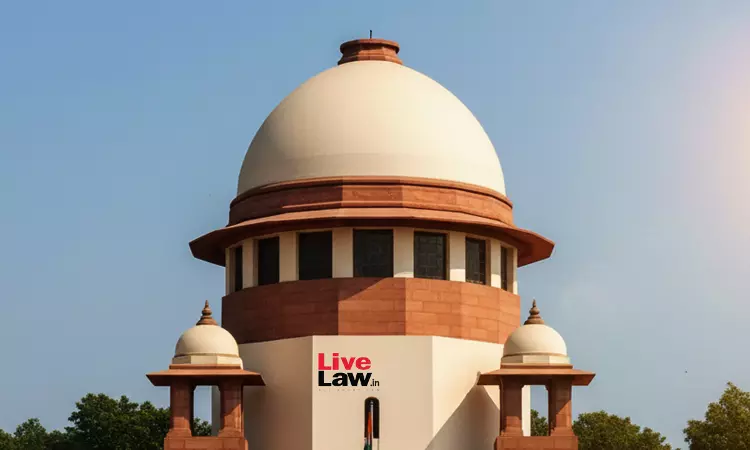
The Supreme Court recently suggested that there is a disparity in terms of the assessment of compensation and other additional statutory benefits for the acquired land under the National Highways Act, 1956 and the Right to Fair Compensation and Transparency in Land Acquisition, Rehabilitation and Resettlement Act, 2013It suggested that the Attorney General for India and the Union of India...
This is a premium content
Available exclusively to
Our subscribers
Subscribe Premium 
INR 1099+GST
Your support helps us to bring you more content at
an affordable subscription scheme !!!
All payment options available
The Supreme Court recently suggested that there is a disparity in terms of the assessment of compensation and other additional statutory benefits for the acquired land under the National Highways Act, 1956 and the Right to Fair Compensation and Transparency in Land Acquisition, Rehabilitation and Resettlement Act, 2013
It suggested that the Attorney General for India and the Union of India look into this matter and see if the legislative scheme could be revisited to bring parity for the determination of the market value of the acquired land with reference to Article 300A of the Indian Constitution.Article 300A protects the right to property as a constitutional right.
A bench comprising Chief Justice of India Surya Kant, Justice Joymalya Bagchi, and Justice Vipul M Pancholi passed this order on January 13 while hearing an application moved by one Anand Prakash Verma. Varma moved an application on behalf of 21 landowners, whose lands were acquired under the National Highways Act, 1956, but they were not given proper compensation.
Brief history of litigation
Unhappy with the determined compensation by the competent authority, they filed a petition under Section 34 of the Arbitration and Conciliation Act, 1996, as contemplated under the 1956 Act, before the Additional District Judge.
While the petitions were at the final stage of arguments, the High Court of Punjab and Haryana rendered a judgment on March 20, 2025, whereby Sections 3G and 3J of the 1956 Act were declared unconstitutional.
It said that these provisions unfairly denied benefits to land losers available under the Land Acquisition Act, 1894 and the Right to Fair Compensation and Transparency in Land Acquisition, Rehabilitation and Resettlement Act, 2013. Section 3G(5) said that against the determination of compensation, the appeal lies before an Arbitrator to be appointed by the Central Government. Section 3J states that nothing in the Land Acquisition Act, 1894, shall apply to an acquisition under the National Highways Act.
Consequent to this judgment, the application of the land owners stood invalidated, and they filed for a withdrawal of the application, which was allowed. In the meantime, the Supreme Court on May 30, 2025, stayed the operation of the High Court's judgment.
But the landowners could not file a fresh application as it would be barred by limitation, rendering them practically remediless. Because of this conundrum, the Supreme Court invoked Article 142 and revised the dismissal application before the District Judge.
Issues raised during hearing
During the hearing before the Supreme Court, the Court noted that noted to issues. First, under Section 3G(5) of the NH Act, the parties have to invoke the arbitration for seeking enhancement of land acquisition compensation. But such a petition is not adjudicated by a judicial authority but by an officer notified by the Central Government, mostly Collectors.
The Court flagged that such officers, be it Collectors or Commissioners of the Revenue District/Divisions, don't have the desired experience of a judicially trained mind to adjudiciate the complex issues like determination of market value of the land or other statutory benefits which the affected parties are entitled to pursuant to the Union of India & another vs. Tarsem Singh & others, (2019) and under the 2013 Fair Compensation Act.
Furthermore, against the award passed under the NH Act, the only remedy is the limited appellate reliefs under the Arbitration and Concilation Actt.
In contrast to the NH Act, the Land Acquisition Act allowed the enhancement by judicial courts, and there was a further remedy of first appeal before the High Court, wherein it could reappreciate the materials before it.
Moreover, the additional statutory benefits and higher rate of compensation have been widened under the 2013, making the land owners under the 1954 Act disproportionately placed.
"It may, thus, be seen that the land owners, whose land is acquired under the 1956 Act, vis-à-vis the land owners whose lands are acquired now under the New Act, have been treated as separate classes, apparently without any intelligible differentia. This leads to grave heartburn among the land owners of the first category, namely, those whose lands are acquired under the 1956 Act".
While the Court appreciated that the 1954 Act allows time-bound and expeditious hearings, it felt that the object can be kept intact while ensuring that land owners will be entitled to the assessment of compensation as was determined under the new or the old Act.
"Though such a legislative policy is laudable, prima facie, it seems that this object can be kept intact while ensuring the land owners that they will be entitled to assessment of compensation for the acquired land in the same manner as is determined for the land owners whose lands are acquired under the Old Act or under the New Act, even when such acquisition is also for infrastructural development."
Keeping in mind that this is a matter that the legislative should deal with, the Court observed: "Keeping these factors in view, we implore and suggest that the Union of India should revisit the legislative scheme and consider the desirability of bringing parity in the matter of providing a mechanism for the determination of the market value of acquired land with reference to Article 300-A of the Constitution of India.Since the issue primarily falls within the domain of the legislature, we refrain from expressing any final opinion and leave it in the first place to the entire discretion of the authority concerned to look into this aspect and take a holistic view."
The Court has asked the Registry to send one copy to the office of the Attorney General for India and to the Solicitor General of India.
The matter will now be heard on April 21. Till then, the stay on the High Court's order will continue.
Case Details: M/S RIAR BUILDERS PVT LTD & ANR. v UNION OF INDIA & ORS.|Diary No(s).26933/2025
Citation : 2026 LiveLaw (SC) 65
Appearances: For Petitioner(s) :Ms. Tanu Priya Gupta, AOR Ms. Khushi Sharma, Adv. Mr. K S Kang, Adv. Mr. Amrendra Kumar Mehta, AOR Ms. Pallavi Daem, Adv. Ms. Gunjan Kumari, Adv. Mr. Karan Kapoor, Adv. Mr. Gagneshwar Walia, Adv. Mr. KS Minhas, Adv. Mr. KE Minhas, Adv. Mr. Manik Kapoor, Adv. Ms. Srishti Singla, Adv. Mr. Shrey Kapoor, AOR
For Respondent(s) :Mr. Rajive Bhalla, Sr. Adv. Mr. Yash, Adv. Mr. Amitoj Bir Singh, Adv. Mr. Divyansh Misra, Adv. Ms. Gauri Bedi, Adv. Mr. Deepak Samota, Adv. Mr. Kamal Joshi, Adv. Mr. Shubham Bhalla, AOR Mr. Amrendra Kumar Mehta, AOR Mr. Vishal Arun Mishra, AOR Mr. Anilendra Pandey, AOR
For landowners Mr. Charanpal Singh Bagri, Adv. (Intervenors) Dr. Gurjit Kaur, Adv
Gursimran Kaur Bakshi
Gursimran is the Principal Correspondent with LiveLaw for the Supreme Court. She can be reached out at: simrankaurbakshi@livelaw.in

