



- Home
- /
- Supreme court
- /
- EPF Act | Whether Penalty For...
EPF Act | Whether Penalty For Delayed Provident Fund Deposit Is Mandatory? Supreme Court Refers To Larger Bench
Saima Anjum
15 Sept 2026 7:49 PM IST
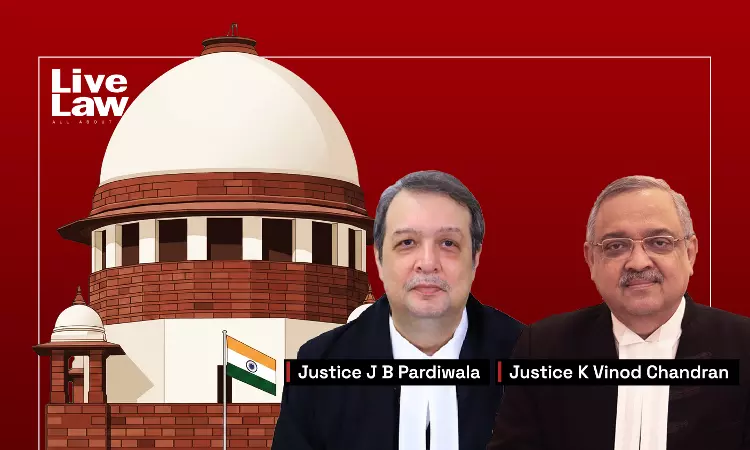
The Court doubted its 2022 precedent which held that penalty is automatic and there was no discretion on the EPF authority to waive it.
The Supreme Court has recently doubted the correctness of its earlier decision in Horticulture Experiment Station Gonikoppal, Coord v Regional Provident Fund Organization(2022), which had held that imposition of damages for delayed payment under Section 14B of the Employees' Provident Funds and Miscellaneous Act, 1952 (EPF & MP Act) is automatic and mandatory. A bench of Justice JB...
This is a premium content
Available exclusively to
Our subscribers
Subscribe Premium 
INR 1099+GST
Your support helps us to bring you more content at
an affordable subscription scheme !!!
All payment options available
The Supreme Court has recently doubted the correctness of its earlier decision in Horticulture Experiment Station Gonikoppal, Coord v Regional Provident Fund Organization(2022), which had held that imposition of damages for delayed payment under Section 14B of the Employees' Provident Funds and Miscellaneous Act, 1952 (EPF & MP Act) is automatic and mandatory.
A bench of Justice JB Pardiwala and Justice K Vinod Chandran has referred the question of whether Section 14B confers a discretion on the authority to levy or not levy penalty, to a larger bench.
The appeals arose from orders passed at the instance of the Central Board of Trustees under the EPF & MP Act, which had applied the earlier ruling that the “share of workmen dues” must be kept outside liquidation, and that concerned workmen/employees must be paid Provident Fund (PF) and Gratuity Fund (GF) dues by the Successful Resolution Applicant (SRA) implementing a resolution plan under the Insolvency and Bankruptcy Code, 2016.
Before the Supreme Court, the Employees' Provident Fund Organisation (EPFO) relied on Maharashtra State Cooperative Bank Limited v Assistant Provident Fund Commissioner (2009) (which was reiterated by National Company Law Appellate Tribunal (NCLAT) and upheld by the Supreme Court in Jet Aircraft Maintenance Engineers Welfare Association v Ashish Chhawchharia), to content that PF dues must be paid in full under the EPF & MP Act even where a resolution plan is in operation.
The Court noted its recently decided case in Jalgaon District Central Coop. Bank Ltd v State of Maharashtra(2026), which held that the statutory first charge under Section 11(2) of the EPF & MP Act overrides even the non-obstante clause of the Securitisation and Reconstruction of Financial Assets and Enforcement of Security Interest Act, 2002 (SARFAESI Act).
It also referred to its ruling in State Bank of India v Murari Lal Jalan & Florian Fritsch (Consortium)(2024), which held that PF dues must be paid upfront by the SRA in compliance with Section 11 of the EPF & MP Act, while gratuity dues could be staggered.
The bench also perused the Second Proviso to Section 14B, which empowers the Central Board to reduce or waive damages levied on an establishment that is a Sick Industrial Company with a rehabilitation scheme sanctioned by the erstwhile Board for Industrial and Financial Reconstruction (BIFR) under the Sick Industrial Companies (Special Provisions) Act, 1985 (SICA). Noting that SICA has been repealed and replaced by the IBC framework, the bench observed that “we are of the opinion that the Central Board could consider the application of waiver or reduction, which the SRA could make before it, considering the fact that the resolution plan sought to be implemented, is akin to a plan of rehabilitation as sanctioned by the BIFR under the SICA.”
The Court also noted that in Horticulture Experiment Station Gonikoppal, Coord v Regional Provident Fund Organization, it had held that imposition of damages for delayed payment is automatic, without any requirement to examine the employer's actus reus or mens rea, or any justification for imposing damages.
While agreeing that no actus reus or mens rea inquiry is required, the bench disagreed with the conclusion that the provision leaves the authority with no discretion at all. It, thus, observed that “though, we fully agree with the Co-ordinate Bench that there is no reason to find actus reus or mens rea, we are of the opinion, with abiding respect to the Co-ordinate Bench, that Section 14B even after its amendment confers a discretion on the authority to decide on whether the circumstances justify a complete absolution from penalty.”
Relying on Organo Chemical Industries & Anr v Union of India & Ors, the Court noted that the words “may recover” and “may think fit to impose” were held to confer discretion both on whether to impose damages and, if imposed, on their quantum, with the Commissioner's power characterised as quasi-judicial and requiring a speaking order.
The Court also perused the 1988 amendment of Section 14B which separated the compensatory element (interest) from the penal element (damages). Analysing the amendment, the bench noted that “may recover” preserved the authority's discretion on whether to impose any penalty at all, even though the quantum, once penalty is found justified, is governed by the scheme.
It observed as, “the words employed under the amended Section 14B, is to the effect that the Commissioner or the Authorized Officer, 'may recover' by way of penalty such damages. Hence, the discretion is still left with the authority to decide as to whether there should be an imposition of penalty at all. If the Authorized Officer is satisfied that the imposition of penalty has to be made in the facts and circumstances, then the levy shall be under the scheme; which alone is outside the discretion of the authority.”
Recording its doubt over the correctness of Horticulture Experiment Station Gonikoppal, Coord v Regional Provident Fund Organization, the bench referred the question to a larger bench.
“We are, hence, in doubt of the proposition laid down in Horticulture Experiment Station Gonikoppal by a Coordinate Bench; with due respect to the learned Judges. While directing the deposit of the dues as computed under the EPF & MP Act including that levied under Section 7Q of that Act, we refer the question as to whether there is a discretion under Section 14B on the Authorized Officer to levy or not to levy the penalty.”
“We, therefore, direct the Registry of this Court to place the matter before the Hon'ble the Chief Justice of India for consideration by a larger Bench.”
The bench also clarified that it would not impair the appellants' or SRAs' right to approach the Central Board for waiver or reduction under the Second Proviso to Section 14B. It also directed that the due amounts under the EPF & MP Act, along with Section 7Q interest, be paid in four quarterly instalments commencing December 15, 2026 to September 15, 2027, with any accrued interest on the deferred instalments to be communicated and settled by October 15, 2027, failing which the EPFO would be entitled to proceed with recovery upon any single default.
Headnote
Employees' Provident Funds and Miscellaneous Provisions Act, 1952 — Section 14B & Section 7Q — Insolvency and Bankruptcy Code, 2016 (IBC) — Liability of Successful Resolution Applicant (SRA) — Mandatory vs. Discretionary Nature of Damages under Section 14B — Reference to Larger Bench - Liability of SRA to Clear EPF Dues - Provident fund and gratuity dues fall outside the liquidation estate under Section 36(4)(b)(iii) of the IBC and cannot be subjected to the waterfall mechanism under Section 53(1) - In terms of Section 11(2) of the EPF & MP Act, statutory first charge is created in respect of workmen dues (including Section 7Q interest and Section 14B damages), which overrides non-obstante priority clauses in subsequent legislation - the Successful Resolution Applicant (SRA) is liable to pay provident fund and gratuity dues in full to save the resolution plan from being hit by Section 30(2)(e) of the IBC.
Rehabilitation Mechanism and Power of Central Board under Second Proviso to Section 14B - The Second Proviso to Section 14B empowers the Central Board to reduce or waive damages for an establishment undergoing rehabilitation under the now-repealed SICA - Since the IBC superseded SICA for corporate turnaround, a resolution plan under IBC is functionally akin to a scheme of rehabilitation sanctioned by BIFR - The Central Board is competent to consider an application for reduction or waiver of damages preferred by an SRA under the Second Proviso. [Paras 6-18].
Discretion of Authorized Officer to Impose Damages under Section 14B — Doubt Cast on Horticulture Experiment Station: A doubt was expressed regarding the ratio in Horticulture Experiment Station Gonikoppal v. Regional Provident Fund Organization, (2022) 4 SCC 516, which held that imposition of damages under Section 14B is strictly automatic and mandatory upon civil default without requiring discretion - The phrase 'may recover from the employer by way of penalty such damages' in the post-1988 amended Section 14B indicates that the Authorized Officer retains quasi-judicial discretion to decide whether or not to levy penalty/damages at all under extenuating circumstances - If the officer decides to impose damages, only the quantum is rigidly regulated by the scheme under Paragraph 32A - Statutory interest under Section 7Q is purely compensatory and distinct from the punitive damages under Section 14B - Question referred to a Larger Bench - Appellants directed to deposit outstanding EPF dues and Section 7Q interest in four quarterly installments, subject to final determination of waiver/damages by the competent forum. [Relied on Maharashtra State Cooperative Bank Limited v. Assistant Provident Fund Commissioner, (2009) 10 SCC 123; Jalgaon District Central Coop. Bank Ltd. v. State of Maharashtra, 2025 SCC OnLine SC 2513; State Bank of India v. Murari Lal Jalan & Florian Fritsch (Consortium), (2025) 4 SCC 354; Jet Aircraft Maintenance Engineers Welfare Assn. v. Ashish Chhawchharia, 2022 SCC OnLine NCLAT 418; Paras 7– 20]
Case: M/s Kerala Industrial Infrastructure Development Corporation v Central Board of Trustees and Anr.
Citation : 2026 LiveLaw (SC) 933
Appearance:
For Appellant: Mr. Ritin Rai, Sr. Adv.; Mr Radha Shyam Jena, AOR; Mr PS Sudheer, AOR; M/S Legal Options, AOR; Mr Haris Beeran, Adv.; Mr Azhar Assees, Adv.; Ms Rizwana R Raj, Adv.; Mr Shaswat Jena, Adv.; Ms Sonia Dube, Adv.; Ms Kanchan Yadav, Adv.; Ms Saumya Sharma, Adv.; Mr Rishi Maheshwari, Adv.; Ms Anne Mathew, Adv.; Mr Bharat Sood, Adv.; Mr Jashan Vir Singh, Adv.; Ms Ritika Sinha, Adv.
For Respondents: Mr PV Dinesh, Sr. Adv.; Mr Ritin Rai, Sr. Adv.; Mr PS Sudheer, AOR; Mr Abdulla Naseeh Vt, AOR; Ms Shruti Jose, AOR; M/S Mukesh Kumar Singh And Co., AOR; Mr Abhishek Sharma, AOR; Mr Sandeep Jindal, AOR; Mr Mukund P Unny, AOR; Mr Vinay Mathew Joseph, Adv.; Mr Pramod Kumar Goel, Adv.; Ms Akansha Bharti, Adv.; Mr MA Shaji, Adv.; Ms Anchal Sharma, Adv.; Ms KJ Karthika, Adv.; Mr Ajay K Tyagi, Adv.; Mr RS Sharma, Adv.; Mr Robin George, Adv.; Mr Deepak Sharma, Adv.; Mr Vivek Bansal, Adv.; Mr PV Vinod, Adv.; Ms Anna Oommen, Adv.; Mr Saketh, Adv.; Mr Mukesh Kumar Singh, Adv.; Mr Rahul Saini, Adv.; Mr Vikash Kumar, Adv.; Mr Pushkar Singh Mall, Adv.; Mr Jeetendra Kumar, Adv.; Ms Kajal Rani, Adv.; Ms Komal Singh, Adv.; Mr Naveen Yadav, Adv.; Mr Abhay Jadaun, Adv; Mr Musthafa Atheeq, Adv.; Ms Rachel Sara James, Adv.; Mr Rishi Maheshwari, Adv.; Ms Anne Mathew, Adv.; Mr Bharat Sood, Adv.; Mr Jashan Vir Singh, Adv.; Ms Ritika Sinha, Adv.
Tags


