



- Home
- /
- Supreme court
- /
- ESI Act | Best Judgment Assessment...
ESI Act | Best Judgment Assessment Under S.45A Can't Be Invoked Saying Records Produced Are Inadequate: Supreme Court
Yash Mittal
19 Dec 2025 4:03 PM IST
The statutory threshold for Section 45A is not inadequate production but non-production
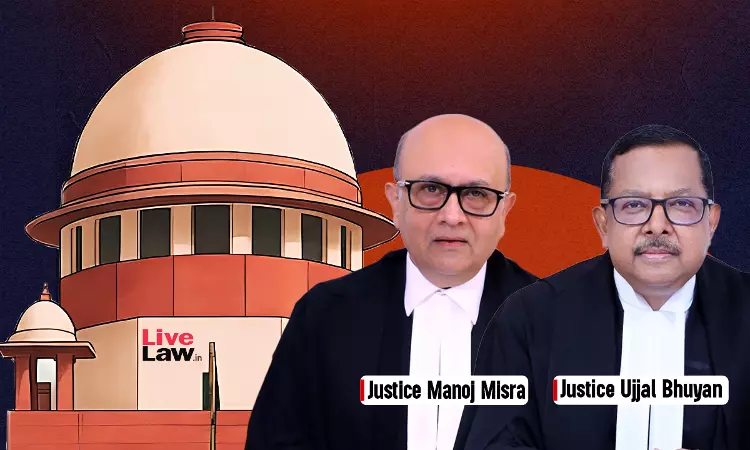
In the context of the Employees' State Insurance Act, 1948, the Supreme Court ruled that if an employer has produced records such as ledgers, cash books, vouchers, and statutory returns and cooperated with the ESI Corporation, the Corporation cannot invoke Section 45A to raise demands for contribution periods older than five years.The bench of Justice Manoj Misra and Justice Ujjal Bhuyan...
This is a premium content
Available exclusively to
Our subscribers
Subscribe Premium 
INR 1099+GST
Your support helps us to bring you more content at
an affordable subscription scheme !!!
All payment options available
In the context of the Employees' State Insurance Act, 1948, the Supreme Court ruled that if an employer has produced records such as ledgers, cash books, vouchers, and statutory returns and cooperated with the ESI Corporation, the Corporation cannot invoke Section 45A to raise demands for contribution periods older than five years.
The bench of Justice Manoj Misra and Justice Ujjal Bhuyan heard the case where the dispute arose from a demand raised by the ESI Corporation in 1996 relating to alleged unpaid contributions for the period August 1988 to March 1992. Following a show-cause notice proposing a demand of over ₹26 lakhs, the employer participated in the proceedings, appeared at personal hearings, and produced ledgers, cash books, vouchers and statutory returns.
Despite this, in 2000, the Corporation invoked Section 45A, which permits “best judgment” assessment, and determined liability at ₹5.42 lakh, alleging that certain supporting bills and vouchers had not been furnished to enable segregation of wage components.
The employer's challenge before the ESI Court and thereafter the High Court failed, with both courts holding that Section 45A was not subject to the five-year limitation under Section 77(1A)(b) of the Act.
Under the ESI Act, Section 77(1A)(b) clearly provides that “no claim shall be made by the Corporation after five years of the period to which the claim relates.” At the same time, Section 45A empowers ESIC to make a “best judgment” assessment where an employer fails to submit records or obstructs inspection, without prescribing any time limit.
Thus, the core issue was whether ESIC could enforce contribution demands beyond the statutory five-year period prescribed under Section 77(1A)(b) by resorting to Section 45A, which does not expressly stipulate any limitation.
Setting aside the Madras High Court's order, the judgment authored by Justice Bhuyan held that while limitation does not directly apply to proceedings under Section 45A, the power itself can be invoked only in narrowly defined circumstances namely, where there is complete non-production of records or physical obstruction of inspection.
Since the employer had produced records and cooperated, Section 45A could not be used, the Court observed, adding that the Corporation's claim raised long after the five-year period was time-barred.
“The appellant furnished ledgers, cash books, vouchers and returns, and had attended personal hearings repeatedly. The respondent's allegation was not non-production of the record but inadequacy of the record. In such a case, the proper statutory course for the respondent, once records had been produced, was to examine the correctness thereof under Section 75 and if any dispute persisted, to initiate proceedings within the period of limitation prescribed by the proviso to Section 77(1A)(b). Invocation of Section 45A in such circumstances was misconceived.”, the court observed.
“In the present case, the materials placed before us shows that the appellant had produced ledgers, cash books, journal vouchers, contractor records and returns of contribution for the period in question. Personal hearings were granted on numerous dates and the appellant had appeared through its authorised representative in such hearings. The corporation has itself recorded in its order that records were produced but certain supporting bills were not furnished in respect of some heads of expenditure. This finding, even if accepted at face value, does not bring the case within the ambit of Section 45A. The statutory threshold is not inadequate production but non-production. The statute does not permit a best judgment determination merely because the record produced is inadequate.”, the court observed.
Accordingly, the appeal was allowed.
Cause Title: M/S. Carborandum Universal Ltd. VERSUS ESI Corporation
Citation : 2025 LiveLaw (SC) 1232
Click here to download judgment
Appearance:
For Petitioner(s) : Ms. S. Janani, Sr. Adv. Mr. Manohar Gupta, Adv. Mr. Gopal Singh Chauhan, Adv. Mr. Kunal Malik, AOR
For Respondent(s) : Mr. Vaibhav Manu Srivastava, AOR Mr. Mahesh Srivastava, Adv. Mr. Gurpreet Singh, Adv.
Tags

Yash Mittal
Yash Mittal is a Correspondent with LiveLaw, covering the Supreme Court of India

