



- Home
- /
- Supreme court
- /
- Failure To Produce Original Deed In...
Failure To Produce Original Deed In Forgery Case Not Ground To Discharge Accused : Supreme Court
Yash Mittal
22 Sept 2026 7:30 PM IST
The Court observed that forgery can be proved through circumstantial evidence as well.
The Supreme Court on Tuesday (September 22) held that the omission/failure to produce a forged document to prove the forgery charge at a pre-trial stage cannot be a reason for quashing the prosecution's case. The Court said that even after submission of a charge sheet, a document not submitted with a charge sheet can be produced subsequently. “…absence of the original document relied upon...
This is a premium content
Available exclusively to
Our subscribers
Subscribe Premium 
INR 1099+GST
Your support helps us to bring you more content at
an affordable subscription scheme !!!
All payment options available
The Supreme Court on Tuesday (September 22) held that the omission/failure to produce a forged document to prove the forgery charge at a pre-trial stage cannot be a reason for quashing the prosecution's case. The Court said that even after submission of a charge sheet, a document not submitted with a charge sheet can be produced subsequently.
“…absence of the original document relied upon by the prosecution to bring home the charge of forgery would be a matter to be considered at the trial and its absence by itself cannot be made the basis for quashing the entire prosecution. In other words, the prosecution can attempt to bring home the charge on the basis of circumstantial evidence. However, the entire proceedings would not be liable to be quashed without affording an opportunity to the prosecution to attempt to prove the charge at the trial...”, the Court observed.
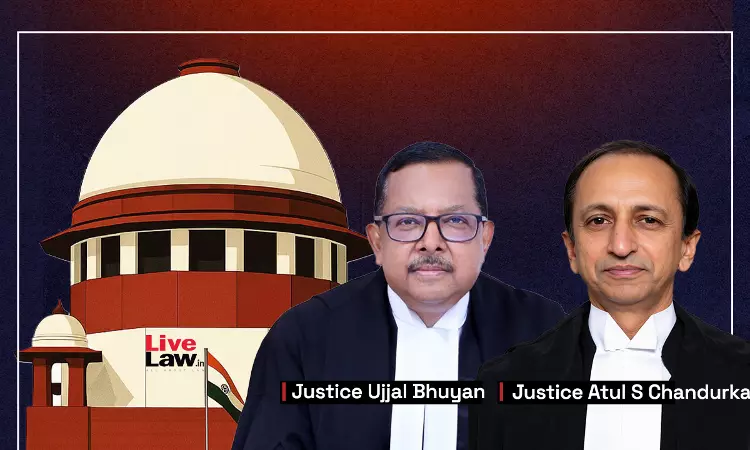
The aforesaid observation came from a bench of Justice Ujjal Bhuyan and Justice Atul S Chandurkar, while setting aside the Bombay High Court Goa Bench Single Judge order, which had reversed the Magistrate's order refusing to discharge the accused persons merely because the forged document i.e., a sale deed, was not produced by the police at the time of submission of a charge sheet in an alleged offence relating to forgery.
The Single Judge had entertained the accused's writ petition seeking a discharge, ignoring the earlier decision of the Division Bench which had refused to interfere with the order framing charges against the accused persons on the same grounds raised before the Single Bench.
The judgment authored by Justice Chandurkar, at the outset, found the Single Judge order to be against the judicial comity as well as against the principle of 'issue estoppel', holding that the Single Judge had exceeded the permissible scope of inquiry by re-appreciating the prosecution material despite the earlier Division Bench having already considered the same issue. Moreover, on the merits of the case, the Court said that the High Court erred in discharging the accused persons on mere absence of the forged document, i.e., the original sale deed, at the time of filing of a charge sheet.
“…absence of the original sale deed, by itself, could not be the basis to record a finding that in no case, the offence of forgery could not be established.”, the Court said.
Relying on the three-Judge Bench decision in Rama Shanker Lal v. State of U.P., (1971) the Court noted that forgery can, in an appropriate case, be established even without production of the document alleged to have been forged, provided the evidence ultimately excludes reasonable doubt.
“…in view of the decision in Rama Shanker Lal (supra), absence of the original document that is alleged to be forged, by itself, cannot sound the death knell of the prosecution case. It is only after evaluating the entire prosecution material that a finding would be required to be recorded as to whether the charge of forgery has been proved beyond reasonable doubt. That the prosecution could result in acquittal at the conclusion of the trial is a different matter altogether.”, the Court said.
“In other words, on the basis of other evidence on record, the prosecution could attempt to prove the offence of forgery, albeit beyond reasonable doubt. This would naturally depend on the facts of each case.”, the Court added.
Omission To File Document With Chargesheet Does Not Bar Later Production
The Court also referred to Central Bureau of Investigation v. R.S. Pai, 2002 INSC 178, which held that although the investigating officer is required to produce the relevant documents along with the chargesheet under Section 173(5) CrPC, an omission does not render subsequent production of such material impermissible.
“…it is apparent that normally, the Investigating Officer is required to produce all the relevant documents at the time of submitting the charge-sheet. At the same time, as there is no specific prohibition, it cannot be held that the additional documents cannot be produced subsequently. If some mistake is committed in not producing the relevant documents at the time of submitting the report or charge-sheet, it is always open to the Investigating Officer to produce the same with the permission of the Court…Normally, the documents gathered during the investigation upon which the prosecution wants to rely are required to be forwarded to the Magistrate, but if there is some omission, it would not mean that the remaining documents cannot be produced subsequently.”, the Court observed in RS Pai.
Accordingly, the Court restored the criminal case before the trial court and directed the Magistrate to proceed with the trial in accordance with law.
Cause Title: ANTONETTO J D'SOUZA VERSUS ALDILA BRAGANZA AND OTHERS
Citation : 2026 LiveLaw (SC) 973
Click here to download judgment
Appearance:
For Petitioner(s): Ms. Vrinda Grover,Adv. Mr. Navin Prakash, AOR
For Respondent(s): Respondent-in-person Mr. Akshai Malik, Adv. Mr. Khawar Saleem, Adv. Mr. Nikhil Jain, AOR
Tags

Yash Mittal
Yash Mittal is a Correspondent with LiveLaw, covering the Supreme Court of India

