



- Home
- /
- Supreme court
- /
- Family Court Judges Not Eligible...
Family Court Judges Not Eligible For High Court Elevation : Supreme Court Refuses To Revisit Precedent
Debby Jain
31 Aug 2026 1:28 PM IST
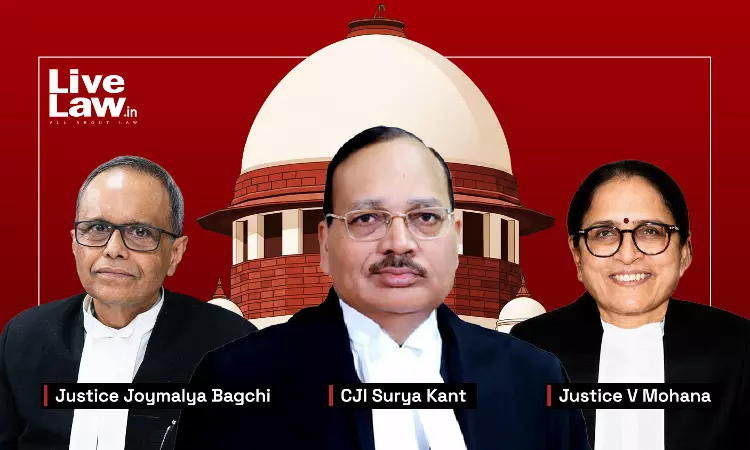
The Court also questioned the need to have separate cadre for Family Court Judges in States like Maharashtra.
The Supreme Court on Monday refused to entertain a plea by seven Family Court judges from Maharashtra seeking a declaration that they hold “judicial office” for the purpose of eligibility for appointment as High Court judges under Article 217 of the Constitution.A Bench comprising Chief Justice of India Surya Kant, Justice Joymalya Bagchi and Justice V Mohana held that the issue had...
This is a premium content
Available exclusively to
Our subscribers
Subscribe Premium 
INR 1099+GST
Your support helps us to bring you more content at
an affordable subscription scheme !!!
All payment options available
The Supreme Court on Monday refused to entertain a plea by seven Family Court judges from Maharashtra seeking a declaration that they hold “judicial office” for the purpose of eligibility for appointment as High Court judges under Article 217 of the Constitution.
A Bench comprising Chief Justice of India Surya Kant, Justice Joymalya Bagchi and Justice V Mohana held that the issue had already been conclusively dealt with by the Supreme Court in its earlier judgment in S.D. Joshi and Others v. High Court of Judicature at Bombay and Another [(2011) 1 SCC 252], which had held that the post of a Family Court judge in a separate cadre could not be treated as a “judicial office” for the purposes of Article 217(2)(a).
The petitioners, represented by Senior Advocate R Basant, urged the Court to revisit the earlier ruling in light of changed circumstances, particularly the manner in which Family Court judges have been appointed in Maharashtra over the past 36 years.
Basant submitted that all seven petitioners had been appointed under the Family Courts Recruitment Rules and had completed more than seven years of service, with the first four having completed at least ten years as Family Court judges. Some had spent as many as 26 years in judicial service, first as subordinate judges and subsequently as Family Court judges.
“This involves a question of interpretation of Article 217,” Basant said, explaining why the petitioners had approached the Supreme Court directly. He argued that they could not seek relief from the High Court because the Supreme Court had already ruled on the issue in SD Joshi.
Justice Bagchi pointed out at the outset that the earlier judgment “clearly answers the issue against your clients.”
Basant accepted that position but argued that the judgment should be reconsidered because of changed factual circumstances.
He pointed out that the Maharashtra High Court had reported that for the last 36 years, no person from outside the judicial service had been recruited as a Family Court judge in the State.
“These officers of the judicial service have written an examination, passed it and then been appointed as judges of the Family Court. So they have always been officers of the judicial service,” Basant submitted.
He also referred to the Supreme Court's decision in Rejanish v.Deepa, arguing that it had removed any disqualification preventing such Family Court judges from appearing for selection as District Judges.
Chief Justice Surya Kant, however, observed that the Rajnish judgment did not address the interpretation of Article 217.
Basant agreed, explaining that his argument was instead based on Article 217(2)(a), which permits eligibility to be established through a combination of years of practice at the Bar and years spent holding a judicial office.
He submitted that the expression “judicial office” had been interpreted restrictively in SD Joshi, after the Court compared the functions of Family Court judges with those of judges belonging to the regular District Judge cadre.
According to Basant, the earlier judgment had been influenced by the fact that the Family Courts Act permitted persons other than members of the judicial service to be appointed to Family Courts.
He argued that the factual position in Maharashtra had since evolved.
“For the last 36 years, not one has been appointed from that source. All those who have been appointed have been either judicial officers or advocates having the requisite service and requisite standing at the Bar,” Basant said.
He argued that there was therefore no longer a justification to deny Family Court judges the status of holding judicial office for the limited purpose of Article 217.
CJI questions separate Family Court cadre
The Chief Justice, during the hearing, questioned the creation of a separate cadre for Family Courts in Maharashtra.
The CJI noted that in most States, Family Court judges are drawn from the regular judicial service and are posted to Family Courts on deputation. Such judges retain their status as judicial officers and can subsequently return to the mainstream judicial cadre.
“You have an exclusive cadre for Family Courts. It is a separate cadre. You don't deal with criminal matters. You don't deal with other matters. The problem lies somewhere else. The problem lies in the creation of a separate cadre for Family Courts,” CJI Surya Kant observed.
The Court noted that the petitioners' argument, in substance, appeared to seek an eventual merger of the separate Family Court cadre with the mainstream judicial cadre.
Basant acknowledged that a request for such a merger had been made in SD Joshi but said the present plea was narrower.
“I cannot repeat that request now. That was not allowed. My only question is, for the purpose of Article 217, a Family Court judge holding the post of Judge of the Family Court must be held to be holding a judicial office,” he submitted.
The CJI pointed out that in most States the issue did not arise in the same manner because Family Court judges were generally drawn from the District Judge cadre and sent to Family Courts on deputation.
“They don't lose their status as judicial officers for the purposes of Article 217(2)(a),” the CJI observed.
No need to revisit the precedent : Court
The Bench repeatedly questioned whether there had been any change in law or facts substantial enough to justify reconsidering the earlier judgment.
“So unless and until there is any change, factually or legally, why should we revisit this issue? Rejanish really doesn't touch this issue,” the CJI said.
Basant agreed that Rejanish did not directly address the question.
The CJI then observed that the alternative would effectively require the Supreme Court to doubt and overrule SD Joshi.
Justice Bagchi similarly noted that the petition under Article 32 could survive only if the Bench was prepared to question the correctness of the earlier judgment with a view to overruling it.
“If you want us to doubt the ratio of Joshi and entertain it for the purpose of overruling it, you must give us some contrary judgment, some alternate interpretation of Article 217 which was not considered,” Justice Bagchi told Basant.
Justice Bagchi further pointed out that SD Joshi had undertaken a detailed comparison of the functions of judges in the District Judge cadre and those performed by Family Court judges and had found that they were not equivalent.
The Bench also noted that the earlier judgment had considered the treatment of Family Courts alongside tribunals and other specialised adjudicatory bodies before concluding that Family Court judges could not be treated as equivalent to judges of the regular judicial cadre.
The Supreme Court suggested that if the petitioners wanted to address the structural problem created by the separate Family Court cadre, they could approach the State government and the High Court on the administrative and policy side.
The Court observed that in States where a separate Family Court cadre exists, a policy decision could potentially be taken to abolish the separate cadre and make Family Court postings transferable among members of the higher judicial service.
The CJI also questioned Basant as to why the State government and High Court could not rework the rules in consultation with each other.
Basant, however, argued that the existing interpretation in SD Joshi prevented the High Court from doing so without the Supreme Court first revisiting the judgment.
The CJI disagreed and asked counsel to consider what the relevant statutory provision actually required.
Basant submitted that the applicable provisions contemplated a person being a District Judge or being capable of being appointed as a District Judge, and did not expressly require equivalence with a District Judge. He argued that the basic requirement was seven years' experience as a judicial officer or seven years' standing as an advocate.
He also pointed out that although certain other categories of government officers could technically enter the Family Court system, no such appointments had been made in Maharashtra for 36 years.
Ultimately, the Bench declined to entertain the writ petition.
In its order, the Court held that the question raised by the petitioners had already been answered against them in SD Joshi and that the present Article 32 petition essentially sought a review or recall of that judgment.
“The writ petition essentially seeks review/recall of that judgment. It seems to us that a writ petition under Article 32 is not apt recourse to seek review of judgment of this Court,” the Bench said.
The Court further held that the petitioners had not made out a case within the existing legal framework to warrant interference.
It suggested that the petitioners could instead approach the concerned High Court and State government to consider reformulating the rules governing appointments to Family Courts, particularly in light of the different arrangements followed in other States.
“This would essentially be a policy matter, for which the HC and State govt may in consultation with each other take appropriate decision,” the Court said.
Case : INDRAKALA JOGINDER NANDA Vs HIGH COURT OF JUDICATURE AT BOMBAY | D No. 38854/2026
Citation : 2026 LiveLaw (SC) 908
Tags
Debby Jain
Debby Jain is a Correspondent with LiveLaw, covering the Supreme Court of India

