



- Home
- /
- Supreme court
- /
- Govt Contracts Should Not Have...
Govt Contracts Should Not Have One-Sided Clauses Foreclosing Legal Remedies For Private Parties : Supreme Court
Yash Mittal
24 March 2026 2:03 PM IST
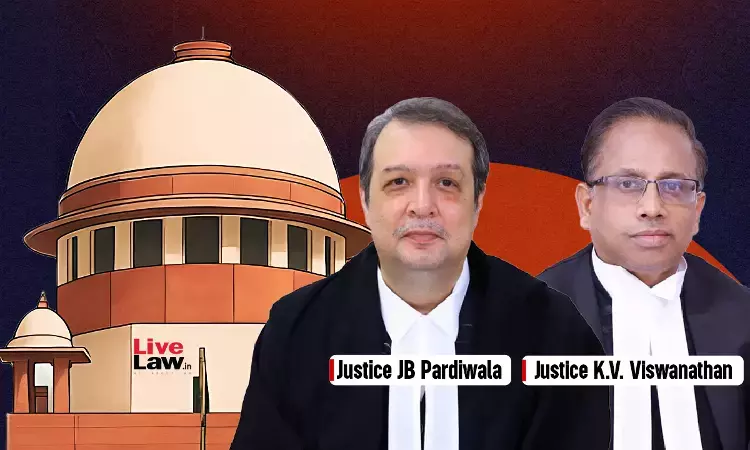
The Court deprecated clauses which allow Governmnent to determine fault and foreclose legal remedies.
The Supreme Court on Monday (March 23) strongly deprecated the one-sided clauses in the government contracts, which limit or take away the private party's right to access to justice by approaching the courts or arbitrator. A bench of Justices JB Pardiwala and KV Viswanathan set aside the Calcutta High Court's Port Blair bench decision which had interfered with the arbitral award passed...
This is a premium content
Available exclusively to
Our subscribers
Subscribe Premium 
INR 1099+GST
Your support helps us to bring you more content at
an affordable subscription scheme !!!
All payment options available
The Supreme Court on Monday (March 23) strongly deprecated the one-sided clauses in the government contracts, which limit or take away the private party's right to access to justice by approaching the courts or arbitrator.
A bench of Justices JB Pardiwala and KV Viswanathan set aside the Calcutta High Court's Port Blair bench decision which had interfered with the arbitral award passed against the Respondent-Andaman & Nicobar Administration. The High Court set aside the award relying on a one-sided contractual Clause 3.20 which barred the Appellant, a private marine service provider, from approaching the courts or arbitrator against the Respondent's unilateral decision to levy penalty for the alleged negligence found in the service.
The dispute arose from a "Manning Agreement" entered into in 2008 between the Appellant-ABS Marine Services and the Respondent-Andaman and Nicobar Administration for providing crew on 17 government vessels. After a vessel, suffered damage in rough seas in July 2009, the Administration unilaterally recovered ₹2,87,84,305 from the contractor's pending bills as penalty.
At the heart of the controversy was Clause 3.20 of the agreement, which allowed the Respondent-Administration to determine loss and recover it unilaterally. Further, it declared its decision “final and binding”, barred both court proceedings and arbitration to adjudicate on this issue.
At the same time, it permitted the Administration to initiate legal proceedings if full recovery was not possible, creating a one-sided framework.
An award was passed in favour of the Appellant, directing the Respondent to make a payment of Rs. 2,87,84,305/- with interest @ 9 per cent from the date of recovery till the date of the award. The arbitrator directed that payment shall be made within three months. The challenge to an award under Section 34 was dismissed by the District Court, leading to an appeal under Section 37 before the High Court.
Aggrieved by the High Court's interference with the award, prompted the contractor to appeal to the Supreme Court.
Calling the High Court's approach to be erroneous to interfere with the award, the judgment authored by Justice Viswanathan termed the aforementioned Clause as grossly discriminatory, unfair and contrary to legal principles stating that “one party to a contract cannot decide whether the other party was in wilful breach or has committed neglect, when liability by the other party is disputed.”
“Clause 3.20 cannot be so construed as to let one party to a dispute decide whether the other party is in breach.”, the court said.
The Court found the glaring inconsistency in the Clause stating that while the Administration reserved its right to approach the courts to recover additional amounts from the Appellant but barred the Appellant to challenge the one-sided recovery before the court.
“A close reading of Clause 3.20 reveals an interesting aspect. Even on the aspect of quantification in cases where liability is admitted by the agent, where the administration is not able to fully recover, they have reserved for themselves the right to initiate proceedings for recovery of the differential amount. To say the least, this is grossly discriminatory. It is high time that clauses of these types are not incorporated in contracts between a private party on the one hand and the State and its instrumentalities on the other, foreclosing even redress through Courts of law.”, the court observed.
However, the Court clarified an important principle that parties may exclude certain disputes from arbitration (excepted matters), but they cannot exclude all legal remedies entirely.
“Matters may be 'excepted' from arbitration, for that is a well-recognized concept, but a vacuum in legal remedies cannot result. 'Except' matters one may but 'Exclude' justice, one cannot.”, the court observed, pointing out that while parties may legitimately agree to "except" or carve out certain disputes from arbitration, they cannot "exclude" justice entirely by barring all legal remedies.
The Court said that accepting such a type of Clause would enable the State to unilaterally decide liability and quantum, bar the contractor from challenging that decision anywhere, and leave the contractor with no remedy even where the State's decision was arbitrary, mistaken, or mala fide.
“The interpretation canvassed by the respondent, if accepted, would militate against the fundamental principle of the Rule of Law that no party shall be a judge in its own cause. Notions of justice and fair play would be rendered a mockery, if the interpretation canvassed by the respondent is countenanced.”, observed the court, adding that “if the respondent's contention is to be accepted the said interpretation strikes at the very heart of the fundamental legal maxim 'Ubi jus ibi remedium' – there is no wrong without a remedy.”
Accordingly, the appeal was allowed, and the arbitral award was restored.
Headnote
Arbitration – Jurisdiction – Excepted Matters – Rule of Law – Section 28 of the Indian Contract Act, 1872 – Section 9 of the Code of Civil Procedure, 1908 – The Supreme Court held that one party to a contract cannot be the sole arbiter to decide whether the other party committed a breach when liability is disputed. Such an interpretation violates the fundamental principle that no party shall be a judge in its own cause - Supreme Court clarified that while certain matters may be "excepted" from arbitration, they cannot be "excluded" from judicial remedy entirely, as a vacuum in legal remedies is opposed to the Rule of Law.
Contractual Interpretation – Harmonious Construction – Clauses 3.20 and 3.22 – Supreme Court noted that a widely worded arbitration clause (Clause 3.22) must be read in conjunction with restrictive default clauses (Clause 3.20) - Clause 3.20, which accorded finality to the Administration's decision and barred legal proceedings, was interpreted to apply only where liability is admitted and only the quantification is at issue - Where liability is disputed, the matter falls within the ambit of the arbitration clause. [Relied on State of Karnataka v. Shree Rameshwara Rice Mills Thirthahalli, (1987) 2 SCC 160; J.G. Engineers Private Limited v. Union of India, (2011) 5 SCC 758; Sri Vedagiri Lakshmi Narasimha Swami Temple v. Induru Pattabhirami Reddi, 1966 SCC OnLine SC 243; Paras 25-38]
Cause Title: M/s ABS Marine Services Versus The Andaman and Nicobar Administration
Citation : 2026 LiveLaw (SC) 287
Click here to download judgment
Appearance:
For Appellant(s) : Mr. S. Niranjan Reddy, Sr. Adv. Mr. Sidharth Sethi, AOR Ms. Shivangi Pathak, Adv. Ms. Palak Arora, Adv.
For Respondent(s) :Mr. Vikramjeet Banerjee, A.S.G. Ms. Indira Bhakar, Adv. Mr. Mukesh Kumar Verma, Adv. Mr. Santosh Ramdurg, Adv. Mr. Shreekant Neelappa Terdal, AOR

Yash Mittal
Yash Mittal is a Correspondent with LiveLaw, covering the Supreme Court of India

