



- Home
- /
- Supreme court
- /
- Hate Speech | Public Figures Must...
Hate Speech | Public Figures Must Be Mindful That Words Have Consequences In Our Diverse Society : Supreme Court
LIVELAW NEWS NETWORK
30 April 2026 10:37 AM IST
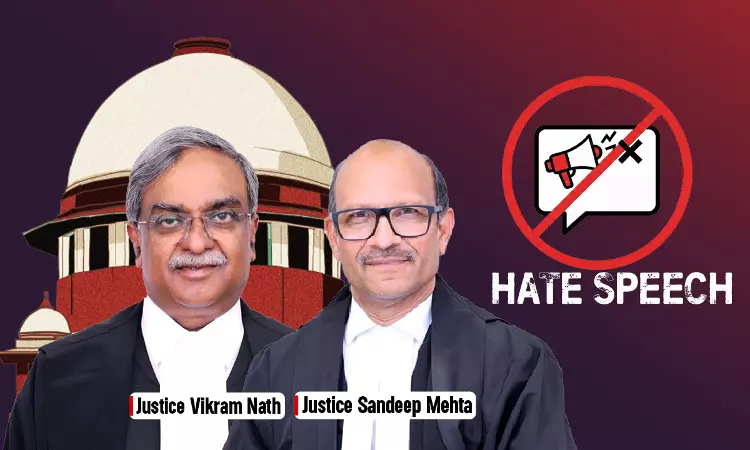
Hate speeches strike at the moral fabric of our nation, and are antithetical to fraternity, the Court stated.
Even while refraining from issuing directions to curb hate speech offences on the ground that the relief fell outside the judicial domain, the Supreme Court appealed to all citizens to imbibe a sense of fraternity, and sounded a strong word of caution against the propagation of communally divisive remarks.The Court underscored that the preservation of constitutional order is not...
This is a premium content
Available exclusively to
Our subscribers
Subscribe Premium 
INR 1099+GST
Your support helps us to bring you more content at
an affordable subscription scheme !!!
All payment options available
Even while refraining from issuing directions to curb hate speech offences on the ground that the relief fell outside the judicial domain, the Supreme Court appealed to all citizens to imbibe a sense of fraternity, and sounded a strong word of caution against the propagation of communally divisive remarks.
The Court underscored that the preservation of constitutional order is not the responsibility of the State alone, and individuals and public figures must also bear that responsibility. Highlighting the diversity of our nation, and the Constitutional vision for fraternity, the Court stated that individuals and public figures must remember that words have consequences in a diverse society like ours.
"In a constitutional democracy, public discourse carries with it a corresponding duty of restraint and responsibility. Individuals, public figures, and institutions alike must remain mindful that words have consequences, particularly in a society as diverse as ours," the Court cautioned.
"While the law provides mechanisms to address conduct that threatens public order or communal harmony, the more enduring safeguard against the menace of hate speech lies in the collective constitutional conscience of society. Ultimately, the Constitution does not survive merely through institutions or legal frameworks, but through the sustained fidelity of its citizens to the values it embodies," the Court stated.
The Court emphasised that hate speech is fundamentally antithetical to the constitutional value of fraternity and corrodes the moral fabric of the Republic, observing that freedom of speech cannot be used as a vehicle to inflame divisions or promote hostility between communities
The bench comprising Justice Vikram Nath and Justice Sandeep Mehta declined to issue general directions, pointing out that creation of offences was within the exclusive domain of the legislature. The Court also noted that there was no legislative vacuum with regard to hate speech, and the existing legal framework adequately addressed such crimes. Whether further amendments are needed is a matter which is left to the wisdom of the Union and the States.
Even while declining to issue directions, the Court, in the epilogue of the judgment, stressed the importance of fraternity, and the dangers of hate speeches.
Fraternity consciously incorporated as a Constitutional ideal
The Court reminded that the framers of the Constitution envisioned modern India as a "State founded upon secularism, inclusivity, and unity in diversity." Emerging from the backdrop of communal divisions during the colonial period, partition and caste-based discrimination, they emphatically rejected the notion that people professing different faiths and beliefs cannot coexist.
The Court underscored that the Preamble is an integral part of the Constitution and embodies foundational values such as justice, liberty, equality and fraternity, which together form the guiding framework of the constitutional order.
Hate speech distorts fraternity; against India's civilisational ethos
The Court stated that once the constitutional ideal of fraternity is internalised by citizens, both individuals and those in positions of influence, the very impulse to engage in “hate speech” would stand diminish.
"Hate speech, at its core, stems from a perception of difference that breeds exclusion, where the “other” is viewed as alien, inferior, or undeserving of equal regard. So long as this binary of “us” and “them” persists, the promise of fraternity remains unrealised, and true constitutional belonging becomes elusive," stated the judgment authored by Justice Vikram Nath.
"Hate speech is thus not merely a deviation from acceptable discourse; it is fundamentally antithetical to the constitutional value of fraternity and strikes at the moral fabric of our Republic. It also runs counter to the deeper civilisational ethos of India. The land historically known as Bharata has, across centuries, been a refuge for diverse communities fleeing persecution, offering not merely shelter but acceptance and assimilation. This tradition of inclusivity is not episodic, but deeply embedded in the cultural consciousness of the nation," the judgment stated.
The Court stated that a civilisation which embraced the idea of 'Vasudaivaka Kutumbakam' cannot endorse a narrow idea based on exclusion.
"For a nation that has historically embraced the idea of the world as one family, the modern construct of “citizenship” cannot be reduced to a basis for exclusion or division. It is, therefore, inconceivable that citizens be classified or discriminated against on grounds such as caste, colour, creed, gender, or any other marker rooted in an “us versus them” mindset. Such an approach would be wholly inconsistent with the constitutional vision of unity, dignity, and equality."
Fundamental duty of every citizen to promote fraternity
Referring to Article 51A of the Constitution, the Court reminded that a fundamental duty is cast upon every citizen to promote harmony and the spirit of common brotherhood among all the people of India, transcending religious, linguistic, regional and sectional diversities.
Hate speech, is not merely an exercise of free expression but a distortion of it, one that undermines the constitutional promise of an inclusive and cohesive society by fostering hostility and discrimination against identifiable groups.
The Court also ruled, in a connected petition, that no hate speech offence was made out against BJP leaders Anurag Thakur and Parvesh Verma in realtion to their speeches of 2020.
While concluding, the Court commented :
"While we decline to issue directions of the nature sought, we deem it appropriate to observe that issues relating to 'hate speech' and 'rumour mongering' bear directly upon the preservation of fraternity, dignity, and constitutional order. It would be open to the Union of India and competent legislative authorities to consider, in their wisdom, whether any further legislative or policy measures are warranted in light of evolving societal challenges or to bring about suitable amendments as suggested by the Law."
Case Title : Ashwini Kumar Upadhyaya v. Union of India, W.P.(C) No. 943/2021 (and connected cases)
Citation : 2026 LiveLaw (SC) 437
Tags


