



- Home
- /
- Supreme court
- /
- High Courts Must Act As Guardians...
High Courts Must Act As Guardians Of District Judiciary, Not Castigate Judges In Orders: Supreme Court
LIVELAW NEWS NETWORK
17 April 2026 10:47 AM IST
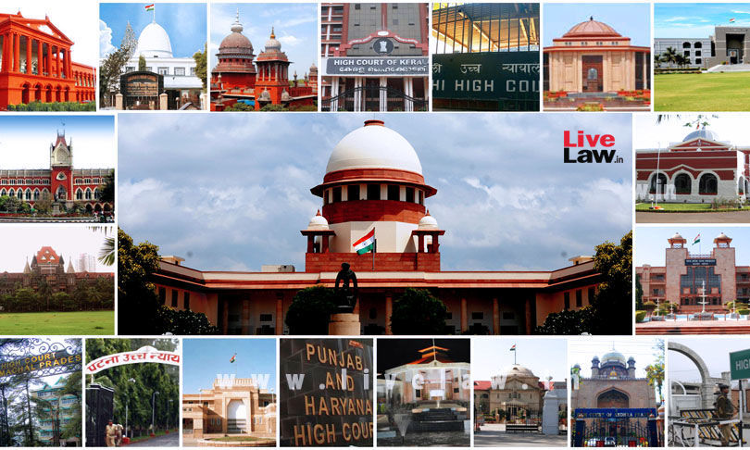
The power of superintendence under Article 227 must not be used to oppress judges, but to nurture and guide them, the SC reminded.
The Supreme Court has cautioned that it has become a recent trend for High Courts to castigate judicial officers and record adverse remarks or strictures against them while exercising supervisory, appellate or revisional jurisdiction, stressing that such an approach is inconsistent with the institutional role of High Courts as guardians of the district judiciary.A Bench of Justice Vikram Nath...
This is a premium content
Available exclusively to
Our subscribers
Subscribe Premium 
INR 1099+GST
Your support helps us to bring you more content at
an affordable subscription scheme !!!
All payment options available
The Supreme Court has cautioned that it has become a recent trend for High Courts to castigate judicial officers and record adverse remarks or strictures against them while exercising supervisory, appellate or revisional jurisdiction, stressing that such an approach is inconsistent with the institutional role of High Courts as guardians of the district judiciary.
A Bench of Justice Vikram Nath and Justice Sandeep Mehta observed that when infirmities are noticed in orders passed by judicial officers, the immediate reaction should not be to make disparaging observations in judicial orders, particularly because High Courts, being courts of record, are expected to protect and guide officers in the subordinate judiciary.
"Before parting, we may record a discordant note that it has become a recent trend to castigate Judicial Officers and record adverse remarks/strictures against them in judicial orders passed by the High Court in the exercise of supervisory, appellate or revisional jurisdiction. The High Court, being a Court of record in the State, is expected to act as the guardian of the Officers in district judiciary. While finding infirmities in the order passed by a Judicial Officer, the immediate reaction ought not to be to make adverse or disparaging observations against the concerned Judicial Officer in a judicial dispensation."
The Court further warned that disparaging remarks or strictures can have serious consequences for the service career of judicial officers and may demoralise the district judiciary as a whole. Emphasising the proper use of supervisory jurisdiction, the Bench underscored that the power of superintendence under Article 227 of the Constitution must function as a mechanism for nurturing and guiding judicial officers rather than as a tool of oppression.
"Such disparaging remarks/strictures may ruin the career of the Judicial Officer in addition to demoralising the district judiciary as a whole. Power of superintendence conferred upon the High Courts by Article 227 of the Constitution of India ought not to be used as a tool of oppression but rather as a mechanism for nurturing and guiding the Judicial Officers in the State."
Suggestion of In-House Administrative Mechanisms
The Court noted that some High Courts have already evolved in-house mechanisms to address deficiencies in orders passed by trial judges. Under such systems, observations regarding the quality of orders or conduct of proceedings can be recorded in a remark slip and placed before the Administrative Judge or the Chief Justice for appropriate follow-up action on the administrative side.
Recommending wider adoption of such practices, the Bench stated that recording structured administrative remarks on judgments and proceedings would be a more appropriate institutional response than issuing adverse judicial observations against individual officers. The Court directed that a copy of its order be circulated to all High Courts for information and necessary follow-up action.
Background
The Court made these remarks while deciding a bail matter which arose from a tenancy dispute between the parties. The complainant had earlier filed a civil suit regarding tenancy rights but later stated before the civil court that the dispute had been amicably settled, leading to dismissal of the suit in 2017. Subsequently, the complainant filed a criminal complaint, resulting in registration of an FIR for offences including cheating and criminal breach of trust.
The accused was arrested in May 2018 and was granted interim bail by the Magistrate, which was later confirmed. In 2026, the High Court, in revision proceedings, set aside the bail order on the ground that the Magistrate's order allegedly violated procedural requirements under the Criminal Rules and Orders and lacked proper authentication.
Supreme Court's Findings
The Supreme Court held that the High Court's interference with the bail order after a lapse of nearly eight years was based on hyper-technical considerations and amounted to a perverse exercise of jurisdiction. The Court emphasized that cancellation of bail directly impinges upon the liberty of an individual and cannot be undertaken mechanically without cogent and overwhelming circumstances.
The Bench also noted that the dispute appeared to have predominantly civil overtones and that the High Court had overlooked settled principles governing cancellation of bail.
Appearances:
For petitioners :Mr. Siva Prasad Ghose, Mr. Anondo Mukherjee, Ms. Parul Sharma, Mr. Jitender Kumar and Mr. Anil Kumar, AOR.
For respondents : Mr. Rohit Dutta (VC), Mr. Anas Tanwir, AOR, Mr. Suryanu Sengupta, Mr. Dhrubajit Saikia, Ms. A. Banerjee, Ms. Geetanjali Nagpal, Mr. Kunal Mimani, AOR, Mr. Prashant Alai and Mr. Abhinav Rana, Advocates.
Headnote
Criminal Law – Cancellation of Bail – Principles for Interference – High Court's Supervisory Jurisdiction – Section 437 CrPC – Article 227 of the Constitution – The Supreme Court set aside a Calcutta High Court order that had cancelled an accused's bail after eight years based on hyper-technical procedural grounds - The High Court had ruled that the Magistrate's original 2018 bail order was "born in sin" because it only bore initials rather than a full signature, allegedly violating Rule 183 of the Calcutta High Court Criminal (Subordinate Courts) Rules, 1985 – Held - Rejection of bail at the initial stage and cancellation of bail already granted must be dealt with on different bases - Bail once granted should not be cancelled in a mechanical manner without considering if supervening circumstances (such as interference with justice or absconding) render it no longer conducive to a fair trial - A procedural rule governing day-to-day functioning cannot override the substantive mandate of the CrPC unless a gross failure of justice is demonstrated - The High Court's interference after a lapse of nearly eight years on trivial grounds was "audaciously perverse".
Judicial Conduct – Adverse Remarks against District Judiciary – The Supreme Court condemned the practice of casting disparaging remarks or strictures against Judicial Officers in judicial orders - Power of superintendence under Article 227 should be a mechanism for "nurturing and guiding" rather than a "tool of oppression" - Supreme Court directed that the strictures against the Magistrate be expunged and recommended that all High Courts adopt an "in-house mechanism" (remark slips) for administrative follow-up on judicial infirmities instead of recording them in public judgments. [Relied on Dolat Ram v. State of Haryana, (1995) 1 SCC 349; Paras 14-32]
Case : Shuvendu Saha v. State of West Bengal
Citation : 2026 LiveLaw (SC) 382


