



- Home
- /
- Supreme court
- /
- High Courts Must Be Fair In Their...
High Courts Must Be Fair In Their Administration : Supreme Court Flays Allahabad HC For Discrimination In Staff Regularisation
Yash Mittal
19 Dec 2025 9:42 PM IST
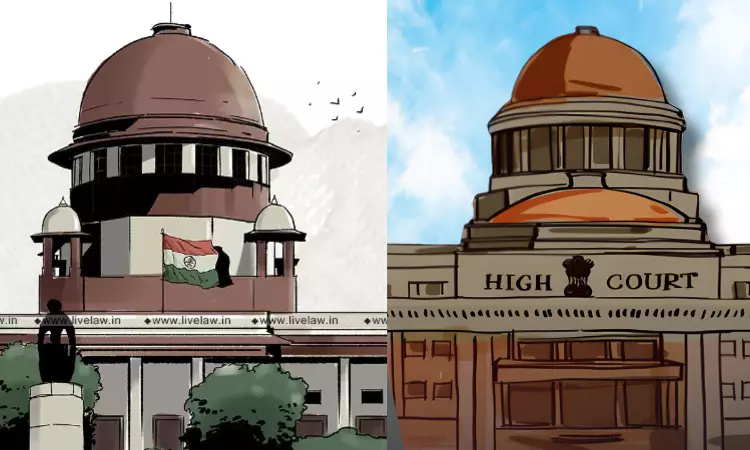
The Supreme Court on Friday (December 19) set aside the Allahabad High Court's order which, while regularizing services of a few of its employees, did not regularise services of similarly situated employees. The Court reminded the High Court of its duty to uphold constitutional morality within their own administration.“High Courts, being Constitutional Courts entrusted to uphold equality...
This is a premium content
Available exclusively to
Our subscribers
Subscribe Premium 
INR 1099+GST
Your support helps us to bring you more content at
an affordable subscription scheme !!!
All payment options available
The Supreme Court on Friday (December 19) set aside the Allahabad High Court's order which, while regularizing services of a few of its employees, did not regularise services of similarly situated employees. The Court reminded the High Court of its duty to uphold constitutional morality within their own administration.
“High Courts, being Constitutional Courts entrusted to uphold equality and fairness, are expected to encompass such principles within their own administrative functioning as well, and must exemplify the standards of a model employer. Such principles are at the risk of being undermined when discriminatory treatment is meted out to employees similarly situated within the same establishment. Such actions pose grave threat to the sacrosanct principles of non-arbitrariness and reasonableness as enshrined under Articles 14, 16 and 21 of the Constitution of India.”, observed a bench of Justices JK Maheshwari and Vijay Bishnoi, while ruling in favour of the employees, and directing their immediate regularization and the grant of full service benefits, ending a two-decade-long denial of permanent status.
“The Appellants have rendered over a decade of service. Numerous similarly placed employees who were employed through same channel of appointment have been regularized. Therefore, with a view to render complete justice in the peculiar facts and circumstances of the present case, in our view, this is a fit case for exercising our inherent powers under Article 142 of the Constitution of India to issue final operative directions.”, the court said.
The employees, appointed as Operator-cum-Data Entry Assistants and Routine Grade Clerks between 2004 and 2005, were hired under the direct orders of the then Chief Justice of the Allahabad High Court. Their appointments were made using the Chief Justice's powers under the High Court's own service Rules of 1976.
The controversy arose when, pursuant to an earlier High Court direction in 2011, a committee of two High Court judges in 2012 recommended the regularisation of some employees appointed through this very channel, but denied the same to the present appellants.
Importantly, while some candidates were regularised because a condition in their appointment letter for an exam had become redundant, and others because their appointment was not explicitly called "ad-hoc," the appellants were denied simply because their appointment letters used the term "ad-hoc."
Founding this approach to be erroneous, the judgment authored by Justice Maheshwari observed:
“In the facts of this case, such a distinction solely on the basis of stipulations as contained in the appointment letter, when the nature of work performed is identical, violates the fundamental principle that equals must be treated equally and persons similarly circumstanced should not be treated differently without a rational and intelligible differentia.”
“we are of the opinion that the Appellants have been caused grave prejudice by the Respondents, in respect of rejection of their representations for regularization, though similarly placed employees have been granted the same, without there being any reasonable distinction between them.”, the court added.
Accordingly, the appeals were allowed.
Cause Title: RATNANK MISHRA & OTHERS VERSUS HIGH COURT OF JUDICATURE AT ALLAHABAD THROUGH REGISTRAR GENERAL (and connected cases)
Citation : 2025 LiveLaw (SC) 1237
Click here to download judgment
Appearance:
For Appellant(s) : Mr. Nischal Kumar Neeraj, AOR Mr. P. S. Patwalia, Sr. Adv. Mr. Shantanu Sagar, AOR
For Respondent(s) : Ms. Preetika Dwivedi, AOR Mr. Abhisek Mohanty, Adv. Mr. Ansh Rajauria, Adv. Mr. Anupam Mishra, Adv.

Yash Mittal
Yash Mittal is a Correspondent with LiveLaw, covering the Supreme Court of India

