



- Home
- /
- Supreme court
- /
- Hindu Daughter-in-Law Who Becomes...
Hindu Daughter-in-Law Who Becomes Widow After Father-in-Law's Death Entitled To Maintenance From His Estate : Supreme Court
LIVELAW NEWS NETWORK
13 Jan 2026 4:25 PM IST
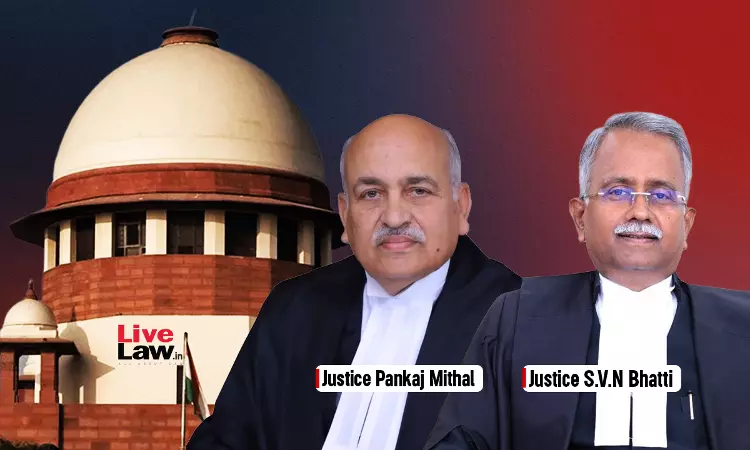
The Court held that the protection of the Hindu Adoption and Maintenance Act cannot be based on the timing of the husband's death.
The Supreme Court has held that a daughter-in-law who becomes a widow after the death of her father-in-law is entitled to claim maintenance from his estate under the Hindu Adoptions and Maintenance Act, 1956.A Bench comprising Justice Pankaj Mithal and Justice S.V.N. Bhatti, while dismissing a batch of civil appeals, ruled that the expression “any widow of his son” under Section 21(vii)...
This is a premium content
Available exclusively to
Our subscribers
Subscribe Premium 
INR 1099+GST
Your support helps us to bring you more content at
an affordable subscription scheme !!!
All payment options available
The Supreme Court has held that a daughter-in-law who becomes a widow after the death of her father-in-law is entitled to claim maintenance from his estate under the Hindu Adoptions and Maintenance Act, 1956.
A Bench comprising Justice Pankaj Mithal and Justice S.V.N. Bhatti, while dismissing a batch of civil appeals, ruled that the expression “any widow of his son” under Section 21(vii) of the Act is unambiguous and includes all widowed daughters-in-law, irrespective of whether the son died before or after the father-in-law.
Background
The dispute arose among the heirs of late Dr. Mahendra Prasad, who died in December 2021. His daughter-in-law Geeta Sharma sought maintenance from his estate under the Hindu Adoptions and Maintenance Act after her husband, one of Dr. Prasad's sons, passed away in March 2023.
The Family Court had dismissed her petition as not maintainable on the ground that she was not a widow at the time of her father-in-law's death. However, the High Court reversed this finding, holding that she qualified as a dependant and directing the Family Court to decide the quantum of maintenance on merits.
The High Court's order was challenged before the Supreme Court by other family members, including the widow of another son and a woman claiming to be Dr. Prasad's long-term live-in partner.
Court's Findings
The Court framed the legal question as follows : whether a daughter-in-law, who becomes a widow after the death of her father-in-law, is a dependant upon the estate of the father-in-law, and entitled to claim maintenance from his estate.
Section 21 of the Act defined "dependents" and its sub-section (viii) stated - "any widow of his son or of a son of his predeceased son, so long as she does not remarry: provided and to the extent that she is unable to obtain maintenance from her husband's estate. or from her son or daughter, if any, or his or her estate; or in the case of a grandson's widow, also from her father- in-law's estate;"
Answering the core legal question, the Court held that Section 21(vii) of the Act clearly recognises “any widow of his son” as a dependant, subject to her inability to maintain herself from her husband's estate or that of her children.
"A plain reading of the above definition of the dependants makes it crystal clear that the relatives of the deceased, namely, “any widow of his son” would be a dependant provided she is unable to maintain herself from her husband's estate or from her son or her daughter's estate and in the case of grandson's widow, from her father-in-law's estate."
Section 22 of the Act provides for the maintenance of dependants and casts an obligation upon all the heirs of the deceased Hindu to maintain the dependants of the deceased out of the estate inherited by them from the deceased. Referring to this, the Court observed, "In simpler words, all the heirs of the deceased Hindu are obliged to maintain the dependants of the deceased from the funds inherited out of the estate of the deceased."
Sub-section (2) of Section 22 further provides that where a dependant of the deceased Hindu has not obtained share in the estate of the Hindu either by testamentary or intestate- succession, such a dependant shall be entitled to maintenance from those who take the estate. "Therefore, anyone succeeding to the estate of the deceased Hindu is under an obligation to maintain the dependant of the deceased."
The Bench emphasised that the statute does not use the phrase “widow of a predeceased son” and that courts cannot read words into a provision where the language is plain and unambiguous. Relying on settled principles of literal interpretation, the Court observed that the timing of the son's death is irrelevant for determining dependency.
"The legislature in its wisdom has deliberately avoided to use the word “predeceased” before the “son” so as to include any widow of the son. The time of her becoming a widow or the death of the son is immaterial."
Classification based on timing of son's death violates Article 14
The Court further noted that excluding widowed daughters-in-law based solely on whether their husbands died before or after the father-in-law would be arbitrary and violative of Article 14 of the Constitution. Such a distinction, it held, has no rational nexus with the object of the Act, which is to provide maintenance to dependants who are unable to maintain themselves.
It also observed that denying maintenance on such a technical interpretation would offend Article 21, as it could expose widowed women to destitution and undermine their right to live with dignity.
"The classification sought to be made between widowed daughters-in-law based solely on the timing of the husband's death, namely, (a) those whose husbands died during the lifetime of the father-in-law, and (b) those whose husbands died after him; is manifestly unreasonable and arbitrary. Such a classification bears no rational nexus with the object and purpose of the Act, which is to secure maintenance to dependants who are unable to maintain themselves. In both situations, the women are similarly situated in so far as the object of the Act is concerned, having suffered widowhood, being without spousal support, and facing comparable financial vulnerability.
Denial of maintenance to one category based on a fortuitous circumstance beyond their control is manifestly arbitrary and violative of the guarantee of equality before law under Article 14 of the Constitution. Any interpretation contrary to one opined above, would also infringe upon Article 21 of the Constitution, which guarantees the right to life with dignity. The right to life has been judicially expanded to include the right to livelihood and basic sustenance.
Denying maintenance to a widowed daughter-in-law from the estate of her deceased father-in- law on a narrow or technical construction of the statute would expose her to destitution and social marginalization, thereby offending her fundamental right to live with dignity. The provisions of the Act must, therefore, be read purposively and in conformity with constitutional values, so as to advance social justice and protect the dignity of vulnerable dependants rather than defeat it."
The judgment also quoted Manu Smriti, Chapter 8, verse, which says : "No mother, no father, no wife, and no son deserves to be forsaken. A person who abandons these blameless (relatives) should be fined six hundred (units) by the king."
Upholding the High Court's view, the Supreme Court concluded that Geeta Sharma's maintenance petition was maintainable and that the Family Court must decide it on merits. The appeals were dismissed, with no order as to costs.
"In view of the aforesaid facts and circumstances, we are clearly of the opinion that “any widow of the son” of a deceased Hindu is a dependant within the meaning of Section 21 (vii) of the Act and is entitled to claim maintenance under Section 22 of the Act," the judgment summarised its conclusion.
Headnote
Hindu Adoptions and Maintenance Act, 1956; Sections 21(vii) and 22 — Maintenance of Dependants — Whether a daughter-in-law who becomes a widow after the death of her father-in-law is a 'dependant' entitled to claim maintenance from his estate? - Held that a plain and literal reading of Section 21(vii) makes it crystal clear that "any widow of his son" is a dependant - The legislature deliberately avoided using the word "predeceased" before "son" in this section, unlike other statutes – At the time of the son's death, whether before or after the father-in-law's demise is immaterial for determining the status of the widow as a dependant - When the language of a statute is clear and unambiguous, it must be given its natural meaning – Held that Courts cannot "add, and mend" or supply assumed omissions to the text of the law - Departure from the literal rule is only permissible in rare cases, as the exclusive domain to legislate lies with the legislature.
Constitutional Validity — Articles 14 and 21 - Classifying widowed daughters-in-law based solely on the timing of their husband's death (before or after the father-in law) is arbitrary and lacks a rational nexus with the Act's object of securing maintenance for vulnerable dependants - Denying maintenance on such technical grounds would expose them to destitution, violating the right to life with dignity under Article 21 - Section 19 casts a personal obligation on the father-in-law to maintain his daughter-in-law during his lifetime - Section 22 creates an obligation on the heirs of the deceased to maintain dependants out of the estate - A claim under Section 22 arises only after the death of the father-in-law – Appeals dismissed. [Relied on B. Premanand v. Mohan Koikal (2011) 4 SCC 266; Vinod Kumar v. DM, Mau (2023) 19 SCC 126; Paras 16-28]
Senior Advocates Dr Abhishek Manu Singhvi and V Giri appearaed for the appellants.
Senior Advocate Vikas Singh appeared for the respondents.
Case : Kanchana Rai v Geeta Sharma
Citation : 2026 LiveLaw (SC) 41
Click here to read the judgment
Tags


