



- Home
- /
- Supreme court
- /
- 'Hostile Witness Testimony Can Be...
'Hostile Witness Testimony Can Be Used To Acquit Also, Not Just Convict' : Supreme Court Sets Aside Murder Conviction
Yash Mittal
13 May 2026 8:16 PM IST
Observing that the evidence of hostile witnesses can be used not only for conviction but also to discredit the prosecution case and support acquittal, the Supreme Court on Wednesday (May 13) has acquitted a man accused of killing a man belonging to a SC/ST category.The Court found that the very foundation of the prosecution's case was discredited by the prosecution's witnesses as they...
This is a premium content
Available exclusively to
Our subscribers
Subscribe Premium 
INR 1099+GST
Your support helps us to bring you more content at
an affordable subscription scheme !!!
All payment options available
Observing that the evidence of hostile witnesses can be used not only for conviction but also to discredit the prosecution case and support acquittal, the Supreme Court on Wednesday (May 13) has acquitted a man accused of killing a man belonging to a SC/ST category.
The Court found that the very foundation of the prosecution's case was discredited by the prosecution's witnesses as they didn't support the prosecution's stand on the place of occurrence of the crime.
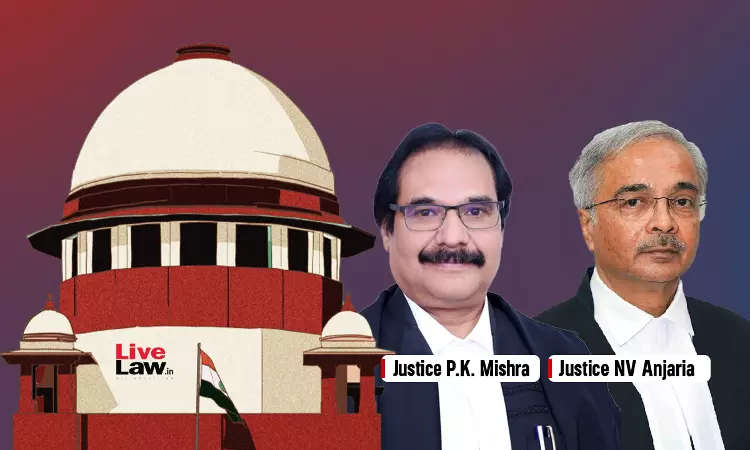
“…when the testimony of a hostile witness is admissible subject to be feeded by corroboration and the conviction on that basis could be arrived at, the reverse is also true as a canon of appreciation of evidence. What necessarily implies is that as the evidence of a hostile witness can be used for convicting the accused, such evidence could indeed be applied and utilised also for the purpose of acquitting the accused, when what is testified by the hostile witness inspires credibility, when read with the other evidence on record, either ocular or documentary. The dictum would be that the testimony of a hostile witness or statement in the deposition of hostile witness could be properly employed to discredit the prosecution case and a conclusion of acquittal could well be supported through it and could be founded therein.”, observed a bench of Justice Prashant Kumar Mishra and Justice NV Anjaria.
The bench set aside the conviction of the Appellant who was sentenced to life imprisonment under Sections 302 and 323 of the Indian Penal Code and Sections 3(2)(v) and 3(1)(x) of the Scheduled Castes and Scheduled Tribes (Prevention of Atrocities) Act, 1989.
The appellant was convicted by the Special Sessions Judge for SC/ST Act-cum-VII Additional District & Sessions Judge, Ranga Reddy District, for the murder of one Shiva Shankar on May 12, 2013. The Telangana High Court confirmed the conviction on February 4, 2025, leading to the present appeal.
The prosecution claimed that the deceased had eloped with the appellant's younger sister (aged 18) on February 14, 2013. According to the prosecution, a village Panchayat was held thereafter, which decided that the deceased would leave Ogipur village while the girl would stay at her parental house.
The incident allegedly occurred when the deceased returned to the village to attend a friend's wedding. As he was passing near the appellant's house in the morning, the appellant confronted him, a quarrel ensued, and the appellant beat him with a stone. The deceased succumbed to his injuries while being shifted to a hospital in Hyderabad.
Setting aside the impugned order, the judgment authored by Justice Anjaria observed that the prosecution's case crumbled on the foundational question of whether the incident even occurred as claimed.
The Court noted the contradictions between the prosecution's witnesses. When the testimonies of the PWs 1 and 3 were read with PWs 4 and 5, the foundation of the prosecution's case was destroyed, as the place of occurrence of the crime could not be ascertained. PWs 1, 3, 4 and 5 were declared as hostile wittnesses.
“…the interaction of evidence of PW1 and PW3 read with the evidence of PW4 and PW5, demolished the very fulcrum of the prosecution case, in as much as the very occurrence of the incident was discredited and became liable to be disbelieved, cementing doubts further by the fact that though the incident was claimed to have occurred in the open place humming with vehicular traffic, no person from the nearby was examined as a witness to support and establish the incident.” the court held.
Also, noting that the scene of offence was the main road where quarries were located nearby, with trucks and lorries passing day and night, the Court said that despite this being a public place humming with traffic, the prosecution examined no independent witness from the vicinity.
“…the very occurrence of the incident was discredited and became liable to be disbelieved, cementing doubts further by the fact that though the incident was claimed to have occurred in the open place humming with vehicular traffic, no person from the nearby was examined as a witness to support and establish the incident. Thus, the occurrence of incident itself could not be said to have been proved by the prosecution.”, the court observed.
In terms of the aforesaid, the appeal was allowed.
“In wake of such weak, contradictory and crumbling evidence, where the prosecution miserably struggled to be finally unable to prove its case, the conviction recorded by the Trial Court and confirmed by the High Court is not sustainable. Both the courts committed a concurrent error in convicting the appellant. The judgment and order of the trial court and the High Court deserve to be set at naught.”, the court ordered.
Headnote
Criminal Evidence – Testimony of Hostile Witness – Evidentiary Value for Acquittal – The Supreme Court ruled that just as the dependable part of a hostile witness's testimony can be used to convict an accused if corroborated by reliable evidence, the reverse is also true - The testimony or statement in the deposition of a hostile witness can be properly employed to discredit the prosecution's case and support a conclusion of acquittal, especially when it inspires credibility and aligns with other evidence on record to cast serious doubt on the occurrence of the incident - Held: The evidence of a hostile witness does not get completely washed off the record - If such evidence discredits the very fulcrum and genesis of the prosecution's story (such as the holding of a village panchayat or the presence of eyewitnesses), and is supported by unexplained medical discrepancies and a failure to examine independent public witnesses at a busy crime scene, the benefit of the doubt must go to the accused - The concurrent convictions by the Trial Court and High Court were set aside, and the appellant was acquitted. [Relied on Ghulam Hassan Beigh vs. Mohammad Maqbool Magrey and Others, (2022) 12 SCC 657; Bhaskarrao and Others vs. State of Maharashtra, (2018) 6 SCC 591; Koli Lakhmanbhai Chanabhai vs. State of Gujarat, (1999) 8 SCC 624; Himanshu alias Chintu vs. State (NCT of Delhi), (2011) 2 SCC 36; Paras 6-10]
Cause Title: TALARI NARESH VERSUS THE STATE OF TELANGANA
Citation : 2026 LiveLaw (SC) 496
Click here to download judgment
Appearance:
For Petitioner(s) : Mr. D Ramakrishna Reddy, Adv. Mrs. D. Bharathi Reddy, AOR Mr. Nishant Sharma, Adv. Mrs. D Tejaswi Reddy, Adv. Ms. Adviteeya, Adv.
For Respondent(s) : Mr. Kumar Vaibhaw, Adv. Mr. Devrishi Tyagi, Adv. Ms. Devina Sehgal, AOR Mr. Srikanth Varma Mudunuru, Adv. Mr. Yatharth Kansal, Adv.

Yash Mittal
Yash Mittal is a Correspondent with LiveLaw, covering the Supreme Court of India

