



- Home
- /
- Supreme court
- /
- Human Rights Courts Can Be...
Human Rights Courts Can Be Approached Directly Without Prior Recourse To Commission: Supreme Court Upholds Karnataka Rule
Saima Anjum
8 Sept 2026 4:22 PM IST
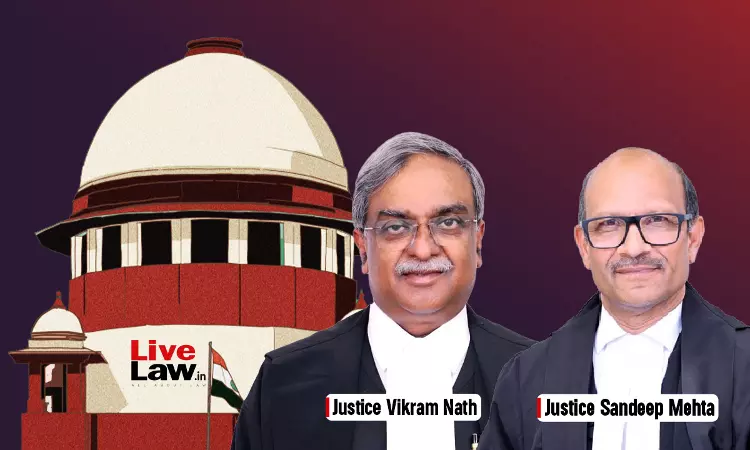
The Supreme Court has recently upheld the validity of Rule 6 of the Karnataka State Human Rights Courts Rules, 2006, holding that the provision is neither inconsistent with the Protection of Human Rights Act, 1993 nor ultra vires the rule-making power of the State legislature under Section 41 of the Act. Setting aside the High Court's orders, the Court has restored the proceedings...
This is a premium content
Available exclusively to
Our subscribers
Subscribe Premium 
INR 1099+GST
Your support helps us to bring you more content at
an affordable subscription scheme !!!
All payment options available
The Supreme Court has recently upheld the validity of Rule 6 of the Karnataka State Human Rights Courts Rules, 2006, holding that the provision is neither inconsistent with the Protection of Human Rights Act, 1993 nor ultra vires the rule-making power of the State legislature under Section 41 of the Act. Setting aside the High Court's orders, the Court has restored the proceedings initiated against the concerned police officials.
A bench of Justice Vikram Nath and Justice Sandeep Mehta ruled so while setting aside a Karnataka High Court judgment which had struck down Rule 6 as unconstitutional, and consequently quashed a criminal complaint filed before a Human Rights Court constituted under the Act.
For context, Rule 6 prescribes the procedure in respect of complaints before a Human Rights Court, permitting a victim of human rights violation (or his/her legal representative, or a registered non-governmental organisation, or public person) to file a complaint against a public servant alleged to have committed or abetted such an offence while acting under colour of his office. Upon receipt of the complaint, the Court may either direct investigation by a police officer not below the rank of Superintendent of Police or conduct an inquiry in accordance with the procedure prescribed for private complaints under the Code of Criminal Procedure, 1973 (CrPC, now the Bharatiya Nagarik Suraksha Sanhita, 2023). It also provides for the course to be followed upon receipt of the investigation report, consideration of sanction for prosecution wherever required, and the conduct of trial in accordance with the procedure applicable to trials before a Court of Session.
The appellant had filed a complaint before the Sessions Judge and Special Judge (Human Rights Court), Vijayapura, alleging violation of his human rights by police while he was in custody. The Human Rights Court referred the matter to the Superintendent of Police for investigation under Section 156(3) of the CrPC (now Section 175(3) of the Bharatiya Nagarik Suraksha Sanhita, 2023). Subsequently, a case was registered against the concerned police officials.
Thereafter, the concerned officials challenged the case before the Karnataka High Court, contending that Rule 6 was inconsistent with the broader scheme of the 1993 Act and beyond the powers granted under Section 41 of the Act, which grants power to the State legislature to make rules to carry out the provisions of the 1993 Act. Accepting the contention, the High Court held Rule 6 as unconstitutional and quashed the proceedings initiated against the officials. The Supreme Court, however, had stayed the operation of the High Court's ruling pending the appeal it has now decided.
To decide the question, the Supreme Court explained that the 1993 Act contemplates two separate institutional mechanisms for protection of human rights. One is the Human Rights Commission constituted under Sections 12 to 18 of the Act, performing an inquisitorial and recommendatory role. Another is the Human Rights Courts constituted under Section 30, exercising judicial power in cases of human rights violations. The bench observed that these functions are not identical.
The Court held that mere conferment of inquiry and recommendatory powers on the Commission cannot be read as making the recommendation a mandatory precondition for prosecution under the Act. “Nothing in Sections 12 to 18 of the 1993 Act expressly provides that every prosecution concerning an offence arising out of a violation of human rights must originate from a recommendation of the Commission. Equally, Section 30 thereof does not make the jurisdiction of the Human Rights Court dependent upon the completion of any prior proceeding before the Commission. In our considered opinion, to read such a limitation into the statute would amount to supplying a condition which Parliament itself has not enacted,” the bench held.
The Court also clarified that Rule 6 does not create any new offence rather, or prescribe any new punishment, or expand the definition of “human rights” under the Act. Rather, it merely provides the procedural mechanism for invoking the jurisdiction already conferred on the Human Rights Court under Section 30 of the Act.
Rejecting the High Court's ruling that Rule 6 exceeded the rule-making power conferred under Section 41, the bench perused the provision as, “Section 41 of the 1993 Act is confined only to the matters enumerated in sub-section (2) thereof. Section 41(1) thereof expressly empowers the State Government to make rules “to carry out the provisions of this Act”. More importantly, sub-section (2) begins with the words “in particular and without prejudice to the generality of the foregoing power”.The language employed by Parliament makes it clear that the matters specified in clauses (a) to (c) are illustrative and do not exhaust the amplitude of the general power conferred by sub-section (1).”
The bench relied on St Johns Teachers Training Institute v Regional Director, NCTE, to reiterate that delegated rules cannot supplant the parent Act but may supplement it by providing ancillary procedural machinery to effectuate the legislative scheme. On this note, the bench viewed that, “Rule 6 of the 2006 Rules supplements Section 30 of the 1993 Act by prescribing the procedure through which a Human Rights Court may deal with offences arising out of violations of human rights. It does not supplant the 1993 Act.”
The bench also referred to Paramvir Singh Saini v Baljit Singh, noting that the Supreme Court has already recognised that complaints regarding the use of force in police stations may be made both to the State Human Rights Commission and to the Human Rights Court. It, thus, reinforced that recourse to a Human Rights Court does not depend on a prior Commission inquiry.
The bench further clarified that an inquiry or recommendation by the Commission does not amount to a prior prosecution or punishment, and hence the two parallel recourses could not be said to be in violation of the rule against double jeopardy.
Holding that Rule 6 of the 2006 Rules to be intra vires the 1993 Act, the Supreme Court set aside the High Court's judgment along with its order quashing the proceedings against the concerned police officials. The bench, however, clarified that its finding must bear no opinion on the merits of the case.
Case: Sayad Asifulla v State of Karnataka & Ors.
Citation : 2026 LiveLaw (SC) 911
Click here to read the judgment
Appearances:
For Appellant: Mr Avishkar Singhvi, AAG; Mr Lzafeer Ahmad BF, AOR; Mr Rajesh Gulab Inamdar, AOR; Mr Aujaswi Maken, Adv.; Mr BLN Sanjit, Adv.; Ms Rakshita Singh, Adv.; Mr Ritik Grover, Adv.; Ms Bhawna Piplani, Adv.; Mr Abhishek Kaushik, Adv.; Ms Sonal Priya, Adv.; Mr Nizam Pasha, Adv.; Mr Mushtaq Salim, Adv.; Mr Sidharth Kaushik, Adv.; Ms Awstika Das, Adv.; Mr. Arif Ali, Adv.
For Respondent: Ms Kiran Suri, Sr. Adv.; Dr. Vipin Gupta, AOR; Ms Patil Rekha Chandra Gouda, AOR; Mr Sheelavant Vijaykumar Maheswarappa, Adv.; Mr SJ Amith, Adv.; Ms Aishwarya Kumar, Adv.; Mr Vishwanath Gururaj Joshi, Adv.
Tags


