



- Home
- /
- Supreme court
- /
- Illegality In Appointment Cannot Be...
Illegality In Appointment Cannot Be Regularised Citing Long Duration Of Service : Supreme Court
Yash Mittal
18 Aug 2026 8:27 PM IST
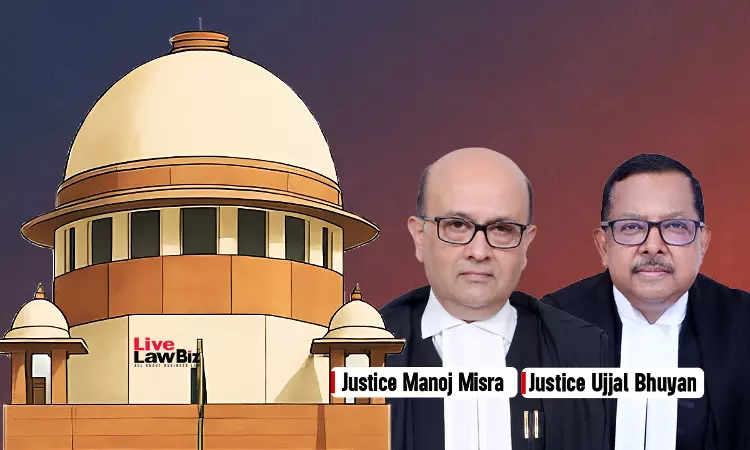
The Court observed that while "irregularity" in appointment can be cured, illegality cannot be.
The Supreme Court on Tuesday held that an illegal appointment cannot be allowed to acquire legality merely because the employee has continued in service for a long period, ruling that “illegality cannot be cured and made legal and valid by lapse of time.”The judgment came in a batch of appeals concerning the deputation and subsequent absorption of four officers of the Haryana Development...
This is a premium content
Available exclusively to
Our subscribers
Subscribe Premium 
INR 1099+GST
Your support helps us to bring you more content at
an affordable subscription scheme !!!
All payment options available
The Supreme Court on Tuesday held that an illegal appointment cannot be allowed to acquire legality merely because the employee has continued in service for a long period, ruling that “illegality cannot be cured and made legal and valid by lapse of time.”
The judgment came in a batch of appeals concerning the deputation and subsequent absorption of four officers of the Haryana Development and Panchayat Department into the Public Works Department (Building & Roads). The officers, Pradeep Atri, Praveen Chaudhary, Pankaj Gaur and Arun Bhatia ,had been absorbed as Assistant Engineers/Sub-Divisional Engineers in the PW(B&R) Department.
The Court held that while the deputation of Atri and Chaudhary was illegal, that of Gaur and Bhatia was irregular, the absorption of all four officers was illegal, non est and void. The Court consequently quashed their absorption and directed their repatriation to the Development and Panchayat Department, where their cadre and seniority are to be determined in accordance with the applicable rules
Political interference in process condemned
The Court also condemned the "blatant political interference" in the deputation and absorption of the four officers.
The bench of Justice Manoj Misra and Justice Ujjal Bhuyan set aside the Punjab & Haryana High Court's judgment which, while questioning the absorption of the officers to the PWD department with the help of political interference, refused to interfere with their services on the ground of long continuance in service.
Referring to Secretary, State of Karnataka v. Umadevi (2006), the Court held that illegal appointments cannot be regularized merely by lapse of time.
“We are afraid the High Court fell in grave error in allowing the aforesaid four officers to continue their services in the PW(B&R) Department even after declaring their deputation and absorption as illegal and bad in law. Illegality means something which is contrary to law; something which is wrong right from the inception. It is void ab initio. Illegality cannot be cured and made legal and valid by lapse of time. Illegality, which is distinct and different from irregularity, cannot be regularized by taking a sympathetic view on the ground of long continuance in service. This position has been explained by a Constitution Bench of this Court in Uma Devi. If the appointment itself is in infraction of the rules, in this case the 1965 Rules, it is an illegality. Such an illegality cannot be cured by resorting to the novel method of absorption which has been explained as appointment by transfer.”, the Court observed.
The controversy revolves around four officers, namely Pradeep Atri, Praveen Chaudhary, Pankaj Gaur, and Arun Bhatia, who were initially appointed as Sub-Divisional Officers in the Development and Panchayat Department but later sent on deputation and subsequently absorbed in the PW(B&R) Department. Interestingly, the deputation and absorption of the Appellant officers to the PW (B&R) Department was done with the help of political interference.
Moreover, three of these officers had failed the direct recruitment examination for the very post they later secured through absorption. The fourth officer, Praveen Chaudhary, never even appeared for the exam.
The Punjab & Haryana High Court took a sympathetic view regarding their long service on deputation but held their deputation and absorption to be bad in law, following which the appeals were filed before the Supreme Court by the officers.
The State attempted to justify the absorption under Rule 10 of the 1965 Rules, citing "special circumstances." However, the Court found the grounds cited, shortage of officers, M Tech degrees, and good performance, were "normal attributes" and not "special" in any sense.
Setting aside the High Court's sympathetic view, the judgment authored by Justice Bhuyan observed the illegality in the deputation and absorption of the Appellants officers in PWD despite having not cleared the examination, cannot be cured due to lapse of time. Further, the Court rejected the State's argument that the deputation and absorption was necessitated due to shortage of officers in the department.
“We are of the view that shortage of officers in a department cannot be construed to be a 'special circumstance' within the meaning of Rule 10 of the 1965 Rules.”, the Court observed.
“What Rule 10 of the 1965 Rules therefore contemplates is that an appointment by transfer is to meet a special situation, may be an exigency of public service which cannot wait an appointment by direct recruitment or an appointment by way of promotion, the only two modes of regular recruitment as contemplated under Rule 6(1) of the 1965 Rules which would be time consuming. It may so happen that for a particular project, specialised hands or a person or persons with certain specific qualifications or talent or skill are required. Rule 10 is meant for such an exigency and in the process to overcome the barrier posed by Rule 6 whereby 100 percent of the vacancies are to be filled up either by direct recruitment or by promotion (50 percent each, making up the entirety of 100 percent).”, the Court added.
High Court erred for not repatriating the officers to their parent department
“Though the High Court held the deputation and absorption of Shri Pradeep Atri, Shri Praveen Chaudhary, Shri Pankaj Gaur and Shri Arun Bhatia as bad in law, yet it did not repatriate them to their parent Department on the ground that they did not have any lien on their parent Department. High Court also did not terminate their services on the ground that they had rendered service for more than 18 years since 2005 and terminating their service at this stage would result in their hardship. Therefore, taking a sympathetic view, the High Court did not disturb their deputation and absorption as Assistant Engineer (Civil) in the PW(B&R) Department but did not grant them the seniority assigned to them by the Government.”, the Court held.
In terms of the aforesaid, the appeals were disposed.
Cause Title: HEMANT KUMAR & ORS. VERSUS STATE OF HARYANA (with connected appeals)
Citation : 2026 LiveLaw (SC) 822
Click here to download judgment
Appearance:
For Petitioner(s) : Mr. Bijender Chahar, A.S.G. Mr. Ranjit Kumar, Sr. Adv. Mr. Gurminder Singh, Sr. Adv. Mr. Nidesh Gupta, Sr. Adv. Dr. Hemant Gupta, A.A.G. Mr. Samar Vijay Singh, AOR Ms. Payal Gupta, Adv. Mr. Rony John, Adv. Ms. Sabarni Som, Adv. Mr. Aman Dev Sharma, Adv. Mr. Gaj Singh, AdvMs. Preetika Dwivedi, AOR Mr. Abhisek Mohanty, Adv. Mr. Ansh Rajauria, Adv. Mr. Siddharth Batra, AOR Ms. Shivani Chawla, Adv. Ms. Preetika Shukla, Adv. Mr. Ashutosh Chugh, Adv. Mr. Chritarth Palli , AOR Mr. Sandeep Bajaj, Adv. Mr. Soayib Qureshi, AOR Ms. Anchal Kushwaha, Adv. Mr. Aman Qayoom Wani, Adv.
For Respondent(s) : Mr P.S. Patwalia, Sr. Adv. Mr. Nidesh Gupta, Sr. Adv. Mr Guru Krishnakumar, Sr. Adv. Mr. Birendra Chahar, Sr. Adv. Dr. Hemant Gupta, A.A.G. Mr Chritarth Palli, AOR Mrs Harsheen Palli, Adv. Mr Agam Aggarwal, Adv. Mr Rajat Gupta, Adv. Ms Deveshi, Adv. Mr. Amit Verma AOR Ms. Preetika Dwivedi, AOR. Mr. Sandeep Bajaj, Adv. Mr. Soayib Qureshi, AOR Ms. Anchal Kushwaha, Adv. Mr. Aman Qayoom Wani, Adv. Mr. Samar Vijay Singh, AOR Ms. Payal Gupta, Adv. Ms. Sabarni Som, Adv. Mr. Aman Dev Sharma, Adv. Mr. Gaj Singh, Adv. Mr. Rony John, Adv. Mr. Keshav Mittal, Adv. Mr. Anjuman Tripathy, AOR Mr. Santosh Krishnan, AOR Mr Anjuman Tripathy, AOR Mr Mohit Singh Sikarwar, Adv. Mr Navdeep Singh, Adv. Mr Ashwin K, Adv. Mr Anisha Chauhan, Adv.
Tags
Yash Mittal
Yash Mittal is a Correspondent with LiveLaw, covering the Supreme Court of India

