



- Home
- /
- Supreme court
- /
- In Murder Cases, Sessions Court...
In Murder Cases, Sessions Court Can't Pass 'Life Imprisonment Without Remission' Sentence : Supreme Court
Yash Mittal
19 Dec 2025 2:30 PM IST
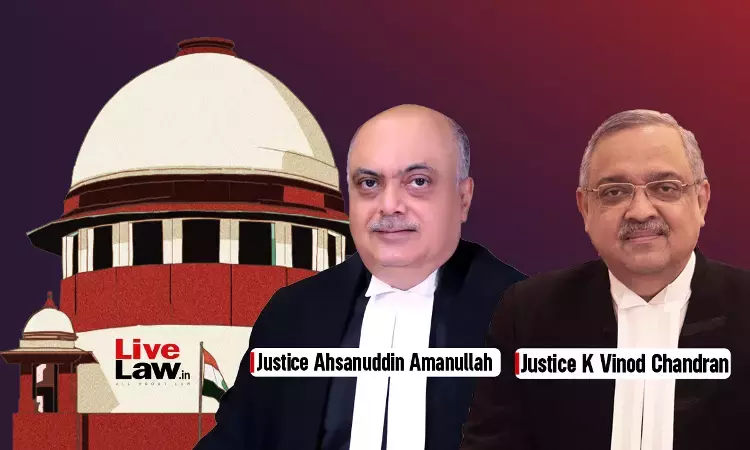
Only Constitutional Courts can pass a sentence barring the grant of remission, the Supreme Court clarified.
Clarifying the scope of sentencing powers in murder cases, the Supreme Court held that a Sessions Court cannot impose a sentence of life imprisonment for the remainder of a convict's natural life without remission, as such sentencing powers are exclusively vested in the Constitutional Courts. “The power to impose punishment of imprisonment for life without remission was conferred only on...
This is a premium content
Available exclusively to
Our subscribers
Subscribe Premium 
INR 1099+GST
Your support helps us to bring you more content at
an affordable subscription scheme !!!
All payment options available
Clarifying the scope of sentencing powers in murder cases, the Supreme Court held that a Sessions Court cannot impose a sentence of life imprisonment for the remainder of a convict's natural life without remission, as such sentencing powers are exclusively vested in the Constitutional Courts.
“The power to impose punishment of imprisonment for life without remission was conferred only on the Constitutional Courts and not on the Sessions Courts.”, observed a bench of Justices Ahsanuddin Amanullah and K Vinod Chandran, while partly allowing the convicts appeal, modifying his sentence of life imprisonment till his natural life without remission as imposed by the Sessions Court to a standard life imprisonment entitling him to claim statutory right of remission.
The case pertained to a gruesome crime, where the convict, a relative by marriage, entered the hut of a widow (mother of five) who had repeatedly resisted his sexual advances. After she spurned him once more, he poured kerosene on her and set her ablaze. She suffered 60% burns and died ten days later.
The conviction was primarily based on two consistent dying declarations, one recorded by a police officer and another by a Magistrate in the presence of a doctor, which clearly named the accused and described his motive.
The core legal issue was whether the trial court was correct in imposing life imprisonment meaning that it will be till the end of his natural life and directing the accused to be not granted the benefit of remission under Section 428 of the Code of Criminal Procedure, 1973.
Setting aside the Karnataka High Court's decision which affirmed the trial court's sentencing order, the judgment authored by Justice Chandran observed that:
“The sentence of life imprisonment no doubt means the entire life, subject only to the remission and commutation provided under Cr. PC and also to Articles 72 and 161 of the Constitution of India, which cannot be curtailed by a Sessions Court. Nor can the Sessions Court, a creation of the Cr.PC curtail the provision under Section 428, Cr.PC, available in the Code which created it.”
The Court acknowledged the jurisprudence established in Swamy Shraddananda (2) v. State of Karnataka, (2008) 13 SCC 767, where the Court created a "middle ground" sentencing option for heinous crimes falling short of the "rarest of the rare" category. In such cases, the Supreme Court or a High Court can specify that a life sentence must be served for a fixed long term (e.g., 20, 25, 30 years) or for the convict's entire life without remission. This position was subsequently upheld by the Constitution bench decision of Union of India v. V. Sriharan alias Murugan and Others, (2016) 7 SCC 1.
However, the Court in the aforesaid decision clarified that this power to order life imprisonment beyond 14 years, cannot be applied by the Sessions Court.
“Going by the decisions cited, it has to be held that life imprisonment awarded would be for the rest of the life, the power to grant remission and commutation under Sections 432 to 435 Cr.PC cannot be curtailed by the Sessions Court, when the remission as provided under the Constitution was declared to be not permissible of interference by the Constitutional Courts. The power of alternate sentencing to cover the hiatus between 14 years and death, cannot be applied by the Sessions Courts. Hence, the sentence of life imprisonment cannot be directed to be till the end of natural life, by the Sessions Court which direction would be in conflict with the provisions of the Cr. PC. The power of remission or commutation conferred on the State cannot be taken away and the sentence as awarded by the trial court and confirmed by the High Court for the offence under Section 302 of the Indian Penal Code, 18605 is confirmed as imprisonment for life.”, the court observed.
Accordingly, the appeal was partly allowed, modifying the sentence to a standard "imprisonment for life," deleting the "till natural death" and "no remission" stipulations. Further, the Court said that the accused remains eligible to be considered for remission/commutation by the government as per policy and law.
Cause Title: Kiran Versus The State of Karnataka
Citation : 2025 LiveLaw (SC) 1231
Click here to download judgment
Appearance:
For Petitioner(s) Ms. Sangeeta Kumar, AOR Ms. Vidushi Garg, Adv.
For Respondent(s) Mr. Sanchit Garga, AOR Mr. Bhanu Pratap Singh, Adv. Mr. Kunal Rana, Adv. Mr. Shashwat Jaiswal, Adv.
Tags

Yash Mittal
Yash Mittal is a Correspondent with LiveLaw, covering the Supreme Court of India

