Inadvertent Typographical Errors No Ground To Castigate Judicial Officer : Supreme Court Expunges Remarks Against Judge
Yash Mittal
3 Nov 2026 5:39 PM IST
The Supreme Court has expunged the adverse remarks and strictures recorded by the Rajasthan High Court in its judgment against a Special Judge, after finding that the High Court had made adverse remarks against a judicial officer without giving her a chance to be heard.
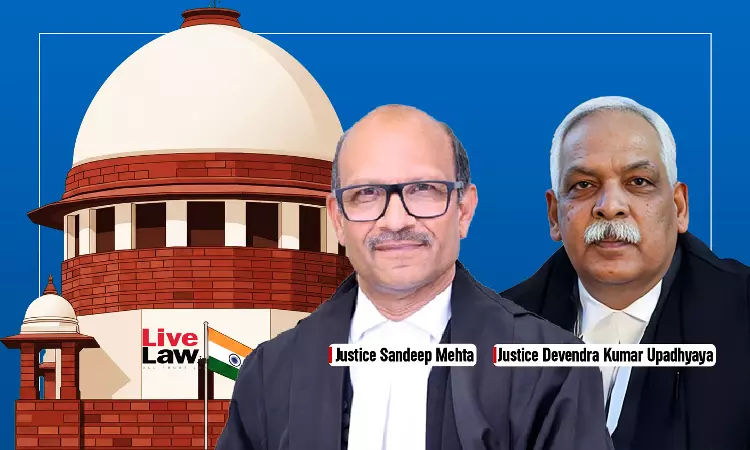
“…we feel that the adverse observations and the strictures recorded by the High Court against the appellant-Judicial Officer were uncalled for and avoidable.”, observed a bench of Justice Sandeep Mehta and Justice Devendra Kumar Upadhyaya, while allowing the plea filed by a POCSO Special Judge posted in Jhunjhunu District, Rajasthan seeking an expungement of the adverse remarks and strictures recorded by the High Court on judicial side.
After finding that some overlapping extracts of evidence/numerical details of the record of evidence from one trial were inadvertently incorporated into the judgment of the other by the Petitioner-Judge, during the course of rendering judgments in the two cases, the High Court made an adverse remark against the Petitioner that she is not devoting time to write a judgment, but is depending upon a Stenographer. Further, the High Court went on to record that because the petitioner was shirking her responsibility, therefore not entitled to remain in service of Judiciary.


Also, the High Court asked the In-charge of the Rajasthan Judicial Academy to impart training to the Presiding Officer about judgment writing, and directed to copy of its order to a part of her ACR for year 2024.
Aggrieved, the Judge moved the Supreme Court seeking expungement of the adverse remarks passed against her on judicial side without affording her an opportunity of hearing.
Before the Supreme Court, the errors in the judgment, including the incorrect serial numbers of the prosecution witnesses, were explained by the Judicial Officer as bona fide typographical errors which, according to her, neither altered nor affected the outcome or substance of the judgment. Regarding the overlapping facts that came to be recorded in the judgment, the Judicial Officer afforded an explanation that both cases were intricately intermingled and interwoven with each other, as the witnesses in both the cases and the substantive evidence were almost the same. Moreover, she stated that due to limited resources available, and her stenographer being on leave, there occured an inadvertent error.
Finding credence in her explanation, the judgment authored by Justice Mehta called the High Court's remarks uncalled for, as being a guardian of judicial officers of the State, recording “such adverse remarks may have the deleterious effect of destroying the Judicial Officer's career and may also have a chilling effect on the entire district judiciary.”
“These disparaging remarks and the strictures were recorded on the judicial side, without affording an opportunity to the appellant-Judicial Officer to show cause or to place her explanation on record before such observations and strictures were made, and hence, suffer from the vice of nonadherence to the principles of natural justice.”, the Court said.
The Court advised the High Court to exercise their powers with greater magnanimity.
“…we are of the opinion that it was a fit case wherein the High Court, while exercising the power of superintendence, should have acted with greater magnanimity and in the true spirit of its role under Article 227 of the Constitution of India as guardian of the officers in the district judiciary…To castigate a Judicial Officer for inadvertent typographical errors in a judgment, which did not, in any manner, affect the outcome of the case was avoidable.”, the court said.
“In this background, we are unable to subscribe to the view taken by the High Court that the appellant-Judicial Officer was acting in dereliction of her duties while rendering the judgment dated 20th January, 2024.”, the Court held.
“As a consequence, the strictures and adverse remarks recorded against the appellant-Judicial Officer in paragraphs 9, 10, and 11 (supra) of the impugned order dated 1st May, 2025, as well as the directions in paragraphs 17 and 18 (supra) regarding training and placement in her ACR, cannot be sustained and was expunged and set aside.”, the Court ordered, directing the transmission of the order copy to the Registrar General, High Court of Judicature for Rajasthan, for being placed before the Hon'ble Chief Justice of the High Court.
Appearance:
For Petitioner(s) Mr. Gagan Gupta, Sr. Adv. Mr. Javed Khan, Adv. Ms. Vanya Gupta, AOR Mr. Saurabh Gupta, Adv. Mr. Shivendra Singh, Adv.
For Respondent(s) Mr. Saurabh Rajpal, AOR Mr. Vinay Kumar Singh, Adv.