



- Home
- /
- Supreme court
- /
- Insurer Not Liable For Risk Beyond...
Insurer Not Liable For Risk Beyond Sum Assured Unless Premium Paid In Advance: Supreme Court
Saima Anjum
18 Aug 2026 7:39 PM IST
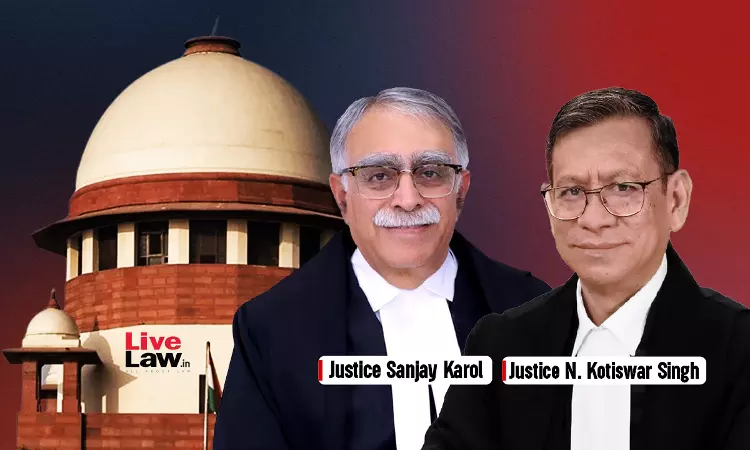
The Supreme Court on Tuesday (18.08.2026) has held that an insurer cannot be held liable for a loss occurring at a time when the insured's turnover had already exceeded the sum insured under a Marine Cargo Annual Turnover Policy, and premium for the enhanced turnover had not been paid in advance. The decision was made in view of the bar of Section 64VB of the Insurance Act, 1938.A bench of...
This is a premium content
Available exclusively to
Our subscribers
Subscribe Premium 
INR 1099+GST
Your support helps us to bring you more content at
an affordable subscription scheme !!!
All payment options available
The Supreme Court on Tuesday (18.08.2026) has held that an insurer cannot be held liable for a loss occurring at a time when the insured's turnover had already exceeded the sum insured under a Marine Cargo Annual Turnover Policy, and premium for the enhanced turnover had not been paid in advance. The decision was made in view of the bar of Section 64VB of the Insurance Act, 1938.
A bench of Justice Sanjay Karol and Justice Nongmeikapam Kotiswar Singh allowed the appeals filed by the New India Assurance Company against the judgment of the National Consumer Disputes Redressal Commission (NCDRC), wherein the Commission had directed the appellant to pay the amount assessed by its own surveyor towards a fire loss claim.
The respondent had availed a Marine Cargo Annual Turnover Policy from the appellant for an expected turnover of Rs 1200 Crores, with premium payable in two equal instalments. A fire broke out at a Container Freight Station where the respondent had stored 41,481 cotton bales. Appellant's own surveyor had assessed the loss to be of Rs. 22,01,29,271.
However, the respondent's turnover had crossed the insured amount of Rs 1200 Crore, and stood at Rs 1724.12 Crores on the date of fire. No additional premium had been paid at that stage. More than a month after the fire incident, the respondent paid an additional premium of Rs 86,86,125; following an email sent by a Relationship Manager of the appellant seeking release of “another instalment based on the current turnover” to “regularise the turnover”. The claim was later repudiated by the appellant.
The NCDRC had ruled in favour of the respondent, relying on the email sent by the Divisional Manager of the appellant, which stated that after payment of second instalment, “all the transits are covered till the expiry of policy even if it crosses Rs 1200 crores.” As per the NCDRC, this assurance meant that the coverage continued irrespective of turnover exceeding the insured sum.
The bench delivered the judgment separately, yet, concurringly. Justice Sanjay Karol held that Section 64VB of the Insurance Act creates “a statutory embargo on an insurer assuming risk if the premium has not been paid to them, either prior to such assumption or within the stipulated time period in which it is guaranteed to be paid.” He further held that under Section 64VB(2), “the risk cannot be assumed earlier than the date on which the premium has been paid.”
Justice Karol also held that Section 64VB was squarely attracted, since the turnover-linked sum insured of Rs 1200 Crores was exhausted well before the fire incident, and it was “incumbent upon the respondent, in view of the clear stipulation under Section 64VB, to either extend the coverage by paying the amount based on estimated turnover or at least guaranteeing to pay the same within a particular time period.”
The appellant submitted the 2006 internal guidelines issued by the company which expressly stated that “premium adjustment to be done only downwards, in view of the provisions of Section 64VB.” On this, Justice Karol observed that, “while it is a settled position of law that a principal is liable for the actions of its agents, it is also trite that the same should be done in accordance with the rules and regulations of the principal or, in other words, in the regular course of duty by the agent. It can only be expected, and reasonably so, by the appellants that its agent would be cognizant of the directives issued by it. In that view of the matter, no occasion arose for the Divisional Manager of the appellants to assure the respondent of extension of coverage.”
Referring to Harshad J Shah v LIC of India, Justice Karol observed that an agent's authority “need not be expressed and it may be implied from circumstances”, but held that in view of the company's 2006 guidelines, “the circumstances do not permit such authority.”
The respondent contended the application of estoppel in the facts of the case. Justice Karol, however, rejected the contention, holding that “if an insurer does a particular act for their own convenience, such as taking the premium in instalments, they cannot hide behind Section 64VB” The doctrine of estoppel, though recognised in Shyam Telelink Ltd v Union of India, “cannot apply against or in contravention of a statute”, it was held.
In another concurring judgment, Justice Nongmeikapam Kotiswar Singh examined the law of agency under the Indian Contract Act, 1872 in detail. Analysing the relevant provisions of the Act, he observed that “the authority attached to an agent extends to acts which are necessary, usual and lawful in the conduct of the authorised business and it does not extend merely because the act relates generally to the employer's business.” He further observed that a Divisional Manager “may ordinarily communicate with the insured, explain the policy and call for premium, but that does not establish authority to create a new risk, enlarge the sum insured or enlarge the scope of liability of the insurer or dispense with a statutory precondition for attachment of risk.”
Justice Singh distinguished between actual and apparent authority as “apparent authority proceeds from the principal's manifestation to the third party,” and that “agent cannot create such authority by his own assertion.”
On the question of ratification under Section 196 of the Contract Act, Justice Singh held that the endorsement enhancing the sum insured was “inconsistent with an intention to ratify, retrospectively, an assurance that additional cover had already been attached” before the fire incident. “Ratification may cure an absence of authority, but it cannot be employed to defeat a mandatory statutory requirement governing the assumption of insurance risk”, it was observed.
“The principle qui facit per alium facit per se applies to acts within the agent's authority, however, it does not enable an agent to confer upon the Principal a liability which the agent was neither authorised nor legally competent to assume on its behalf”, Justice Singh held.
Holding that NCDRC had erred in relying on the Divisional Manager's email to fasten liability on the insurer beyond the sum for which premium stood paid, the bench allowed both appeals, setting aside the NCDRC's judgment that directed payment of the surveyor-assessed claim amount.
Case Title: The New India Assurance Company Limited & Ors. v M/S Louis Dreyfus Commodities India Pvt. Ltd.
Citation : 2026 LiveLaw (SC) 821
For Appellant: Mr Salil Paul, Adv
For Respondent: Mr Joy Basu, Adv
Click here to read the judgment
Tags


