



- Home
- /
- Supreme court
- /
- Interest Accumulated In Suspense...
Interest Accumulated In Suspense Account After NPA Classification Remains Recoverable As Part Of "Debt" : Supreme Court
Yash Mittal
12 Aug 2026 7:34 PM IST
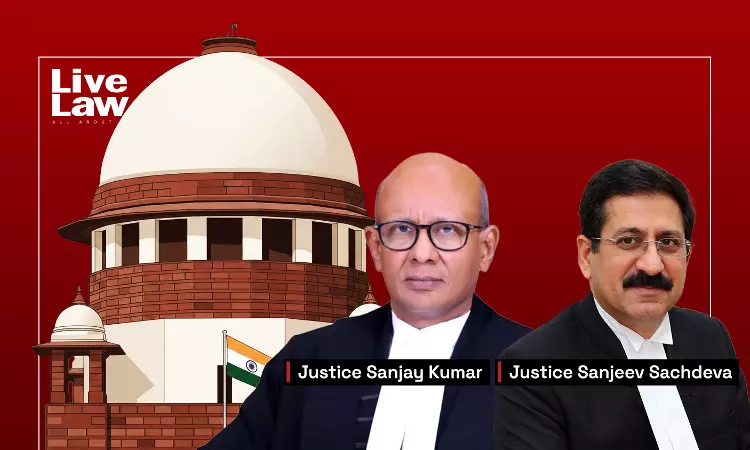
The Supreme Court on Wednesday (August 12) held that an interest accumulated in a separate suspense account, pursuant to the declaration of the debtor's account as a Non-Performing Asset, can be recovered by the banks as the same continues to form part of the “debt” due from the borrower and cannot be ignored while calculating outstanding dues. “PNB is entitled to claim the interest...
This is a premium content
Available exclusively to
Our subscribers
Subscribe Premium 
INR 1099+GST
Your support helps us to bring you more content at
an affordable subscription scheme !!!
All payment options available
The Supreme Court on Wednesday (August 12) held that an interest accumulated in a separate suspense account, pursuant to the declaration of the debtor's account as a Non-Performing Asset, can be recovered by the banks as the same continues to form part of the “debt” due from the borrower and cannot be ignored while calculating outstanding dues.
“PNB is entitled to claim the interest due, which was calculated and maintained in a separate suspense account, in addition to the outstanding principal loan amount…”, observed a bench of Justice Sanjay Kumar and Justice Sanjeev Sachdeva, while allowing the Punjab National Bank's appeal against the Orissa High Court's judgment which denied interest to the bank maintained in the suspense account for the interest due on the outstanding loan amount.
The dispute arose from a ₹5 crore loan sanctioned in 2011 by United Bank of India (now merged with PNB) to the Respondent for construction of a college building.
After the account was classified as an NPA, the bank initiated recovery proceedings before the Debts Recovery Tribunal (DRT). While the DRT substantially reduced the amount recoverable by the bank, the DRAT later recalculated the dues at ₹54.90 lakh along with interest maintained in the suspense account.
However, the Orissa High Court relied upon a certificate issued by PNB in December 2020 that reflected an outstanding amount of around ₹31.99 lakh and directed the bank to accept ₹29.55 lakh as full settlement of the account.
PNB challenged the High Court's orders before the Supreme Court.
Setting aside the impugned judgment, the judgment authored by Justice Sanjay Kumar restored the tribunal's decision, noting that the High Cour erred in overlooking the interest component that had been transferred to a suspense account after the loan became an NPA.
“Oversimplification of calculation by the High Court with respect to the amount payable, ignoring the existence of the suspense account for the interest component since the date of classification of the loan account as a non-performing asset, and giving effect only to the figure mentioned in the PNB's certificate dated 24.12.2020, viz., ₹31,99,000/-, thereby accepting the plea of the Trust that the sum of ₹2,43,321.98 paisa paid by it needed to be deducted therefrom reducing its dues to ₹29,55,678.02 paisa, is therefore clearly unsustainable. The Trust and its trustees cannot blithely ignore the accounting system followed by banks and come up with different calculations at different points of time to suit their own interests.”, the Court observed.
The Court stressed that the mere fact that such interest no longer appears in the regular loan account statement does not mean it ceases to be payable.
Referring to Section 2(g) of the Recovery of Debts and Bankruptcy Act, 1993, the Court emphasized that the statutory definition of “debt” expressly includes interest.
The Court observed that once interest is legally chargeable under the loan agreement and banking regulations, it cannot be excluded merely because it is maintained in a separate accounting head.
“Section 2(g) of the Act of 1993 defines 'debt' to mean, amongst other things, any liability (inclusive of interest) which is claimed as due from any person by a bank or a financial institution. Therefore, there can be no dispute as to the interest component being part of the debt due to PNB.”, the Court said.
Resultantly, the appeal was allowed.
Headnote
Recovery of Debts and Bankruptcy Act, 1993 – Sections 2(g) & 19(20) – Banking Regulation Act, 1949 – Section 21A – Recovery of Dues – Calculation of Dues Post NPA Classification – Interest Maintained in Suspense Account – High Court's Simplification of Dues Setting Aside DRAT Order Unsustainable - Definition of Debt & Inclusion of Interest - Under Section 2(g) of the Act of 1993, 'debt' includes any liability inclusive of interest claimed as due by a bank - Section 19(20) empowers the DRT to pass orders for payment of interest up to the date of realisation, and Section 21A of the Banking Regulation Act, 1949 bars courts from reopening transactions on the ground of excessive interest. [Para 12]
Banking Accounting Practice for NPAs & Suspense Account - Capitalisation of Interest & Directives - As per applicable accounting guidelines, once a loan account is classified as an NPA, the bank applies interest only up to the NPA date in the main loan statement and thereafter maintains a separate suspense account for interest due on the outstanding loan amount - A balance certificate reflecting only the outstanding amount in the primary loan account cannot be misconstrued to wipe out the accrued interest maintained in the separate suspense account - Reaffirming the law settled by the Constitution Bench, banks are entitled to charge interest on periodical rests and capitalise unpaid interest in accordance with RBI directives and voluntary contracts - The borrower cannot present self-serving, inconsistent account statements by selectively ignoring the interest component/suspense account – Held - The High Court committed an oversimplification of calculations by relying solely on a balance certificate while completely ignoring the interest component kept in the suspense account post-NPA classification - The High Court's orders directing full and final settlement on a reduced amount set aside, and the order of the DRAT Kolkata determining the liability at ₹54,90,413/- with pendente lite and future simple interest @ 9% p.a. restored. [Relied on Central Bank of India v. Ravindra and others, (2002) 1 SCC 367; Union of India v. Association of Unified Telecom Service Providers of India and others, (2020) 3 SCC 525; Paras 10 -15]
Cause Title: Punjab National Bank versus M/s. Shree Jyoti Education and Management Trust World and others
Citation : 2026 LiveLaw (SC) 796
Click here to download judgment
Appearance:
For Petitioner(s) Ms. Ekta Choudhary, AOR Ms. Rushali Sikand, Adv. Mr. Gaurav Grover, Adv.
For Respondent(s) Mr. Bharat Sangal, Sr. Adv. Ms. Snigdha Dash, Adv. Mr. Hemant Tripathi, Adv. Ms. Shreya Kasera, Adv. Mr. Sahil Tagotra, AOR

Yash Mittal
Yash Mittal is a Correspondent with LiveLaw, covering the Supreme Court of India

