



- Home
- /
- Supreme court
- /
- Judicial Interference In Tender...
Judicial Interference In Tender Process At Advanced Stage Not Warranted, Challenge Must Be Prompt : Supreme Court
Yash Mittal
19 Aug 2026 11:49 AM IST
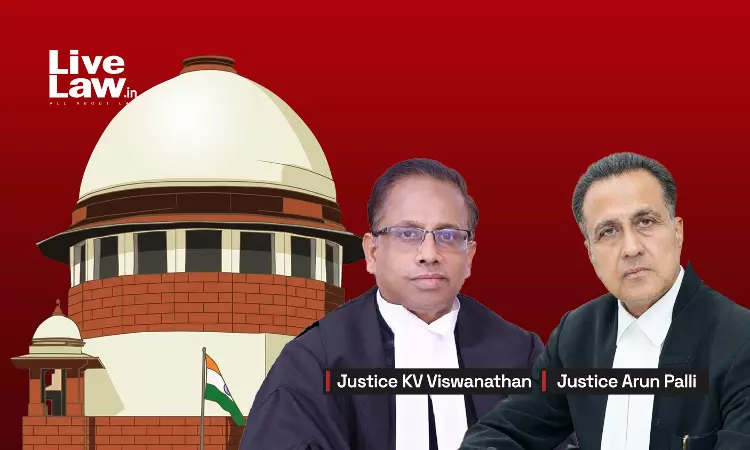
Fence-sitters and unscrupulous litigants cannot disrupt ongoing tender process, the court said.
The Supreme Court on Tuesday (August 18) ruled against judicial interference in public procurement tenders at an advanced stage, noting that a belated challenge to tender conditions, after significant developments had taken place in the evaluation process, would be unfair and unjust to otherwise eligible bidders. A bench of Justice KV Viswanathan and Justice Arun Palli dismissed...
This is a premium content
Available exclusively to
Our subscribers
Subscribe Premium 
INR 1099+GST
Your support helps us to bring you more content at
an affordable subscription scheme !!!
All payment options available
The Supreme Court on Tuesday (August 18) ruled against judicial interference in public procurement tenders at an advanced stage, noting that a belated challenge to tender conditions, after significant developments had taken place in the evaluation process, would be unfair and unjust to otherwise eligible bidders.
A bench of Justice KV Viswanathan and Justice Arun Palli dismissed appeals challenging tender conditions for procurement of sports goods and outdoor gymnasium equipment for government schools in Delhi, noting that the process had substantially advanced and third-party rights had crystallized.
“Judicial discretion, therefore, must be exercised with extreme circumspection to ensure that fence–sitters, proxies, and unscrupulous litigants who bring a challenge at an advanced stage, are not allowed to disrupt an ongoing process.”, the Court observed.
Noting that despite the Appellants having a notice of the tender conditions from the inception of the tendering process, chose to remain silent for four months, before challenging the tender conditions on the grounds of being excessive, exclusionary and arbitrary before the High Court. When the challenge to the tender was made, substantial development took place, including the crystallisation of a third-party rights, which the Court found to be prejudicing the rights of the successful bidders.
The court noted that the Sports Equipment Tenders were floated on December 22, 2025, with the bidding deadline being January 13, 2026. However, the writ petition challenging the tender conditions was filed only on April 1, 2026, about four months after publication. By then, one of the six sports equipment tenders had already been awarded, while the remaining tenders had moved through document verification and physical demonstration stages and had reached financial evaluation by the time of the Supreme Court's consideration.
“Tender schedules operate within compressed and purpose – bound timelines. Four months may appear modest when viewed merely as a measure of calendar time. In the life of a tender, however, it may mark the distance between invitation and evaluation, between evaluation and selection, and between an open field and the crystallization of competing interests. Delay in such matters is therefore not assessed by counting days alone. It must be assessed by reference to what has occurred during those days, whose interests have arisen, and what public consequences would follow from unsettling the process at that stage.”, the judgment authored by Justice Palli observed.
Tendering process cannot be stalled at the verge of final evaluation of the price bids
“Those who participated in the tendering process, met every single condition/eligibility criterion, and went through a rigorous evaluation of their technical bids were declared responsive/compliant. Such entities, at the verge of final evaluation of their price bids, too have acquired certain rights and interests. Therefore, to stall the process and afford any judicial indulgence to the Appellants, who approached the High Court at their own convenience, would be unfair. Rather unjust.”, the Court said.
The court further held that a challenge to an eligibility condition accrues on the very day the condition is published. A bidder who considers itself excluded or rendered ineligible by an allegedly arbitrary condition must raise the grievance at the earliest opportunity.
The Supreme Court also attached particular significance to the public purpose behind the tenders. The procurement involved sports and gym equipment worth around ₹34 crore, intended for approximately 16 lakh school students. A substantial portion of the procurement had come to a standstill because of the litigation, the court noted.
The bidders had particularly challenged a condition requiring sports equipment suppliers to maintain a fully functional office in Delhi and a warehouse in Delhi/Delhi-NCR for the previous three years.
The clause stated that the requirement was imposed because the department might require equipment to be supplied at short notice.
The appellants argued that the condition was exclusionary and relied on the Supreme Court's 2025 decision in Vinishma Technologies Pvt. Ltd. v. State of Chhattisgarh, where a tender condition requiring prior supply experience specifically to State government agencies in Chhattisgarh had been held arbitrary and discriminatory.
The Supreme Court, however, distinguished that decision. It noted that the Delhi condition was presented as an operational requirement, intended to ensure prompt installation, inspection, servicing, maintenance and replacement of equipment, particularly because delays concerning defects or safety could affect schoolchildren.
As a result, the appeals were dismissed.
“…the Appellants' case is bereft of any merit, it is for this belated challenge, portraying a lack of bona fide that we are dissuaded from examining the assailed clauses, rendering any findings on the same, and hence lie on the same page as the High Court.”, the Court held.
Headnote
Government Contracts and Public Tenders – Challenge to Eligibility Conditions – Delay and Laches – Cause of Action – Stage of Intervention – Judicial Review under Article 226/136 - A facial challenge to a tender condition or eligibility criterion—as distinguished from a challenge to bid evaluation or disqualification accrues on the very day the tender condition is published, as nothing further remains to be discovered - An entity finding itself ineligible or excluded by an allegedly arbitrary clause must approach the Court at the earliest - Delay in public procurement tenders is measured not merely by calendar days or the statutory limitation period, but against the progression of the procurement process itself - Where tenderers consciously delay approaching the court until the tender process has advanced substantially, third-party rights have intervened, or public interest would be prejudiced, relief is liable to be refused on the sole ground of delay and laches. Non judicial representations and legal notices do not arrest delay or cure a lack of diligence. [Paras 19 - 26]
Public Procurement – Nature of Tender Timelines – Equitable Considerations and Third-Party Rights - Tender schedules operate within compressed, purpose-bound timelines where even a period of four months marks a significant progression from invitation to evaluation and final selection - Bidders who comply with all tender conditions and successfully clear rigorous technical evaluations acquire legitimate rights and interests as their price bids reach final evaluation - Permitting fence sitters, non-participants, and belated challengers to derail an ongoing public procurement process at an advanced stage is inequitable and unjust - Courts must exercise extreme circumspection to prevent disruption of tenders affecting large scale public interest—such as the supply of sports and gymnasium equipment to over 16 lakh school children. [Paras 19 - 27]
Tender Conditions – Territorial/Operational Nexus vs. Discriminatory Past Local Supply Conditions – Distinction from State-Confined Supply Criteria - Distinguishing Vinishma Technologies Pvt. Ltd. v. State of Chhattisgarh & Anr., which invalidated a past performance condition restricting eligibility solely to bidders with past supply experience inside that particular State as arbitrary and discriminatory - A tender stipulation requiring a functional office in Delhi and a warehouse in Delhi/NCR for the last three years (Clause 2.17) serves an operational rather than a geographical purpose, designed to ensure prompt delivery, inspection, servicing, maintenance, and replacement of bulk sports equipment at short notice for government school children. The ruling in Vinishma Technologies does not have a decisive bearing on an operational infrastructure clause; however, due to the belated nature of the challenge and lack of bona fides, the substantive validity of Clause 2.17 was left open for adjudication in an appropriate proceeding. [Distinguished from Vinishma Technologies Pvt. Ltd. v. State of Chhattisgarh & Anr. (2025 INSC 1182); Paras 28 - 35]
Cause Title: M/S. UTKARSH ENTERPRISES & ORS. VERSUS UNION OF INDIA & ORS.
Citation : 2026 LiveLaw (SC) 825
Click here to download judgment
Appearance:
For Petitioner(s) Mr. Raju Ramachandran, Sr. Adv. Mr. Ejaz Maqbool, AOR Ms. Aanchal Basur, Adv. Ms. Shruti Narayan, Adv. Mr. Zain Maqbool, Adv. Ms. Raji Gururaj, Adv. Ms. Nida Khan Salim, Adv. Mr. Meeran Maqbool, Adv. Mr. Saif Zia, Adv.
For Respondent(s) Ms. Swati Ghildiyal, AOR Ms. Sonakshi Sinha, Adv. Ms. Shweta Bharti, Adv. Ms. Tejaswini Chandrasekhar, Adv. Mr. Jatin Chaddha, Adv. Mr. Abhinav Agrawal, AOR Mr. Piyush Bhardwaj, Adv. Mr. Shivam Sengupta, Adv.
Tags

Yash Mittal
Yash Mittal is a Correspondent with LiveLaw, covering the Supreme Court of India

