



- Home
- /
- Supreme court
- /
- 'Last Seen' Theory Alone Can't...
'Last Seen' Theory Alone Can't Sustain Conviction Without Corroborative Evidence : Supreme Court Acquits Murder Accused
Yash Mittal
19 Dec 2025 12:23 PM IST
The Supreme Court set aside an individual's conviction for murder, holding that a prosecution case resting entirely on circumstantial evidence cannot be sustained solely on the “last seen” theory in the absence of other corroborative evidence. “The present is a case where except for the evidence of last seen together, there is no other corroborative evidence against the...
This is a premium content
Available exclusively to
Our subscribers
Subscribe Premium 
INR 1099+GST
Your support helps us to bring you more content at
an affordable subscription scheme !!!
All payment options available
The Supreme Court set aside an individual's conviction for murder, holding that a prosecution case resting entirely on circumstantial evidence cannot be sustained solely on the “last seen” theory in the absence of other corroborative evidence.
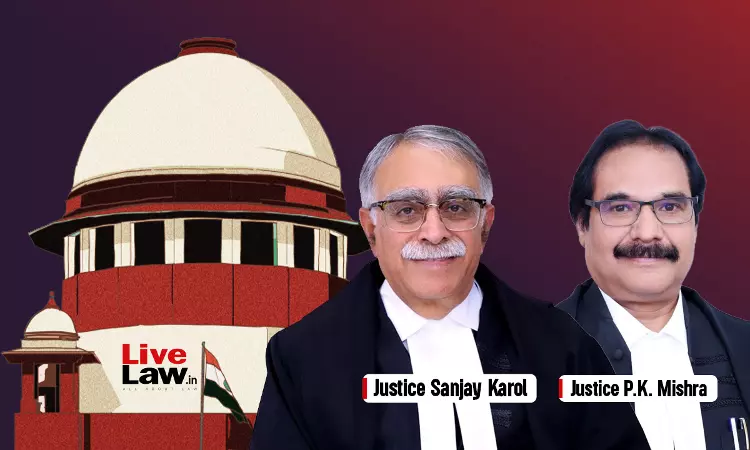
“The present is a case where except for the evidence of last seen together, there is no other corroborative evidence against the appellant. Therefore, the conviction only on the basis of last seen together cannot be sustained.”, observed a bench of Justices Sanjay Karol and Prashant Kumar Mishra, while allowing the convicts' appeal.
The case pertained to the brutal murder, where the deceased body was found with multiple injuries, including ligature marks and severe burns. The prosecution's case rested entirely on circumstantial evidence—specifically, the alleged motive (theft of a tractor for money) and the "last seen" theory.
Witnesses had testified that on the evening of June 6, 2004, the appellant and a co-accused were last seen taking the deceased on a motorcycle. The deceased was never seen alive again. The Trial Court convicted the appellant, and the High Court affirmed it, primarily relying on this "last seen" circumstance and the appellant's failure to explain when he parted company with the deceased.
Setting aside the Chhattisgarh High Court's decision to convict the Appellant solely on his last-seen account with the deceased, the judgment authored by Justice Mishra referencing Kanhaiya Lal vs. State of Rajasthan, (2014) 4 SCC 715 said “a conviction cannot be recorded against the accused merely on the ground that the accused was last seen with the deceased.", adding that the Courts below erred in putting entire burden of proof upon the Appellant under Section 106 Evidence Act, when the prosecution has not discharged its initial burden of proof to successfully the chain of events linking accused to crime, where a reasonable inference was made out against the accused.
“(Section 106) it comes into operation only in situations where the prosecution has already established a reasonable inference against the accused.” the court said.
“we are of the opinion that the nature of circumstantial evidence available against the appellant though raises a doubt that he may have committed the offence but the same is not so conclusive that he can be convicted only on the evidence of the last seen together. Be that as it may. It is a settled proposition that whenever any doubt emanates in the mind of the Court, the benefit shall accrue to the accused and not the prosecution. The present is a case where except for the evidence of last seen together, there is no other corroborative evidence against the appellant. Therefore, the conviction only on the basis of last seen together cannot be sustained.”, the court held.
Accordingly, the appeal was allowed.
Cause Title: MANOJ @ MUNNA VERSUS THE STATE OF CHHATTISGARH
Citation : 2025 LiveLaw (SC) 1230
Click here to download judgment
Appearance:
For Appellant(s) : Mr. Md. Farman, AOR Mr. Salman Khan, Adv.
For Respondent(s) :Mr. Praneet Pranav, D.A.G. Mr. Vinayak Sharma, Adv. Mr. Ravinder Kumar Yadav, AOR

Yash Mittal
Yash Mittal is a Correspondent with LiveLaw, covering the Supreme Court of India

