



- Home
- /
- Supreme court
- /
- Law Student Not Expected To Know...
Law Student Not Expected To Know Better When Judges Themselves Give Different Answers : Supreme Court Grants Relief In Law Officer Exam
LIVELAW NEWS NETWORK
18 March 2026 8:25 AM IST
The ambiguity in the correct answer to an exam question used to recruit a Law Officer led the Supreme Court to accept the competing claims of two candidates. The Court granted relief to both candidates by directing that both of them be accommodated by creating a supernumerary post.The issue was with respect to the exam conducted by the Chandigarh Municipal Corporation in 2021 for one post of...
This is a premium content
Available exclusively to
Our subscribers
Subscribe Premium 
INR 1099+GST
Your support helps us to bring you more content at
an affordable subscription scheme !!!
All payment options available
The ambiguity in the correct answer to an exam question used to recruit a Law Officer led the Supreme Court to accept the competing claims of two candidates. The Court granted relief to both candidates by directing that both of them be accommodated by creating a supernumerary post.
The issue was with respect to the exam conducted by the Chandigarh Municipal Corporation in 2021 for one post of Law Officer. One Charan Preet Singh was selected. His appointment was challenged by another candidate, Amit Kumar Sharma, on the ground that he was wrongly given a negative mark. The Punjab and Haryana High Court, in 2022, accepted the claim of Sharma. Singh therefore appealed to the Supreme Court.
“Which of the following Schedule of the Constitution is immune from judicial review on the grounds of violation of fundamental rights?”
The options provided were:
A) Seventh Schedule
B) Ninth Schedule
C) Tenth Schedule
D) None of the above."
The recruiting authority treated option B, “Ninth Schedule”, as the correct answer. Sharma, however, marked option D, “None of the above”, contending that in light of constitutional jurisprudence, no Schedule enjoys absolute immunity from judicial review. Sharma was therefore given negative mark.
The Single Judge of the High Court upheld the answer key and dismissed Sharma's writ petition. The Single Judge reasoned that Article 31B continues to provide immunity to laws placed in the Ninth Schedule from challenge on the ground of violation of fundamental rights. Relying on precedents such as Shankari Prasad, Sajjan Singh, and the post-Kesavananda Bharati position, the Single Judge held that the Ninth Schedule retains such immunity, albeit subject to limited scrutiny under the basic structure doctrine. On this reasoning, option B was held to be correct.
However, in appeal, the Division Bench of the High Court took a different view. Referring to I.R. Coelho v. State of Tamil Nadu, it held that the immunity of the Ninth Schedule is not absolute and that laws placed therein remain open to judicial review if they violate the basic structure of the Constitution. The Division Bench emphasised that it would be incorrect to state in categorical terms that any Schedule is immune from judicial review merely on the ground of violation of fundamental rights. It therefore held that Sharma's answer, “None of the above”, was legally correct and directed revision of his marks, which led to the displacement of the selected candidate.
The Supreme Court noted that the issue was complex and the answers of the recuriting authority and Sharma cannot be treated as wholly incorrect. The Supreme Court noted that both the Single Judge and the Division Bench had examined a long line of constitutional decisions, including Shankari Prasad, Sajjan Singh, Golak Nath, Kesavananda Bharati, and I.R. Coelho, yet reached different conclusions on the same question.
In this context, the Court observed that when judges themselves differ on the correct answer to such a complex constitutional question, it would be unreasonable to expect law graduates appearing in a competitive examination to arrive at a definitive conclusion. The Court held that “from a law graduate's point of view, both the answers may be correct”.
The bench further noted that while option B (Ninth Schedule) may appear more appropriate based on the plain language of the question, a deeper analysis of constitutional jurisprudence supports the view that no Schedule is absolutely immune from judicial review, thereby making option D also a valid answer.
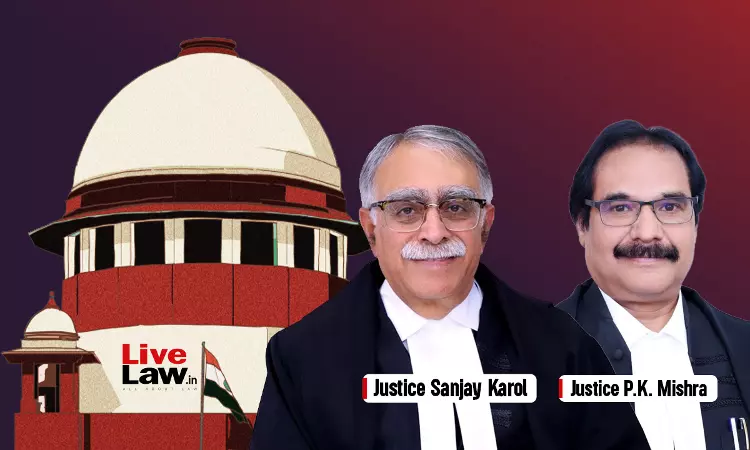
A bench comprising Justice Sanjay Karol and Justice Prashant Kumar Mishra observed :
"When the Judges of the High Court are at variance in their opinion as to the correct answer to Question No.73, it is least expected from mere law graduates, who are competing for a post of Law Officer in the Municipal Corporation, to reach to a correct conclusion while answering the multiple-choice question by process of interpretation of Constitutional provisions involving this Court's judgments in several decades. Thus, we are of the considered view that both the candidates deserve to be accommodated. From a law graduate's point of view, both the answers may be correct, although Option 'B' (Ninth Schedule) appears to be more appropriate considering the language of the question asked. However, on a deeper analysis of this Court's judgments mentioned above, Option 'D' (None of the above) can also be considered to be correct as has been held by the Division Bench."
Adopting an equitable approach, the Court directed the Municipal Corporation, Chandigarh, to accommodate both candidates by creating a supernumerary post and appointing Sharma without disturbing the appointment of the appellant. It also clarified that the appellant, who had already joined service, would retain his seniority.
Headnote
Service Law – Recruitment – Judicial Review of Answer Keys – Ambiguity in Multiple Choice Questions (MCQs) – Selection for the post of Law Officer – Dispute over the correct answer to a question regarding the immunity of the Ninth Schedule of the Constitution from judicial review – Recruiting body considered "Ninth Schedule" (Option B) as correct, while the respondent claimed "None of the above" (Option D) was correct based on the 'Basic Structure' doctrine – Held: When High Court Judges themselves hold divergent views on the interpretation of Constitutional provisions and Supreme Court precedents spanning decades, law graduates appearing for a recruitment exam cannot be expected to reach a singular "correct" conclusion by such complex interpretation – Both candidates found to be deserving of accommodation as both answers could be considered correct from different perspectives.
Equitable Relief – Creation of Supernumerary Post – To balance the equities between a candidate already in service (Appellant) and a deserving candidate deprived of selection due to a contested answer (Respondent No. 3), Supreme Court directed the creation of a supernumerary post – Appellant to retain seniority over the new appointee. [Relied on Vikas Pratap Singh and Others vs. State of Chhattisgarh and Others (2013) 14 SCC 494; Paras 7 - 11]
Case : Charan Preet Singh v Municipal Corporation Chandigarh and another
Citation : 2026 LiveLaw (SC) 253


