



- Home
- /
- Supreme court
- /
- Litigant Cannot Be Worse Off For...
Litigant Cannot Be Worse Off For Filing An Appeal : Supreme Court Explains Doctrine Of 'No Reformatio In Peius'
Saima Anjum
2 Sept 2026 11:05 AM IST
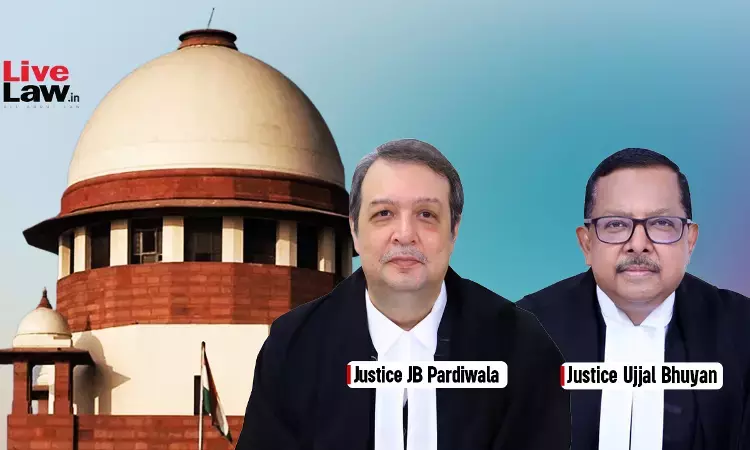
The Supreme Court on Tuesday (01.09.2026) has reiterated the principle that a litigant cannot be placed in a worse position merely for having availed a remedy provided under law. It also held that the penalty enhanced against an appellant on remand, after the appellant's own appeal led to the remand, could not be sustained.The bench of Justice JB Pardiwala and Justice Ujjal Bhuyan ruled so...
This is a premium content
Available exclusively to
Our subscribers
Subscribe Premium 
INR 1099+GST
Your support helps us to bring you more content at
an affordable subscription scheme !!!
All payment options available
The Supreme Court on Tuesday (01.09.2026) has reiterated the principle that a litigant cannot be placed in a worse position merely for having availed a remedy provided under law. It also held that the penalty enhanced against an appellant on remand, after the appellant's own appeal led to the remand, could not be sustained.
The bench of Justice JB Pardiwala and Justice Ujjal Bhuyan ruled so while dealing with an appeal by Saudi Arabian Airlines, which had challenged a penalty imposed under Section 38(3) of the Finance Act, 1979 for delayed deposit of Foreign Travel Tax (FTT). While allowing the appeal primarily on the interpretation of Section 38(3), the Court also discussed the doctrine against reformatio in peius (a change for the worse) after noting how the penalty was enhanced manifold once the appellant chose to pursue statutory remedies.
The airline (appellant) was authorised to collect FTT from passengers on international journeys, under Section 35 of the Finance Act, 1979. It had delayed depositing the tax into the government treasury six times between 1994 and 1997. In five of these cases, demand drafts had already been purchased before the due dates, but could not be deposited on time; which the airline attributed to security restrictions. The other delay was attributed to the concerned employee being on emergency leave.
In the original order-in-original, the adjudicating authority had imposed a penalty of Rs. 12,000 on the airline for the six instances of delayed deposit of FTT. Aggrieved by this, the appellant filed an appeal, which resulted in the matter being remanded for fresh adjudication. On remand, the adjudicating authority passed a de novo order enhancing the penalty to Rs. 71,29,140.
The appellant approached every forum, including the appellate authority, the revisional authority under the Ministry of Finance, and the Bombay High Court contending that the enhancement placed it in a position far worse than if it had never appealed at all. Had the airline simply accepted the original order, its liability would have remained at Rs. 12,000. By exercising its statutory right of appeal, it ended up facing a penalty over 590 times higher.
This contention was rejected at every stage. The appellate authority held that the original penalty of Rs. 12,000 had been erroneous, being less than the statutory minimum prescribed under the Section 38(3), and that this “inadvertent” error had merely been corrected on remand. The revisional authority and the High Court concurred, holding that since the remand was not a limited one, the adjudicating authority was free to re-examine and enhance the penalty in accordance with the statute.
However, the Supreme Court disagreed, holding that all three forums had erred on this aspect. The bench posed the issue that whether a litigant can be worse off by approaching the appellate forum as provided under the law or by approaching a court of law.
Answering this in the negative, the Court relied heavily on the Bombay High Court's earlier decision in Jyoti Plastic Works Pvt. Ltd. v. Union of India, ( authored by Justice Ujjal Bhuyan himself). Referring to it, the bench noted that the maxim reformatio in peius means a change towards the worse, and that in many jurisdictions the practice of a higher forum making a lower order worse for the very party who appealed it is forbidden. The Court observed that the principle, when read as “no reformatio in peius” of “ prohibition of reformatio in peius”, denotes a rule of fair procedure under which using a legal remedy should not aggravate the situation of the person availing it, and that this can be seen as part of natural justice as well as a principle of equality.
The bench also noted that the Bombay High Court in Jyoti Plastic Works had relied on the ruling in Jawal Neco Ltd. v. Commissioner of Customs, affirming that an appellant cannot be worse off by reason of filing an appeal.
The Court also invoked its recent decision in Nagarajan v. State of Tamil Nadu, wherein the principle had been endorsed and applied, holding that no appellant, by filing an appeal, can be placed in a position worse than what existed prior to the filing of the appeal.
Applying the principle, the bench held that the enhancement of penalty from Rs. 12,000 to Rs. 71,29,140 ensued solely because the appellant had exercised its right to appeal, could not be countenanced, regardless of whether the original penalty computation was technically erroneous.
In the light of above, the Court set aside the penalty imposed on the appellant in its entirety, while also setting aside the orders of the Bombay High Court, the revisional authority, the first appellate authority, and the de novo order-in-original, insofar as they related to the six instances of delayed FTT deposit. It also directed a refund of any amount already paid towards the penalty, with interest at 9% per annum, within three months.
The appeal was, thus, allowed.
Case: M/s Saudi Arabian Airlines v Union of India & Ors
Citation : 2026 LiveLaw (SC) 880
Appearance:
For the Appellant(s), Mr. P.V. Dinesh, Senior Advocate, appeared along with Mr. Shankh Sengupta, Mr. Samsuddha Majumdar, Mr. Kartikey Kulshrestha, Mr. Sujoy Sur, Mr. Soham Banerjee, Mr. Shreyash Sharma and Ms. Anna Oommen, Advocates. Mr. Syed Jafar Alam,Advocate-on-Record, also appeared for the Appellant(s).
For the Respondent(s), Mr. Arijit Prasad, Sr Adv, Mr. Udai Khanna, Mr. Sarthak Karol and Ms. Neelakshi Bhaduria, Advocates along with Mr. Gurmeet Singh Makker, Advocate-on-Record, and Mr. B. Sunita Rao,
Tags


