



- Home
- /
- Supreme court
- /
- 'Manifestly Perverse': Supreme...
'Manifestly Perverse': Supreme Court Sets Aside HC Order Granting Bail To Accused Who Allegedly Murdered Witness While On Bail
Yash Mittal
22 Dec 2025 5:30 PM IST
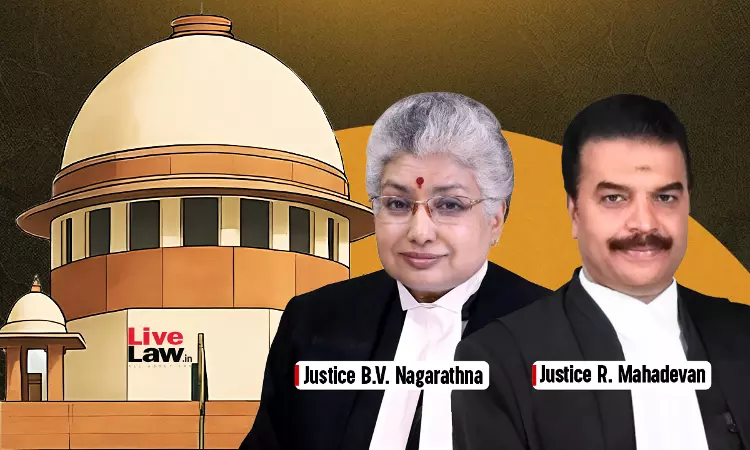
The Supreme Court set aside the Madras High Court's order grant bail to the accused in a murder case, noting that the order granting bail was vitiated by perversity, arbitrariness and non-application of mind.A bench comprising Justices B.V. Nagarathna and R. Mahadevan was hearing an appeal against an order of the Madurai Bench of the High Court, which had granted bail to the accused in an...
This is a premium content
Available exclusively to
Our subscribers
Subscribe Premium 
INR 1099+GST
Your support helps us to bring you more content at
an affordable subscription scheme !!!
All payment options available
The Supreme Court set aside the Madras High Court's order grant bail to the accused in a murder case, noting that the order granting bail was vitiated by perversity, arbitrariness and non-application of mind.
A bench comprising Justices B.V. Nagarathna and R. Mahadevan was hearing an appeal against an order of the Madurai Bench of the High Court, which had granted bail to the accused in an attempt to murder case without considering that they were also accused of murdering a key eyewitness while earlier on bail.
The case arises from an incident dated February 24, 2020, when two Schedule caste persons were allegedly attacked by an unlawful assembly armed with deadly weapons. An FIR was registered under Sections 147, 148, 307, 324 and 323 IPC, along with Section 3(2)(va) of the SC/ST (Prevention of Atrocities) Act. The accused were granted bail in September 2020.
However, while on bail, four of the accused allegedly murdered one of the person leading to registration of a second FIR under Section 302 IPC and allied provisions. Following this, the High Court cancelled the bail in March 2023, and the accused surrendered.
In a surprising turn of events, the Madurai Bench of the Madras High Court granted fresh bail to the accused in the first case and additionally directed a joint trial of both the attempted murder and murder cases. One of the victims, who survived, challenged this order before the Supreme Court.
Victim's Right To Be Heard
One of the principal arguments before the Supreme Court was that the High Court violated Section 15A(5) of the SC/ST (Prevention of Atrocities) Act by failing to meaningfully consider the objections raised by the victim against the grant of bail.
While reiterating that Section 15A(5) confers a mandatory right on victims to be heard in bail proceedings, the Supreme Court clarified that the provision guarantees an opportunity of hearing, not a right to a favourable outcome. The Court noted that in the present case, the victim was aware of the bail proceedings and had raised objections which were recorded by the High Court.
“The grievance is essentially against the manner in which the objections were dealt with, and not against denial of hearing,” the Bench observed, holding that there was no violation of Section 15A(5) as such.
Bail Order Found Perversely Granted
Despite rejecting the argument based on Section 15A(5), the Supreme Court held that the High Court's bail order was liable to be annulled on substantive grounds.
The Court found that a crucial factor was completely ignored by the High Court, namely, that the accused had earlier misused bail and that the bail had been cancelled after the murder of a material witness. This, the Bench said, went to the root of the question of liberty and fair trial.
The Court also faulted the High Court for failing to meaningfully assess the gravity of the offences, including those under Section 307 IPC and the SC/ST Act, the criminal antecedents of the accused, and the serious allegations of witness intimidation and obstruction of judicial proceedings.
Setting aside the impugned order, the judgment authored by Justice Mahadevan observed:
“The impugned judgment passed by the High Court suffers from such fatal infirmities. A determinative factor completely ignored by the High Court is that the respondents / accused were earlier enlarged on bail by the trial Court, and that such bail was subsequently cancelled owing to grave supervening circumstances…The High Court, however, failed even to advert to these aspects, let alone analyse their impact on the entitlement of the respondents / accused to bail. The omission to consider prior cancellation of bail and demonstrated abuse of liberty renders the impugned judgment manifestly perverse.”
“The criminal antecedents of the respondents / accused were expressly placed before the High Court and were recorded in the impugned judgment. However, the High Court failed to draw any conclusion from them or assess their relevance to the likelihood of reoffending, intimidation of witnesses, or obstruction of justice. Recording antecedents without evaluating their impact amounts to an empty formality and does not satisfy the judicial obligation to apply mind to relevant considerations.”, the court added.
“In sum the High Court granted bail to the respondents / accused ignoring prior cancellation of bail and abuse of liberty, failing to consider the death of a material witness and the threat to the fairness of trial, disregarding the gravity and seriousness of the offences, including those under the SC/ST (POA) Act, overlooking criminal antecedents placed on record, and relying on irrelevant considerations such as pendency of civil disputes. Applying the settled principles governing annulment of bail orders, the impugned judgment is vitiated by perversity, arbitrariness, and non-application of mind. Consequently, the judgment of the High Court granting bail to the respondents / accused deserves to be set aside.”, the court concluded.
Accordingly, the order granting was set aside, and the accused were directed to surrender before the jurisdictional trial Court within a period of two weeks from the date of judgment.
Cause Title: LAKSHMANAN VERSUS STATE THROUGH THE DEPUTY SUPERINTENDENT OF POLICE & ORS. ETC.
Citation : 2025 LiveLaw (SC) 1245
Click here to download judgment
Appearance:
For Petitioner(s) : M/S. Ram Sankar & Co, AOR Mr. A Mariarputham, Sr. Adv. Ms. Anuradha Arputham, Adv. Mr. K R Bharathi Kumar, Adv. Mr. Purushothaman, Adv. Dr. Ram Sankar, Adv. Mrs. Harini Ramsankar, Adv.
For Respondent(s) : Mr. Sabarish Subramanian, AOR Ms. Arpitha Anna Mathew, Adv. Mr. Vishnu Unnikrishnan, Adv. Ms. Jahnavi Taneja, Adv. Mr. Veshal Tyagi, Adv. Mr. K.s.badhrinathan, Adv. Mr. Danish Saifi, Adv. Ms. Aashigaa Pravaagini, Adv. Mr. Narender Kumar Verma, AOR Mr. C.R.Jaya Sukin, Adv. Mr. Yashimka Anand, Adv. Mr. Divya Mishra, Adv. Mr. Issac Haiding, Adv. Mr. Suresh Kumari, Adv.

Yash Mittal
Yash Mittal is a Correspondent with LiveLaw, covering the Supreme Court of India

