



- Home
- /
- Supreme court
- /
- Mere Mutation In Revenue Records...
Mere Mutation In Revenue Records Cannot Extinguish One's Title In Property: Supreme Court
Yash Mittal
22 Aug 2026 2:16 PM IST
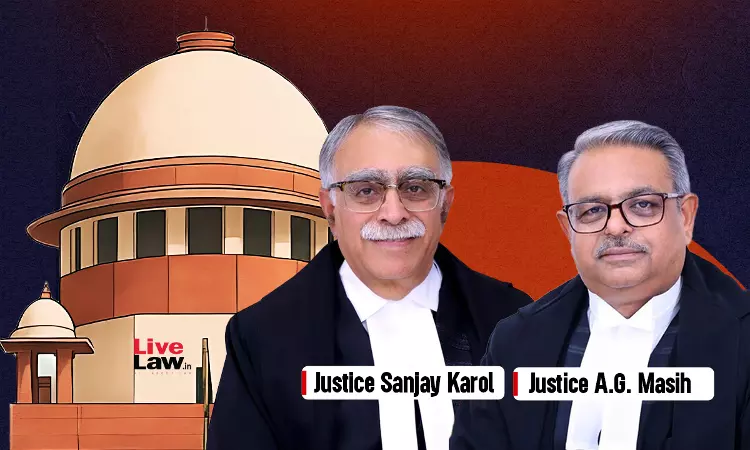
The Supreme Court on Thursday (August 20) reiterated that a revenue record entry neither creates nor extinguishes title to immovable property. A bench of Justice Sanjay Karol and Justice Augustine George Masih heard a case in which title rights in a joint family property were declared extinguished because of a subsequent entry in the revenue records in the name of another person. The...
This is a premium content
Available exclusively to
Our subscribers
Subscribe Premium 
INR 1099+GST
Your support helps us to bring you more content at
an affordable subscription scheme !!!
All payment options available
The Supreme Court on Thursday (August 20) reiterated that a revenue record entry neither creates nor extinguishes title to immovable property.
A bench of Justice Sanjay Karol and Justice Augustine George Masih heard a case in which title rights in a joint family property were declared extinguished because of a subsequent entry in the revenue records in the name of another person.
The case involved agricultural land originally held by one Bhagwansingh, who had two sons, Ramprasad and Vasudev. Following Bhagwansingh's death, the property devolved upon both sons and was initially recorded jointly in their names.
The appellants, who were the legal heirs of Ramprasad, later instituted proceedings seeking declaration of co-ownership, partition and separate possession after the revenue records came to reflect the property solely in the names of Vasudev and his son.
The respondents contended that Ramprasad had voluntarily relinquished his interest through an affidavit, a statement before the Naib Tehsildar and a consent letter, marked as Ex.D5.
The trial court and the first appellate court rejected the defence and decreed the suit in favour of the appellants.
In a second appeal, the Madhya Pradesh High Court overturned the concurrent findings of the First Appellate Court and the trial court, following which an appeal was filed before the Supreme Court by the legal heirs of Ramprasad.
Setting aside the High Court's decision, the judgment authored by Justice Masih said that an entry in favour of another person would not amount to voluntary abandonment of the Appellants' title rights, claiming through Ramprasad, in the joint property.
"A right in immovable property cannot be treated as having been voluntarily abandoned merely because a revenue entry subsequently appears in favour of another person, and the underlying transaction by which title is said to have been surrendered must independently be established by the party relying upon it.”, the Court observed.
Moreover, the Respondents were not able to establish the execution of the relinquishment deed by the Appellant, nor any independent witness was presented to prove that Ramprasad relinquished his title, the Court said. Moreover, the Court said that the High Court erred in relying upon the testimony of a witness, whose testimony was not relevant as it was regarding a different transaction.
“The respondents…did not otherwise establish the existence of any registered deed of relinquishment, and the material relied upon did not, to the standard required in a civil proceeding, establish that Ramprasad had legally divested himself of his interest in the suit property.”, the Court said.
“Respondents No. 1 and 2 have not produced any other document based on which the court could presume that the signature on Exhibits D-17 to D-21 is indeed Ramprasad's. No other document has been produced by respondents No. 1 and 2 bearing Ramprasad's signature. Even if it is assumed that the said signatures are Ramprasad's, respondents No. 1 and 2 have not produced any independent witness who was present at the time of execution of the said exhibit and Ex. D-5. Respondents No. 1 and 2 have failed to clarify under what circumstances the entries in the name of respondent no. 2 were made on a part of the disputed land in 1980- 1981.”, the Court added.
Revenue entry is not presumption of title
The Court said that a mere revenue entry is not a presumption of title, but a rebuttable presumption. The fact that the revenue records subsequently reflected the property in another person's name could not, without proof of the underlying transaction, establish that the original co-owner had relinquished his share, the Court said.
“The order of the Naib Tehsildar may regulate the revenue record, but it cannot, merely by recording one person's name in place of another, operate as a conveyance or a relinquishment of proprietary rights, and the civil court remains fully competent to determine the underlying title, which the revenue entry follows rather than creates. The statutory presumption of correctness attaching to a revenue entry under Section 117 of the Madhya Pradesh Land Revenue Code 1959 is a rebuttable evidentiary presumption and not a presumption of title, and it must be weighed along with the rest of the evidence, which the first appellate court did, finding it displaced for the specific reasons recorded above. For these reasons the High Court fell into error in holding that Ex.D5, whether taken alone or together with the revenue proceedings under Ex.D22, established that Ramprasad had relinquished his proprietary interest in the suit property.”, the Court observed.
Accordingly, the Court allowed the appeal, restoring the trial court's decree recognizing the appellants' co-ownership rights and directed that their shares be worked out through lawful partition.
Headnote
Code of Civil Procedure, 1908 (CPC) – Section 100 – Scope of Second Appellate Jurisdiction – Interference with Concurrent Findings of Fact - Section 100 confers a restricted jurisdiction upon the High Court, and a second appeal can be entertained only where it involves a substantial question of law - Concurrent findings of fact ordinarily cannot be disturbed unless they are demonstrated to be perverse or vitiated by an error of law - The existence of power to interfere where findings are demonstrably perverse cannot become a license to reappreciate evidence merely because another view of it is possible, or because the High Court considers a different inference preferable - Interference is warranted solely when there is a demonstrable error in the approach to the evidence, reliance on inadmissible material, omission of vital evidence, or a conclusion that no reasonable judicial mind could arrive at on the record - The High Court erred in overturning concurrent findings of fact regarding the non-execution of a relinquishment document and the date of knowledge by reappreciating evidence and mischaracterizing a non-attesting witness. [Relied on Bholaram v. Ameerchand, (1981) 2 SCC 414; Kulwant Kaur and Others v. Gurdial Singh Mann (Dead) by LRs. and Others, (2001) 4 SCC 262; P. Kishore Kumar v. Vittal K. Patkar, (2024) 13 SCC 553; Paras 16-30]
Madhya Pradesh Land Revenue Code, 1959 – Section 117 – Revenue Entries / Mutation – Effect on Title - Settled law dictates that an entry in the revenue record neither creates nor extinguishes title; it exists essentially for fiscal purposes - An order of mutation passed by a Naib Tehsildar cannot operate as a conveyance or relinquishment of proprietary rights merely by substituting names in the revenue register - The civil court remains fully competent to determine underlying title, which a revenue entry merely follows rather than creates - The statutory presumption of correctness attaching to a revenue entry under Section 117 of the Madhya Pradesh Land Revenue Code, 1959 is a rebuttable evidentiary presumption and not a presumption of title, which can be displaced by evidence showing the absence of lawful divestment or relinquishment. [Relied on Sawarni v. Inder Kaur and Others, (1996) 6 SCC 223; Paras 21, 22]
Limitation Act, 1963 – Articles 58 & 100 – Suit for Declaration of Co-ownership by Succession – Starting Point of Limitation – Co-owners and Plea of Ouster - The starting point of limitation cannot be fixed merely by identifying the date on which a revenue mutation entry was recorded - In law, the possession of one co-owner is ordinarily treated as possession on behalf of all, and a co-owner in possession does not acquire adverse title merely by continuing in possession - Ouster between co heirs requires an open assertion of hostile title coupled with exclusive possession and enjoyment to the knowledge of the other co-heir; mere exclusive possession is insufficient - Where a suit is substantially for declaration of co-ownership by succession, partition, and separate possession, and not directly founded upon a challenge to a revenue order as the source of title, the limitation runs from the date when the right to sue actually accrued upon knowledge of adverse claims/threat to title (such as a public notice to sell), rather than the date of an unnoticed mutation order. [Relied on P. Lakshmi Reddy v. L. Lakshmi Reddy, (1956) 2 SCC 759; Paras 24-26]
Specific Relief Act, 1963 – Section 34 Proviso – Maintainability of Suit – Non-seeking of Cancellation of Revenue Mutation Entry - The proviso to Section 34 requires a plaintiff seeking a declaration of legal character or right to seek further relief where available, aiming to preclude bare declarations when consequential relief is available and necessary - A suit seeking a declaration of co-ownership along with partition, separate possession, and a permanent injunction does not attract the bar under the proviso to Section 34 - The relief of cancellation of a revenue mutation entry is not equivalent to a declaration of title - Once a civil court determines that an inherited title has not been extinguished, the mutation entry itself cannot impede the declared title, and the absence of a specific prayer for cancellation of the mutation order is not fatal to the maintainability of the suit. [Para 27]
Indian Evidence Act, 1872 – Section 114(e) & Section 114 Illustration (g) – Presumption of Regularity of Official Acts – Non-examination of Material Witness - The statutory presumption of regularity under Section 114(e) extends solely to the regularity of official procedure and does not extend to conclusively proving the bona fides or legality of the underlying private transaction on which the official order is based - an adverse inference under Section 114 Illustration (g) does not follow automatically from the non-examination of an available party/witness (such as the widow) where the acquisition of knowledge of hostile action is independently established through contemporary documentary evidence. [Para 28-30]
Cause Title: JAMNABAI AND OTHERS VERSUS VASUDEV AND OTHERS
Citation : 2026 LiveLaw (SC) 843
Click here to download judgment
Appearance:
For Petitioner(s) :Mr. Padmesh Mishra, Adv. Mr. Vinod Sharma, Adv. Mr. Yashwardhan Rai, Adv. Mr. Vijant, Adv. Mr. Aayushmaan Vatsyayana, AOR
For Respondent(s) : Mr. Vinay Navare, Sr. Adv. Mr. Rudraditya Khare, D.A.G.Ms. Deeplaxmi Subhash Matwankar, AOR Ms. Deeplaxmi S Matwankar, Adv. Ms. Manreet Kaur, Adv. Mr. Amit Gurnani, Adv. Ms. Manshi Jain, Adv. Mr. Yatharth Kansal, AOR Mr. Harmeet Singh Ruprah, AOR Mr. Surjeet Singh GA, Adv. Mr. Sai Shashank, Adv.
Tags

Yash Mittal
Yash Mittal is a Correspondent with LiveLaw, covering the Supreme Court of India

