



- Home
- /
- Supreme court
- /
- 'Mere Telephone Records Can't Prove...
'Mere Telephone Records Can't Prove Illicit Affair' : Supreme Court Upholds Acquittal Of Woman & 2 Men In Husband's Murder Case
Yash Mittal
14 July 2026 10:32 AM IST
Mere production of telephone records cannot substitute substantive proof of an illicit affair leading to murder, the Supreme Court has held while upholding the acquittal of a woman accused of murdering her husband along with her alleged lover and another co-accused in 2007. The Court ruled that the prosecution failed to establish an unbroken chain of circumstances necessary to sustain...
This is a premium content
Available exclusively to
Our subscribers
Subscribe Premium 
INR 1099+GST
Your support helps us to bring you more content at
an affordable subscription scheme !!!
All payment options available
Mere production of telephone records cannot substitute substantive proof of an illicit affair leading to murder, the Supreme Court has held while upholding the acquittal of a woman accused of murdering her husband along with her alleged lover and another co-accused in 2007.
The Court ruled that the prosecution failed to establish an unbroken chain of circumstances necessary to sustain a conviction based on circumstantial evidence. The Court observed that the investigation suffered from "fatal lapses," including the failure to seal recovered articles.
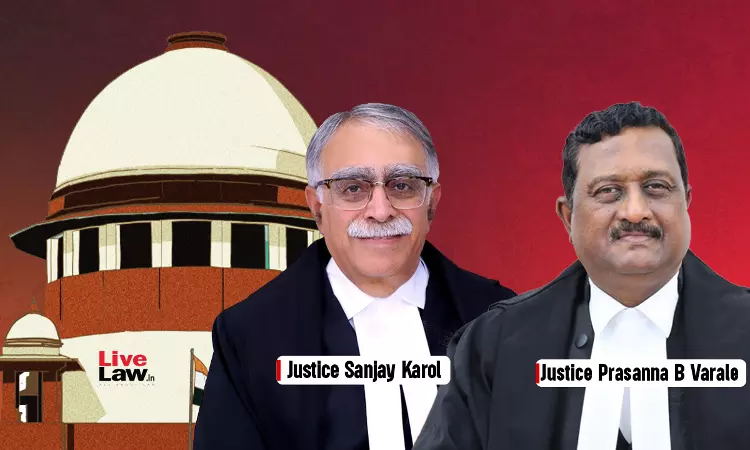
A Bench of Justice Sanjay Karol and Justice Prasanna B. Varale dismissed appeals filed by the State of Maharashtra against a 2010 Bombay High Court judgment that had acquitted Monika Kiran Suryawanshi(accused no.1), Prakash Nagraj Patil(A2) and Dnyaneshwar Gangaram Mahale(A3) of charges under Sections 302 (murder) and 120B (criminal conspiracy) of the Indian Penal Code.
Amongst other lacunae, the Court found the failure to seal the recovered articles devastating for the prosecution's case.
“…we find no error in the well-reasoned judgment of the High Court. The prosecution's case against the accused for murder and conspiracy, resting entirely on circumstantial evidence, suffers from vital lacunae, specifically the failure to establish a motive, the unreliability of the 'last seen' witness, contradictory telephonic records, the devastating failure to seal recovered articles at the spot, and the complete absence of blood in the bedroom where the brutal murder supposedly occurred. The chain of circumstances is broken, and the hypothesis of guilt is not exclusively established.”, the Court observed.
The case stems from the 2007 murder of Kiran Suryawanshi, an ICICI Bank employee. The prosecution alleged that his wife, accused no.1, had an extramarital affair with their neighbour, accused no.2, and conspired with him and his friend, accused no.3, to murder the deceased. The prosecution claimed that accused no.1 administered sedatives to her husband before smashing his head with a grinding stone. Prakash and Dnyaneshwar were allegedly caught while transporting the victim's body on a motorcycle for disposal.
The trial court convicted the Respondents and sentenced them to life imprisonment; however, the Bombay High Court set aside the conviction, noting lacunae in the prosecution's case and defective investigation, particularly the failure to seal the recovered items for forensic examination.
Challenging the High Court's decision, the State moved the Supreme Court.
The Court found that the prosecution failed to prove its alleged motive of an extramarital affair. It held that the evidence merely suggested a one-sided infatuation on the part of Prakash and did not establish that Monika reciprocated the relationship or had any motive to kill her husband.
"Mere production of telephone records does not substitute substantive proof of an illicit affair leading to murder," the Court said.
The Bench also rejected the prosecution's reliance on the "last seen" theory, noting that it failed to conclusively establish the time of death. It further found that the call detail records contradicted the prosecution's claim that Monika had summoned Prakash to her house on the night of the incident. Instead, the records showed no outgoing calls from Monika's phone to Prakash's phone.
Affirming the impugned ruling, the judgment authored by Justice Varale, referring to a Bombay High Court's ruling in Ashraf Hussain Shah v. State of Maharashtra, 1996 SCC OnLine Bom 683, the Court emphasized that the prosecution must not only prove that articles were sealed upon seizure but must also lead "link evidence" to demonstrate they were kept in a sealed condition until they reached the Chemical Analyzer.
“In the absence of seals, the Chemical Analyzer (CA) reports (Exhibits 50 and 56) connecting the blood group 'A' to the grinding stone and clothes become highly doubtful and cannot be construed as incriminating evidence.”, the Court observed.
Further, the Court accepted the Respondents-accused's defence under Section 313, CrPC, where she vehemently argued against the recoveries based on the disclosure statement under Section 27 of the Evidence Act, where she contended that recoveries done from the public place being accessible to all, and the search panchnama does not bear her signature, cannot be considered material evidence to secure the conviction.
“Accused no. 1 vehemently challenged these recoveries, stating in her Section 313 CrPC statement that the house search panchnama was falsely prepared and that her signatures were taken on blank papers. Notably, the search panchnama (Exhibit 54) did not even bear her signature, raising grave suspicions. Furthermore, the alleged recovery of the grinding stone and syringe (Exhibit 94) was made from a dumping place near her house which is a public area accessible to anyone, which heavily dilutes its evidentiary value.”, the Court observed.
Also, the Court found fault in the prosecution's case for attempting to secure the conviction based on the 'last seen theory', given that the exact time of the offence or the death remained unproven by the prosecution.
“Given the prosecution's failure to conclusively establish the exact time of the offence or the exact time of death, the High Court rightly dismissed the “last seen” evidence of P.W.25 as a weak type of evidence…”, the Court observed.
“Furthermore, P.W.1 (Dr. Ajit Patil), who performed the post-mortem, noted severe head injuries, including a comminuted fracture of the frontal bone, and opined that the injuries were caused by a heavy, blunt object like a grinding stone. Yet, shockingly, no blood was found on the mattresses, chaddar, or pillow in the house of accused no. 1. This physical impossibility speaks volumes and entirely contradicts the prosecution's fundamental narrative that deceased Kiran Suryawanshi was brutally bludgeoned to death in his bed.”, the Court added.
However, the Court upheld the conviction of Prakash and Dnyaneshwar under Section 201 IPC, observing that they were caught red-handed transporting the deceased's body wrapped in a plastic bag and bedsheet on a motorcycle in the early hours of February 15, 2007. This clearly established that they knowingly attempted to cause the disappearance of evidence.
Since both had already undergone the one-year sentence imposed for the offence under Section 201 IPC, no further orders were required.
In terms of the aforesaid, the appeal was dismissed.
Headnote
Indian Penal Code, 1860 - Section 302 read with Section 34 & Section 120B – Murder and Criminal Conspiracy – Circumstantial Evidence – Golden principles governing circumstantial evidence – Broken chain of events – The prosecution case rested entirely on circumstantial evidence to prove that the wife (Accused No. 1) along with her lover (Accused No. 2) and others conspired to murder the deceased - Held, the prosecution failed to establish a complete and unbroken chain of circumstances - There was no positive legal evidence proving a reciprocal love affair/motive, the "last seen" theory was found weak and unreliable, and the call detail records directly contradicted the prosecution's narrative - Suspicion cannot take the place of legal proof - The acquittal of the accused persons for the charges of murder and criminal conspiracy upheld. [Paras 19-39]
Section 201 read with Section 34 – Causing disappearance of evidence of offence – Accused caught red-handed transporting dead body – Accused Nos. 2 and 3 were intercepted by the police at 5:00 a.m. while riding a motorcycle carrying a bundle from which a human foot was protruding - The bundle contained the dead body of the deceased, and the motorcycle silencer plate had bloodstains matching the blood group of the deceased - Held, the physical reality of the accused transporting the deceased victim's tied body undeniably establishes that they knowingly caused the evidence of the commission of an offence to disappear with the explicit intention of screening the offenders - The conviction and sentence of rigorous imprisonment for one year sustained. [Paras 35 - 40]
Indian Evidence Act, 1872 - Section 27 – Recovery of weapon and incriminating articles – Failure to affix lac seals at the spot – Total absence of blood at the alleged site of crime – Fatal to prosecution case – The prosecution relied on the recovery of a blood-stained grinding stone (alleged murder weapon) and clothes at the behest of Accused No. 1 - Held, the alleged articles were recovered from a public area accessible to anyone and, crucially, were not sealed at the spot - In the absence of link evidence to prove articles were kept in a sealed condition until they reached the Chemical Analyzer, the reports hold no evidentiary value as the possibility of tampering/planting cannot be ruled out - the complete absence of blood on the mattresses or pillows in the house completely contradicts the narrative that the deceased was bludgeoned to death in his bed. [Relied on Sharad Birdhichand Sarda v. State of Maharashtra, (1984) 4 SCC 116; Tulshiram Bhanudas Kambale v. State of Maharashtra, 1999 SCC OnLine Bom 227; Salim Akhtar alias Mota v. State of Uttar Pradesh, (2003) 5 SCC 499; State (NCT of Delhi) v. Navjot Sandhu, (2005) 11 SCC 600; Maghavendra Pratap Singh Alias Pankaj Singh v. State of Chhattisgarh, (2024) 12 SCC 401; Paras 27, 28, 29]
Cause Title: STATE OF MAHARASHTRA VERSUS MONIKA KIRAN SURYAWANSHI & ORS.
Citation : 2026 LiveLaw (SC) 669
Click here to download judgment
Appearance:
For Appellant(s) : Ms. Punam Kumari, AOR Mr. Sanjay Kharde, Sr. Adv. Mr. Siddharth Dharmadhikari, Adv. Mr. Aaditya Aniruddha Pande, AOR Mr. Shrirang B. Varma, Adv.
For Respondent(s) :Mr. Vinay Navare, Sr. Adv. Ms. Manshi Jain, Adv. Ms. Abha R. Sharma, AOR Mr. Aaditya Aniruddha Pande, AOR
Tags

Yash Mittal
Yash Mittal is a Correspondent with LiveLaw, covering the Supreme Court of India

