



- Home
- /
- Supreme court
- /
- Mere Weapon Recovery & FSL Report...
Mere Weapon Recovery & FSL Report Not Enough In Absence Of Other Corroborative Evidence : Supreme Court Acquits Murder Convict
Yash Mittal
15 Nov 2025 9:35 AM IST
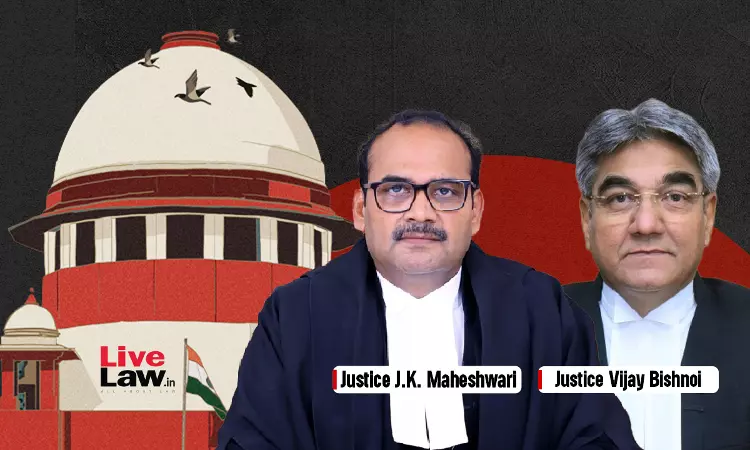
The Supreme Court on Friday (November 14) observed that mere recovery of a weapon, even with a supporting FSL report, is not sufficient to sustain a conviction for murder in the absence of other corroborative evidence connecting the accused to the crime. A bench of Justices JK Maheshwari and Vijay Bishnoi set aside the life sentence of a man convicted of murder, holding that the High Court...
This is a premium content
Available exclusively to
Our subscribers
Subscribe Premium 
INR 1099+GST
Your support helps us to bring you more content at
an affordable subscription scheme !!!
All payment options available
The Supreme Court on Friday (November 14) observed that mere recovery of a weapon, even with a supporting FSL report, is not sufficient to sustain a conviction for murder in the absence of other corroborative evidence connecting the accused to the crime.
A bench of Justices JK Maheshwari and Vijay Bishnoi set aside the life sentence of a man convicted of murder, holding that the High Court had wrongly upheld the conviction solely based on the recovery of the pistol allegedly used in the crime and an FSL report linking the recovered cartridges to the bullets taken from the deceased's body.
The Court noted that the recovery of the weapon, which was also accessible to the Appellants' family members, was unsupported by any independent witness and that there was an unexplained delay in sending the seized firearm for forensic examination.
According to the prosecution's case, on the morning of June 12, 2016, at around 6 a.m. in village M.P. Majra, Jhajjar (Haryana), three persons arrived in a car band allegedly shot the deceased with a pistol. The FIR was filed by her brother following a telephonic message to the police control room.
Subsequent investigation resulted in the arrest of the appellant and two co-accused; a country-made pistol and two live cartridges were recovered from the appellant, while the car and weapon were recovered from another co-accused.
The appellant's defence challenged the conviction on the ground that key eyewitnesses—PW-1 and PW-5—turned hostile during trial and did not support the prosecution's case. PW-1, the brother of the deceased, stated that he arrived at the scene after hearing of the incident and could not identify the assailants. There was no independent witness to corroborate his version of events.
Moreover, the discovery of the weapon was made from an unlocked iron box in the appellant's house,a location accessible to family members,and no independent witness had been examined to establish the chain of custody or that the weapon was used in the killing.
Since the eyewitness to the incident turned hostile, no evidence of 'last seen' was adduced, motive to commit an offence was not proved, the court asked whether “mere recovery and the FSL report can, by itself, sustain the conviction of the appellant – more particularly when other co-accused having motive has been acquitted.”
“At the time of the said recovery, no independent witness from neighborhood has been joined. The iron box was found to be in an open and unlocked state and it was accessible by family members also, wherein other household articles were also kept though not seized separately by him.”, a judgment authored by Justice Maheshwari observed, pointing that the recovery from the place accessible to public or areas accessible to others, alone is not sufficient and it becomes suspicious, as held in Manjunath & Ors. v. State of Karnataka, (2023).
The Court found the prosecution failed to prove that the alleged recovered weapon was used in the crime.
“Though the FSL report indicates that the pistol and cartridges recovered correlate with the bullets found in the body of the deceased, such evidence by itself is not sufficient to establish the appellant's guilt in the absence of any proof that the recovered pistol was indeed used in the commission of the offence. Furthermore, the alleged motive, as projected by the prosecution, primarily pertains to the co-accused persons, who have either not been chargesheeted or have been acquitted by the Trial Court. The purported motive attributed to the appellant is founded merely on a speculative quid pro quo arrangement with the acquitted co-accused and lacks support from any credible evidence.”, the court noted.
“As such, the findings of conviction of the appellant for the alleged offences and sentence to undergo imprisonment for life cannot be sustained. In the totality of the circumstances, the prosecution has failed to prove the guilt of the appellant beyond reasonable doubt.”, the court held.
Accordingly, the appeal was allowed.
Cause Title: GOVIND VERSUS STATE OF HARYANA
Citation : 2025 LiveLaw (SC) 1106
Click here to download judgment
Appearance:
For Appellant(s) Mr. Gagan Gupta, Sr.Adv. Mr. Tanuj Agarwal, Adv. Mr. Apoorva Singhal, AOR Mr. R.Venkataraman, Adv. Mr. Alok Kumar, Adv. Mr. Ashfaq, Adv. Mr. Saurabh Gupta, Adv.
For Respondent(s) Mr. Akshay Amritanshu, AOR Ms. Drishti Rawal, Adv. Ms. Drishti Saraf, Adv. Mr. Mayur Goyal, Adv.
Tags

Yash Mittal
Yash Mittal is a Correspondent with LiveLaw, covering the Supreme Court of India

