



- Home
- /
- Supreme court
- /
- Motive Insignificant When Direct...
Motive Insignificant When Direct Evidence In Form Of Dying Declaration Exists : Supreme Court
Yash Mittal
15 Jan 2026 7:26 PM IST
The Supreme Court on Thursday (January 15) restored the conviction of a man for committing murder of her wife, observing that absence of motive is not fatal to the prosecution when there is clear and credible direct evidence, such as a dying declaration. “Motive assumes significance, primarily in cases based on circumstantial evidence. Where there is direct evidence in the form of a...
This is a premium content
Available exclusively to
Our subscribers
Subscribe Premium 
INR 1099+GST
Your support helps us to bring you more content at
an affordable subscription scheme !!!
All payment options available
The Supreme Court on Thursday (January 15) restored the conviction of a man for committing murder of her wife, observing that absence of motive is not fatal to the prosecution when there is clear and credible direct evidence, such as a dying declaration.
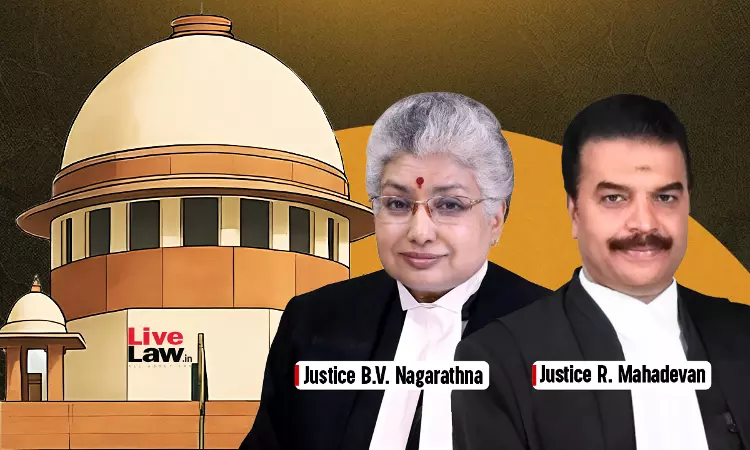
“Motive assumes significance, primarily in cases based on circumstantial evidence. Where there is direct evidence in the form of a credible and trustworthy dying declaration, the absence of strong proof of motive is not fatal to the prosecution case.”, observed a bench of Justices BV Nagarathna and R Mahadevan, while setting aside the Himachal Pradesh High Court's decision which, while acquitting accused in 2014, had questioned the prosecution case on the ground that motive was not established.
It was the prosecution's case that the Respondent No.1, husband had set ablaze her wife leading to her death. The wife has recorded the dying declaration in the presence of the executive magistrate, taking name of his husband, accusing him for setting her ablaze.
The High Court overturned the trial court's decision convicting him of murder, reasoning that the absence of any pending litigation between the spouses showed a lack of animosity and that the prosecution had failed to explain why the accused would commit such a grave act.
Disagreeing with the High Court's decision, the judgment authored by Justice Mahadevan observed that proving a motive wouldn't be necessary when there's a direct evidence proving the crime. Since the deceased's dying declaration was consistent, making it direct evidence against the Respondent No.2, the Court held that proving motive became insignificant.
“In the present case, the evidence on record discloses that the respondent subjected the deceased to frequent quarrels, humiliation and verbal abuse, including branding her a “Kanjri” and repeatedly asking her to leave the matrimonial home. The dying declaration itself refers to persistent matrimonial discord and ill-treatment thereby furnishing a plausible background for the commission of the offence. In any event, the prosecution is not required to establish motive with mathematical precision and failure to conclusively prove motive does not weaken an otherwise reliable and cogent case.”, the court said.
“We are, therefore, of the considered view that the High Court fell into manifest error in reversing the well-reasoned judgment of conviction recorded by the trial Court by re-appreciating the evidence in a manner contrary to the settled principles governing appellate interference.”, the court held.
Accordingly, the appeal was allowed, ordering the Respondent No.1, husband, to surrender and undergo the remaining sentence.
Headnote
Appellate Jurisdiction – Interference with Order of Acquittal – Principles Reiterated – The Supreme Court observed that there is no absolute restriction in law on the appellate court to review and reappreciate the entire evidence upon which an order of acquittal is founded - While an appellate court is ordinarily slow to interfere with an acquittal, it must do so if the judgment is manifestly erroneous, perverse, or based on a misreading of evidence or incorrect application of law - Where the High Court adopts a wholly erroneous process of reasoning and ignores vital circumstances resulting in a grave miscarriage of justice, interference is imperative.
Evidence Act, 1872; Section 32 – Dying Declaration – Credibility and Corroboration – held that a dying declaration, if found to be true and voluntary, can form the sole basis for conviction without any further corroboration – Held that High Court erred in discarding a dying declaration recorded by a Tehsildar (PW-1) after obtaining a medical certificate of fitness - Discrepancies regarding the exact time of the Tehsildar's arrival at the hospital were minor and did not justify discarding a clear and consistent statement by the deceased identifying her husband as the perpetrator.
Criminal Procedure Code, 1973; Section 378 – Appeal against Acquittal – Grounds for Reversal – Noted that an order of acquittal may be reversed if the High Court rejects incontrovertible evidence based on unrealistic suspicion or surmises, or if it discounts the testimony of relatives solely on the ground of being 'interested' witnesses – Held that High Court wrongly placed undue reliance on the testimonies of hostile witnesses and contradictory defence evidence while ignoring the cogent testimonies of independent public servants – Appeal allowed. [Relied on Rajesh Prasad v. State of Bihar (2022) 3 SCC 471; Sadhu Saran Singh v. State of Uttar Pradesh (2016) 4 SCC 35; State of Madhya Pradesh v. Phoolchand Rathore 2023 SCC OnLine SC 537; State of Uttar Pradesh v. Ajmal Beg 2025 SCC OnLine SC 280; Surajdeo Mahto v. State of Bihar (2022) 11 SCC 800; Paras 14-26]
Cause Title: STATE OF HIMACHAL PRADESH VERSUS CHAMAN LAL
Citation : 2026 LiveLaw (SC) 48
Click here to download judgment
Appearance:
For Appellant(s) : Mr. Abhishek Gautam, AOR
For Respondent(s) :Mr. Krishna Pal Singh, AOR (Amicus Curiae) Ms. Anvita Aprajita, Adv. Mr. Mohan Singh Bais, Adv. Mr. Seemab Qayyum, Adv.
Tags

Yash Mittal
Yash Mittal is a Correspondent with LiveLaw, covering the Supreme Court of India

