



- Home
- /
- Supreme court
- /
- NCTE Executive Committee Empowered...
NCTE Executive Committee Empowered To Seek Annual Performance Appraisal Reports From Teacher Educational Institutes : Supreme Court
Yash Mittal
4 Sept 2026 10:46 AM IST
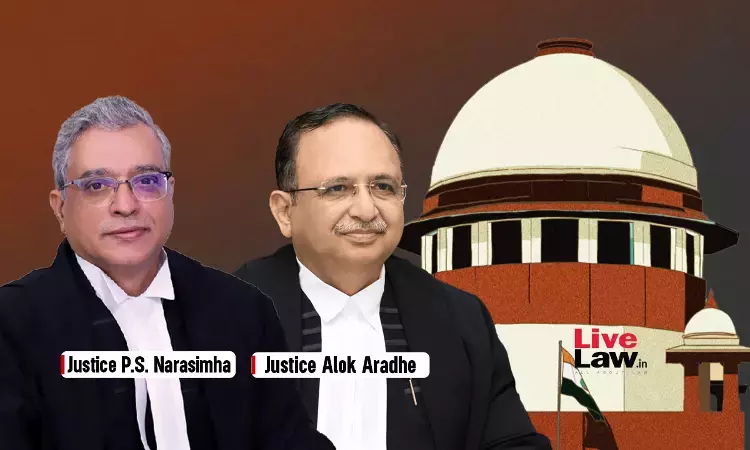
The Supreme Court on Thursday (September 3) upheld the National Council for Teacher Education's and its executive committee's power to call for annual Performance Appraisal Reports (PAR) from Teacher Education Institutes. “…there is ample empowerment of the Council as well as the Executive Committee to call for annual Performance Appraisal Report from institutions imparting...
This is a premium content
Available exclusively to
Our subscribers
Subscribe Premium 
INR 1099+GST
Your support helps us to bring you more content at
an affordable subscription scheme !!!
All payment options available
The Supreme Court on Thursday (September 3) upheld the National Council for Teacher Education's and its executive committee's power to call for annual Performance Appraisal Reports (PAR) from Teacher Education Institutes.
“…there is ample empowerment of the Council as well as the Executive Committee to call for annual Performance Appraisal Report from institutions imparting teacher education.”, observed a bench of Justice Pamidighantam Sri Narasimha and Justice Alok Aradhe, while setting aside the Delhi High Court's Division Bench judgment which ruled against the NCTE's executive committee's authority to issue a notice calling for a Performance Appraisal Report from the Teacher Education Institutes.
“We fail to understand as to how a regulatory measure of a statutory body, empowered to achieve planned and coordinated development of teacher education system in the country could be restrained from calling upon the TEIs to file Performance Appraisal Report. We are of the opinion that even without a specific empowerment under the statute, such a regulatory measure can always be incidental and ancillary to the duties and functions of a regulator. As there is a performance audit of NCTE itself by the Comptroller and Auditor General of India (CAG), it is but natural and incidental that NCTE would require the stakeholders, over which it exercises the regulatory jurisdiction, to provide the necessary Performance Appraisal Report.”, the Court said.
The dispute arose from a Public Notice issued by the Member Secretary Of the Executive Committee of NCTE in September 2019 directing all TEIs running NCTE-recognised courses to submit an annual Performance Appraisal Report through a designated online portal.
The notice prescribed a payment of ₹5,000 for Central and State Government institutions and ₹15,000 for other institutions. It further warned that failure to submit the PAR would invite action under Section 17(1) of the NCTE Act.
The Association of NCTE Approved Colleges Trust and other TEIs challenged the notice before the Delhi High Court.
The Single Judge dismissed the challenge. However, the Division Bench allowed the appeal and quashed the notice, holding, inter alia, that there was no material demonstrating that the PAR proforma had been evolved or approved by the NCTE. It also held that the function of evolving a performance appraisal system under Section 12(k) could not have been delegated to the Member Secretary.
The NCTE thereafter approached the Supreme Court.
Allowing the NCTE's appeal, the Court emphasizing the importance of a role of the teacher in imparting a quality education to the kids, held that “the duties to be performed by the Council and the bodies that are constituted along with it, such as the Executive Committee and the Regional Committees, are perhaps the highest of all the duty bearers.”
“We are of the opinion that there is ample empowerment of the Council as well as the Executive Committee to call for annual Performance Appraisal Report from institutions imparting teacher education. To start with, such a power is clearly traceable to Section 12(k) of the Act, where under the Council could “evolve suitable performance appraisal system, norms and mechanisms for enforcing accountability on recognised institutions” and in exercise of such a function, the Council deliberated on the issue and authorised Executive Committee to implement it through a formal proforma. Thereafter, it is the duty of the Executive Committee to carry forward the mandate of the Council. This is exactly what the Member Secretary did, when he issued the Public Notice dated 22.09.2019 calling upon the institutions running NCTE recognised courses to file Performance Appraisal Report.”, the Court observed.
Action taken by regulators in an accountable manner shouldn't be interfered with
The Court observed that since the NCTE is empowered to seek accountability from TEIs, which are established to impart teacher training, the positive duty of the Executive Committee in exercising such power should not be interfered with on technical grounds.
“Apart from the duty to ensure that the executive authority/statutory bodies do not exercise powers that are not vested in them, Constitutional courts also have a positive duty to ensure that Authorities, more particularly, the regulators do exercise their powers effectively, efficiently and in an accountable manner. In this context, Courts cannot adopt a technical or a pedantic view of the action taken by the regulators.”, the Court observed.
In terms of the aforesaid, the appeal was allowed, holding that “the Council as well as the Executive Committee is within its jurisdiction to call TEIs to upload Performance Appraisal Report.”
Headnote
National Council for Teacher Education Act, 1993 – Section 12(k), Section 12, Section 19, Section 17 & Section 31 – Right of Children to Free and Compulsory Education Act, 2009 – Section 23 – Regulatory Powers of NCTE and Executive Committee – Mandatory Submission of Annual Performance Appraisal Report (PAR) by Teacher Education Institutions (TEIs) – Levy of Processing Fee - Regulatory jurisdiction and powers of the National Council for Teacher Education (NCTE) and its Executive Committee – Validity of Public Notice mandating annual Performance Appraisal Report (PAR) with processing fees - The challenge before the Court pertained to the Public Notice dated 22.09.2019 issued by the Member Secretary of the Executive Committee of NCTE, mandating all recognised Teacher Education Institutions (TEIs) to submit an online annual Performance Appraisal Report (PAR) along with requisite fees (₹5,000/- for Central/State Government institutions and ₹15,000/- for all other categories), failing which action under Section 17(1) of the NCTE Act would be attracted - The Division Bench of the High Court had set aside the Public Notice on technical grounds, holding that the specific proforma was not formally placed before and approved by the Council and that power under Section 12(k) had not been delegated under Section 27 to the Member Secretary.
Reversing the High Court's judgment, the Supreme Court held – i. Traceability of Power and Competence of Executive Committee - The power to call for an annual Performance Appraisal Report is explicitly traceable to Section 12(k) of the NCTE Act, which empowers the Council to evolve a suitable performance appraisal system, norms, and mechanisms for enforcing accountability on recognised institutions - In its 48th General Body meeting held on 05.02.2019, the Council approved the substitution of 'Annual Renewal of Recognition' with the requirement of submitting a 'PAR' through a proforma to be developed by the NCTE - Under Section 19 of the NCTE Act, the Executive Committee is the statutory body entrusted to discharge functions assigned to it by the Council - It acts as the executive arm to implement the Council's decisions; thus, issuing the Public Notice through its Member Secretary to operationalise the PAR mechanism was well within jurisdiction and legal authority; ii. Incidental and Ancillary Powers of Regulators - Even absent explicit statutory empowerment, such a regulatory measure is inherently incidental and ancillary to the duties, functions, and mandate of a statutory regulator charged with achieving planned and coordinated development and maintenance of standards in teacher education - Given that NCTE itself is subjected to a performance audit by the Comptroller and Auditor General of India (CAG), it is natural and incidental that it requires stakeholders within its regulatory sweep to furnish appraisal reports; iii. Nature of Charges Levied - The requirement to remit ₹5,000/- or ₹15,000/- while uploading the PAR on the portal is in the nature of a processing fee, which falls squarely within the incidental and ancillary powers of the statutory regulator; iv. Scope of Judicial Review over Regulatory Authorities evaluate whether the authority has violated any mandatory statutory provision or transgressed its vested power, rather than adopting a pedantic or hyper-technical approach - Constitutional Courts owe a positive duty to ensure regulators exercise their statutory functions effectively, efficiently, and in an accountable manner; v. Constitutional Framework & Seven Duty Bearers of Elementary Education - Under the constitutional mandate of Article 21A read with Section 23 of the RTE Act and the NCTE Act, quality teacher education is fundamental to the life and development of children - To the five duty bearers recognized in Dinesh Biwaji Ashtikar v. State of Maharashtra & Ors. (Appropriate Governments, Local Authority, Neighbouring Schools, Parents/Guardians, and Elementary School Teachers), two additional duty bearers are added - (vi) The Teacher Education Institutions (TEIs) recognized under Section 2(e) of the NCTE Act, and (vii) The National Council for Teacher Education (NCTE) - The regulatory duties entrusted to the NCTE and its Executive Committee are of the highest order among duty bearers; vi. Principle of Accountability in Administrative Law - Accountability is an essential principle of administrative law, comprising three constituent dimensions: (a) Responsibility (identifying duties and obligations), (b) Answerability (reasoned decision-making), and (c) Enforceability (corrective measures against dereliction of duty). [Relied on Dinesh Biwaji Ashtikar v. State of Maharashtra & Ors., 2026 SCC OnLine SC 56; Vijay Rajmohan v. Central Bureau of Investigation, (2023) 1 SCC 329; Paras 8-25]
Cause Title: THE NATIONAL COUNCIL FOR TEACHERS EDUCATION VERSUS ASSOCIATION OF NCTE APPROVED COLLEGES TRUST AND ORS.
Citation : 2026 LiveLaw (SC) 894
Appearance:
For Petitioner(s) : Mr. Tushar Mehta, Solicitor General Ms. Manisha T Karia, Sr. Adv. Ms. Geetanjali Mohan, AOR Mr. Anuj Kapoor, Adv. Ms. Ananya Arora, Adv. Ms. Shreya Gupta, Adv. Ms. Saumya Tiwari, Adv. Mr. Arth Arora, Adv. Mr. Deepin Deepak Sahni, Adv. Mr. Varun Khetwani, Adv. Mr. Adhish Saxena, Adv. Mr. Puneet, Adv.
For Respondent(s) : Mr. Sanjay Sharawat, Sr. Adv. Mr. Abhishek Singh, Adv. Mr. Ravi Kant, Adv. Ms. Priyanka Madavram, Adv. Mr. Karan Chaudhary, Adv. Ms. Indira Goswami, AOR Mr. Amitesh Kumar, Adv. Mrs. Priti Kumari, Adv. Mr. Chandra Prakash, AOR Mr. Pankaj Kumar Ray, Adv. Mr. Vivek Singh, Adv. Mr. C.p. Rajwar, Adv. Mr. Rohan Chandra, Adv. Mr. Krishan Kumar, Adv.
Tags

Yash Mittal
Yash Mittal is a Correspondent with LiveLaw, covering the Supreme Court of India

