



- Home
- /
- Supreme court
- /
- No Inflexible Rule That Alibi Can...
No Inflexible Rule That Alibi Can Be Proved Only In Trial : Supreme Court Quashes S. 498A IPC Case Against BSF Personnel
Yash Mittal
11 Aug 2026 5:03 PM IST
The Supreme Court on Tuesday (August 11) held that the documentary evidence, including official service records establishing the accused's absence from the place of occurrence, constitutes unimpeachable material that can be considered at the threshold stage for quashing of the criminal case. The Court said that the rule that an accused must ordinarily prove alibi during trial is not...
This is a premium content
Available exclusively to
Our subscribers
Subscribe Premium 
INR 1099+GST
Your support helps us to bring you more content at
an affordable subscription scheme !!!
All payment options available
The Supreme Court on Tuesday (August 11) held that the documentary evidence, including official service records establishing the accused's absence from the place of occurrence, constitutes unimpeachable material that can be considered at the threshold stage for quashing of the criminal case.
The Court said that the rule that an accused must ordinarily prove alibi during trial is not an inflexible rule and cannot be interpreted as an absolute bar against considering reliable and undisputed documentary evidence establishing alibi at the pre-trial stage.
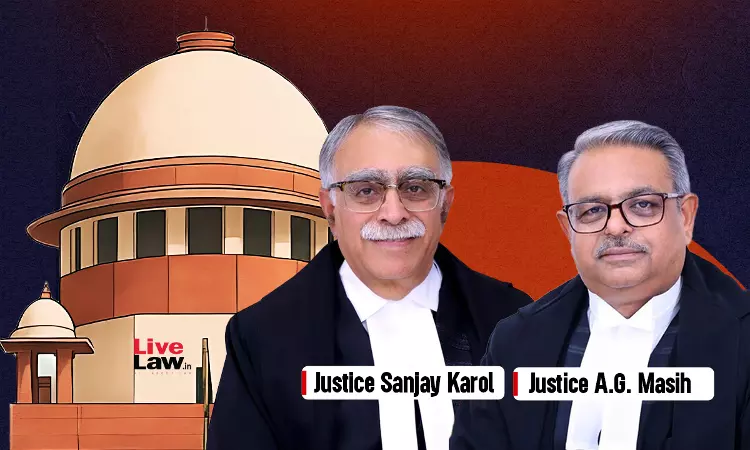
“It cannot be read as laying down an inflexible rule that no species of documentary material touching upon presence or absence of the accused may ever be looked into at the threshold, irrespective of its source, character, and the absence of any dispute as to its authenticity.”, observed a bench of Justice Sanjay Karol and Justice Augustine George Masih, while setting aside the Allahabad High Court's order which had refused to quash the domestic cruelty case (S. 498A IPC) against the Appellant, a BSF personnel, who was posted near the Indo-Bangladesh border and was not present in Uttar Pradesh when the alleged incident occurred.
The High Court refused to take on record the official service documents presented by the Appellant, establishing the plea of alibi under Section 11 of the Evidence Act, 1872. Relying upon the Supreme Court's decision in Rajendra Singh v. State of Uttar Pradesh (2007), the High Court held that the plea of alibi involved disputed questions of fact which could only be adjudicated during trial.
Aggrieved by the High Court's decision, the appellant approached the Supreme Court.
Amongst other issues, the most important issue framed by the Court was whether the High Court was justified in declining to examine, at the threshold, the effect of the official service certificate establishing the appellant's absence from the place of occurrence
Setting aside the High Court's decision, the judgment authored by Justice Masih observed that the High Court erred in placing reliance on Rajendra Singh (supra), to deny plea of alibi at a threshold stage. The Court said that the Rajendra Singh (supra) judgment was delivered in a different set of facts, where the plea of alibi was taken on a sworn private affidavit before the police, whose veracity was open to challenge and cross-examination in a trial.
Distinguishing the Rajendra Singh (supra), the Court gave credence to the Appellant's service record, which unimpeachably established that the Appellant was absent from the crime scene and was posted on the Indo-Sino border to establish his absence when the crime occurred.
“Where the material in question is an official record maintained in the ordinary course of duty by a wing of the Armed Forces of the Union, is placed on record from the earliest stage of investigation itself, and has never been impugned as forged, fabricated, or otherwise unreliable by the prosecution at any stage including before the IO, who himself acknowledged that evidence emerged that appellant was on his duty at the time of the incident such material partakes of the character of unimpeachable material…To hold otherwise would be to elevate procedural formalism over substantial justice and to compel an undeniably absent accused to undergo the ordeal of a full sessions trial notwithstanding admitted and unimpeachable proof to the contrary.”, the Court observed.
The Court also relied on Rajiv Thapar and Others v. Madan Lal Kapoor, (2013) 3 SCC 330, where it laid down a 4-step test to determine if criminal proceedings can be quashed on the basis of defense material/official records prior to trial.
“Step one: whether the material relied upon by the accused is sound, reasonable, and indubitable i.e. the material is of sterling and impeccable quality?
Step two: whether the material relied upon by the accused would rule out the assertions contained in the charges levelled against the accused i.e. the material is sufficient to reject and overrule the factual assertions contained in the complaint i.e. the material is such as would persuade a reasonable person to dismiss and condemn the factual basis of the accusations as false?
Step three: whether the material relied upon by the accused has not been refuted by the prosecution/complainant; and/or the material is such that it cannot be justifiably refuted by the prosecution/complainant?
Step four: whether proceeding with the trial would result in an abuse of process of the court, and would not serve the ends of justice?
If the answer to all the steps is in the affirmative, the judicial conscience of the High Court should persuade it to quash such criminal proceedings in exercise of power vested in it under Section 482 CrPC. Such exercise of power, besides doing justice to the accused, would save precious court time, which would otherwise be wasted in holding such a trial (as well as proceedings arising therefrom) specially when it is clear that the same would not conclude in the conviction of the accused.”
The test laid down in Rajiv Thapar (supra) was endorsed recently in Pradeep Kumar Kesarwani.
In terms of the aforesaid, the appeal was allowed, and the pending criminal proceedings against the Appellant were quashed, and hereby set aside.
Headnote
Criminal Procedure Code, 1973 (CrPC) — Section 482 — Quashing of Criminal Proceedings — Defence Material / Plea of Alibi Based on Unimpeachable Official Records — Distinction from Disputed Questions of Fact - While ordinarily a plea of alibi is a matter of defence to be established by leading evidence at trial and cannot be decided under Section 482 CrPC on the strength of private affidavits, there is no inflexible rule barring the High Court from considering documentary material touching upon the presence or absence of the accused at the threshold where such material consists of official records maintained in the ordinary course of duty by a wing of the Armed Forces of the Union (BSF) whose authenticity is undisputed - Refusing to examine unimpeachable, contemporaneous official records produced from the earliest stage of investigation amounts to elevating procedural formalism over substantial justice and compelling an undeniably absent accused to undergo the ordeal of a full-fledged trial. [Paras 30, 31]
Criminal Procedure Code, 1973 (CrPC) — Section 482 — Quashing on the Basis of Defence Material — 4-Step Test - Reiterating the four-step test laid down in Rajiv Thapar v. Madan Lal Kapoor, when the defence material is of sterling and impeccable quality, completely rules out the assertions in the charges, is not and cannot be justifiably refuted by the prosecution, and proceeding with the trial would result in an abuse of process of the court, the inherent power under Section 482 CrPC must be exercised to quash the criminal proceedings to prevent abuse of the process of the court and save judicial time. [Paras 19 - 35]
Indian Penal Code, 1860 (IPC) — Sections 498-A, 304-B — Dowry Prohibition Act, 1961 — Sections 3, 4 — Quashing of Proceedings Qua Husband — Effect of Acquittal of Co-Accused Parents on Identical Evidence: Where co-accused parents have already been acquitted after a full-fledged trial on the self-same allegations and evidence, and the solitary additional allegation against the husband regarding telephonic dowry demands is unsubstantiated by any Call Detail Records (CDR) and stands neutralised by unimpeached official proof of his deployment on BSF duty outside the State, continuing criminal proceedings against the husband alone constitutes an abuse of the judicial process whose substratum has collapsed.
Continuation of proceedings falls within categories (1), (3), and (6) of State of Haryana v. Bhajan Lal, 1992 Supp (1) SCC 335 and warrants quashing. [Relied on Rajiv Thapar and Others v. Madan Lal Kapoor, (2013) 3 SCC 330; Mahmood Ali and Others v. State of Uttar Pradesh and Others, (2023) 15 SCC 488; Prashant Bharti v. State (NCT of Delhi), (2013) 9 SCC 293; Paras 32–37].
Cause Title: RAHUL VERSUS STATE OF UTTAR PRADESH AND ANOTHER
Citation : 2026 LiveLaw (SC) 786
Click here to download judgment
Appearance:
For Petitioner(s) :Mr. Abhinav Mukerji, Sr. Adv. Ms. Archita Nigam, Adv. Ms. Bihu Sharma, Adv. Mr. Naman Raj Singh, Adv. Mr. Parth Singh, Adv. Ms. Anjali Saxena, Adv. Ms. Akansha, AOR
For Respondent(s) :Dr. Vijendra Singh, AOR Mr. Harsh Pratap Shahi, Adv. Mr. Manish Kumar, Adv. Ms. Somya Chauhan, Adv. Ms. Reena Pandey, AOR Ms. Ishika Neogi, AOR
Tags

Yash Mittal
Yash Mittal is a Correspondent with LiveLaw, covering the Supreme Court of India

