



- Home
- /
- Supreme court
- /
- No Motor Accident Compensation For...
No Motor Accident Compensation For Murder Inside Vehicle : Supreme Court
Yash Mittal
23 July 2026 11:07 AM IST
To claim compensation under the Motor Vehicles Act, death must be having proximate nexus with the use of the vehicle.
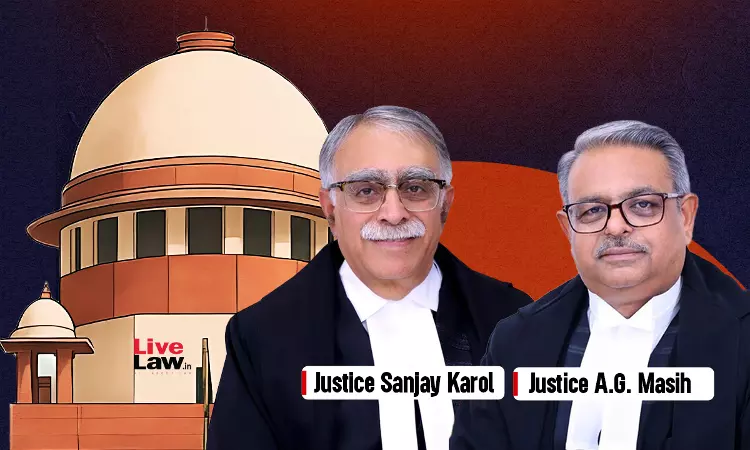
The Supreme Court on Wednesday (July 22) held that a mere involvement of a motor vehicle in a chain of events leading to a person's death is not sufficient to hold the vehicle owner liable to compensate the claimants under the Motor Vehicles Act unless there is a clear proximate relationship between the use of the vehicle and the death. A bench of Justice Sanjay Karol and Justice...
This is a premium content
Available exclusively to
Our subscribers
Subscribe Premium 
INR 1099+GST
Your support helps us to bring you more content at
an affordable subscription scheme !!!
All payment options available
The Supreme Court on Wednesday (July 22) held that a mere involvement of a motor vehicle in a chain of events leading to a person's death is not sufficient to hold the vehicle owner liable to compensate the claimants under the Motor Vehicles Act unless there is a clear proximate relationship between the use of the vehicle and the death.
A bench of Justice Sanjay Karol and Justice Augustine George Masih set aside the concurrent findings of the Chhattisgarh High Court and Motor Accident Claims Tribunal holding the Appellant-vehicle owner liable to compensate the widow for the loss of life of the deceased husband while travelling in the Appellant's car. The Court noted that the Courts below have wrongly presumed that the injury suffered by the deceased while he was inside the car with the Appellant.
“A perusal of the judgments of the Courts below in a sense assume that the injuries suffered by the deceased took place while Dilip and Anand were in the car. How such a conclusion came about, is best known to them.”, the Court observed.
Background
The deceased, who was known to the Appellant, sat in a vehicle driven by his friend Dilip on November 29, 2009. Three days later, on December 2, 2009, his body was found near a village.
The deceased's wife lodged an FIR, leading to the Appellant and two others being charged with kidnapping, murder, and conspiracy.
While the trial court convicted the Appellant, the High Court later acquitted him in 2015, primarily because the prosecution failed to prove the 'last seen' theory.
Separately, the widow and her children filed a claim petition under the Motor Vehicles Act, alleging that deceased was killed inside Appellant's vehicle.
The Tribunal awarded compensation of over Rs. 5.64 lakh, holding that the death was covered under Sections 165 and 166 of the Act. The High Court upheld the award and enhanced the compensation to Rs. 8.60 lakh, leading to an appeal before the Supreme Court.
Issue
The Court examined whether the death of the deceased 'arises out of' the use of the motor vehicle, thereby making the Appellant and/or his insurer liable to compensate the respondents?
Decision
Allowing the appeal, the judgment authored by Justice Karol held that the courts below failed to establish a causal link between the car and death to attract liability under Section 166 of the Act.
“All that has been said is that the injuries sustained by Anand (deceased) were by hard and blunt objects. Now true it is that the claimants need not establish the particular manner in which injuries have been sustained by the injured or the deceased but that does not mean that simply because there was a car somehow involved in a chain of circumstances that led to his death, the provisions of MVA would apply. Some link whatsoever between the car, and the death has to be established.”, the Court observed.
The Court referred to the case of Rita Devi v. New India Assurance Co. Ltd, (2000) 5 SCC 113 to explain the causal relationship between the death and the vehicle, stressing that what is to be understood in the facts of this case is the causal relationship between the death and the motor vehicle. In Rita Devi (supra), the car was subjected to theft, resulting in the death of the deceased. Therein, the Court held that since the primary felonious intention was theft and, therefore, the death, which was a consequence of this, arose in relation to the motor vehicle itself.
Applying the test applied in Rita Devi (supra), the Court observed that “…there is an alleged accidental murder and there is a motor vehicle, but the relationship between the two specifically involving a motor vehicle has not been established. There cannot be, consequently, any liability under the MVA. Judgments of the Courts below are set aside.”
In terms of the aforesaid, the appeal was allowed, and the liability imposed on the Appellant was set aside.
Cause Title: DILIP AGARWAL Versus RAJSHRI AGARWAL & ORS.
Citation : 2026 LiveLaw (SC) 709
Click here to download judgment
Appearance:
For Petitioner(s) :Dr. Rajesh Pandey, Sr. Adv. Ms. Ayushi Pandey, Adv. Mr. Ratik Sodhi, Adv. Ms. Aswathi M.K., AOR
For Respondent(s) :Mr. Rakesh Kumar Singh, AOR Mr. Deepak Kumar Singh, Adv. Mr. Rajnish Kumar Singh, Adv. Mr. Satyakaam Sharma, Adv. Mr. K.V. Alok Shankeran, Adv. Mr. Binod Kumar Singh, Adv.
Mr. Salil Paul, Amicus Curiae
Tags

Yash Mittal
Yash Mittal is a Correspondent with LiveLaw, covering the Supreme Court of India

