



- Home
- /
- Supreme court
- /
- Omission To Sign Order Sheet On...
Omission To Sign Order Sheet On Framing Charges Won't Vitiate Trial, When Charges Were Read Over To Accused : Supreme Court
Yash Mittal
26 March 2026 6:05 PM IST
The Supreme Court has observed that the absence of a signature on the charge-framing order sheet is a curable procedural defect and does not vitiate the trial, particularly where the accused was duly informed of and understood the charges against them. “…the defect relating to the absence of signature on the charge does not constitute an illegality. It is, at best, a curable...
This is a premium content
Available exclusively to
Our subscribers
Subscribe Premium 
INR 1099+GST
Your support helps us to bring you more content at
an affordable subscription scheme !!!
All payment options available
The Supreme Court has observed that the absence of a signature on the charge-framing order sheet is a curable procedural defect and does not vitiate the trial, particularly where the accused was duly informed of and understood the charges against them.
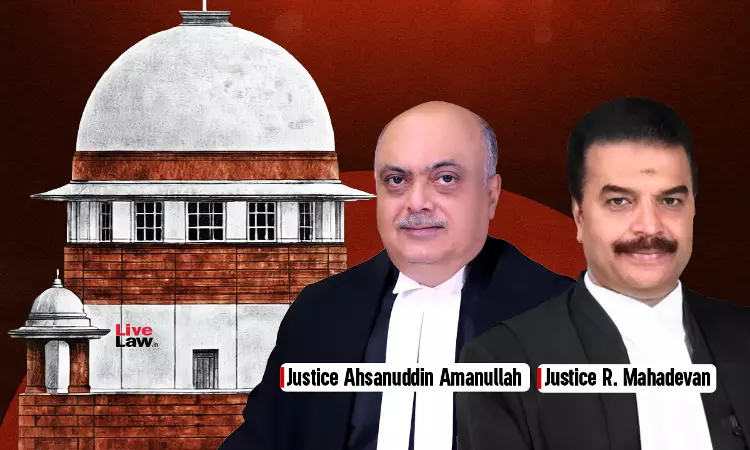
“…the defect relating to the absence of signature on the charge does not constitute an illegality. It is, at best, a curable procedural irregularity within the ambit of Sections 215 and 464 Cr.P.C. In the absence of any demonstrated failure of justice, such defect cannot vitiate the proceedings.”, observed a bench of Justices Ahsanuddin Amanullah and R Mahadevan, while setting aside the Allahabad High Court's order which had ordered a fresh trial against the nine-accused persons in a murder case merely because the trial court's order of charge framing remained unsigned, despite the accused persons were informed and made understood about the charges, moreover also participated in the trial.
Disagreeing with the impugned order, the Court observed that “where the accused (persons) clearly understood the nature of the allegations and had a full opportunity to defend themselves, defects in the charge cannot be treated as fatal.” It reasoned that “even the absence of a formally framed charge does not vitiate the proceedings. The decisive test is whether the accused was misled in the conduct of his defence and whether a failure of justice has resulted.”
The FIR under Sections 147, 148, 149, 307, 302 and 120B of the Indian Penal Code, 1860 was registered against the accused persons. The charge sheet was submitted to the trial court, and the case was committed to the Sessions Court for the trial. The trial court proceeded to frame the charges, to which the accused persons pleaded not guilty, therefore except one accused, the charges were framed against other accused persons, however, the order sheet remained unsigned.
The accused persons participated in the trial after framing of charges against them which were read and make over to them, and only at the stage of defence witness under Section 313 Cr.P.C., did the accused persons realise that the order framing charges remained unsigned, vitiating the trial.
With a prayer to seek a de novo trial, the accused persons filed an application before the High Court under Section 482 Cr.P.C., which was allowed by the High Court directing the fresh trial, prompting the complainant to appeal to the Supreme Court
Setting aside the impugned ruling, the judgment authored by Justice Mahadevan observed that merely the order sheet of charge framing remaining unsigned would not vitiate the proceedings, unless shown that the defect resulted in failure of justice to the accused persons.
"The defence actively participated in the proceedings and extensively cross-examined the prosecution witnesses. The nature of such cross-examination demonstrates that the accused were fully aware of the prosecution case, including their alleged roles, the manner of commission of the offence, and the defence sought to be set up, including the plea of alibi. The continued participation of the accused in the trial without raising any objection to the alleged defect in the charge further reinforces that they were not misled in any manner… The omission of a signature on the charge, though a procedural lapse, does not render the proceedings invalid when the charge was in fact prepared, recorded, read over, and acted upon by the Court and the parties. The record affirmatively demonstrates that the accused had full knowledge of the accusations and effectively contested the prosecution case. The nature of cross examination and the defence adopted leave no manner of doubt that the accused were neither misled nor prejudiced.”, the court observed
Accordingly, the Court held that “…the High Court was not justified in directing that the trial be conducted afresh after it had substantially progressed and evidence had already been recorded.”
Accordingly, the appeal was allowed, directing the trial Court to "proceed with the matter from the stage at which it stood prior to the passing of the impugned order, and shall make an endeavour to conclude the proceedings expeditiously in accordance with law."
Headnote
Criminal Procedure Code, 1973; Section 215, 228, 464, and 465 — Framing of Charge — Procedural Irregularity vs. Fundamental Illegality — De Novo Trial — The Supreme Court set aside a High Court order directing a fresh trial due to an unsigned formal charge-sheet - held that the purpose of framing a charge is to provide the accused with precise notice of accusations to enable an effective defense, rather than being a "mere ritualistic formality" - Where the record indicates that charges were read over and explained to the accused in the presence of counsel, and the accused subsequently participated in the trial for over fourteen years by extensively cross-examining witnesses, there is substantial compliance with Section 228 Cr.P.C. - A procedural lapse, such as the omission of a signature on a formal charge document, constitutes a curable irregularity under Sections 215 and 464 Cr.P.C. unless it is demonstrated that the accused was misled or that a "failure of justice" was occasioned.
Exceptional Nature of De Novo Trials — A direction for a de novo trial is an exceptional measure and should not be resorted to for mere procedural lapses, especially when a trial has substantially progressed and key prosecution witnesses have since expired - Ordering a fresh trial in the absence of demonstrated prejudice irretrievably prejudices the prosecution and defeats the interests of timely justice. [Relied on Willie (William) Slaney v. State of Madhya Pradesh (AIR 1956 SC 116); Main Pal v. State of Haryana (2010) 10 SCC 130; Ajay Kumar Ghoshal v. State of Bihar (2017) 12 SCC 699; Paras 14-17]
Cause Title: SANDEEP YADAV VERSUS SATISH & OTHERS
Citation : 2026 LiveLaw (SC) 296
Click here to download judgment
Appearance:
For Petitioner(s) : Mr. Rajul Bhargava, Sr. Adv. Mr. Kartikeya Bhargava, AOR Mr. Jasir Aftab, Adv.
For Respondent(s) :Mr. Vishwajit Singh, Sr. Adv. Ms. Veera Kaul Singh, AOR Ms. Lakshita Handa, Adv. Mr. Rohan Choudhary, Adv. Mr. Attau Rahman Masoodi, Sr. Adv. Mr. Adarsh Kumar Pandey, Adv. Mr. Arun Kanwa, Adv. Mr. Rohan Wadhwa, Adv. Mr. Mithilesh Kumar Jaiswal, Adv. Mr. Bidhan Chandra Pradhan, Adv. Mr. Birendra Kumar Mishra, Adv. Mr. Varun Rawat, Adv. Mr. Mukesh Kumar, AOR Mr. Vishwajit Singh, Sr. Adv. Mr. Pankaj Singh, AOR Ms. Ruchira Goel, AOR

Yash Mittal
Yash Mittal is a Correspondent with LiveLaw, covering the Supreme Court of India

