



- Home
- /
- Supreme court
- /
- 'Oral Dictation Not Final' :...
'Oral Dictation Not Final' : Supreme Court Slams Party Who Alleged Signed Order Favouring Adani Ports Was Not Same As Oral Order
Yash Mittal
13 May 2026 10:01 AM IST
The Supreme Court on Tuesday (May 12) held that an order/judgment dictated in an open court cannot be deemed as final, as it may be open to alteration or modification by the bench post-dictation. The Court said that only a signed order remains enforceable and binding. “The Court might dictate a draft to keep the facts fresh in the mind and the draft so dictated then becomes final only...
This is a premium content
Available exclusively to
Our subscribers
Subscribe Premium 
INR 1099+GST
Your support helps us to bring you more content at
an affordable subscription scheme !!!
All payment options available
The Supreme Court on Tuesday (May 12) held that an order/judgment dictated in an open court cannot be deemed as final, as it may be open to alteration or modification by the bench post-dictation. The Court said that only a signed order remains enforceable and binding.
“The Court might dictate a draft to keep the facts fresh in the mind and the draft so dictated then becomes final only after signing, subject to corrections and alterations which do not amount to a material change in the order. The signed order is what embodies the final unalterable opinion of the Court, it is the only version of the Court's order which is reached after multiple rounds of correction after dictation in Court.”, the court observed.
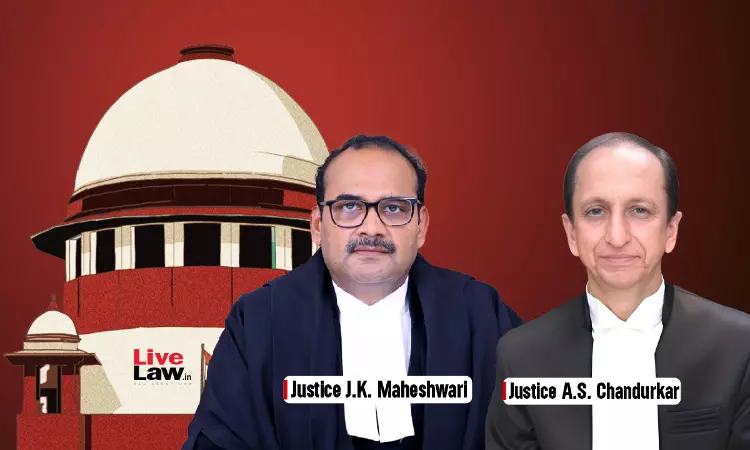
A bench of Justice J.K. Maheshwari and Justice Atul S. Chandurkar made the observation while dismissing a miscellaneous application filed in a dispute connected to land resumption proceedings in favour of the Appellants-landowners, against which the Adani Ports appealed to the Supreme Court.
The controversy arose from a public interest litigation pending before the Gujarat High Court concerning land allotted to entities connected with Adani Ports. During the pendency of the matter, the Gujarat High Court, by an interim order dated July 5, 2024, directed the State Government to proceed with resumption of the land in terms of a State resolution dated July 4, 2024 in favour of the Appellants.
Adani Ports challenged the High Court's order before the Supreme Court, contending that the State resolution directing resumption of land had been passed without granting it an opportunity of hearing and solely on oral instructions of the High Court.
On July 10, 2024, the Supreme Court stayed the High Court's interim order. Later, while finally disposing of the civil appeal on January 27, 2026, the Supreme Court set aside both the High Court's interim order and the State Government's resolution, while granting liberty to the State to pass a fresh order after hearing all affected parties.
However, a controversy subsequently emerged over what was allegedly dictated in open court on January 27, 2026.
The applicants contended that while dictating the order, the bench had orally directed that “status quo as it exists today shall be maintained” and had also indicated that the writ petition before the Gujarat High Court would continue independently. They argued that these directions were omitted from the signed order uploaded on February 12, 2026.
Relying on media reports, a YouTube recording of the court proceedings, and a transcript prepared by themselves, the applicants sought a declaration that the oral dictation constituted the real final order and that the digitally signed order “had no force of law”, as it altered or modified the order on material aspects.
Rejecting the plea, the judgment authored by Justice Maheshwari held that the signed order alone represented the final and binding decision of the Court.
The Court said that it would not have been occasioned to pass an order directing the 'status quo' without hearing the Respondents.
“When the order directing resumption of the land in question was found to be illegal due to want of hearing, on the admission of the State, there was no occasion for this Court to direct maintenance of status quo over the land since it would be an unreasonable restraint over the rights of the Respondent in respect of the land which was resumed.”, the court observed.
The Court effectively ruled that the absence of a grant of status quo in the signed order would not have amounted to a material change in an order dictated in open court.
“Grant of status quo or non-grant thereof is an ancillary direction and it cannot be said to be a material change in the draft order which could not have been made prior to signing of the order without re-hearing.”, the court observed, emphasizing that “the intent of the judge while making the dictation, therefore, becomes material. The Court might dictate a draft to keep the facts fresh in the mind and the draft so dictated then becomes final only after signing, subject to corrections and alterations which do not amount to a material change in the order. The signed order is what embodies the final unalterable opinion of the Court, it is the only version of the Court's order which is reached after multiple rounds of correction after dictation in Court.”
In terms of the aforesaid, the Miscellaneous Application was dismissed imposing costs of ₹2,000 each on the applicants, holding that the application amounted to a “gross abuse of process of law” and an attempt to “undermine the dignity of the Court and browbeat its authority.”
Headnote
Constitution of India, 1950 – Article 145(4) – Supreme Court Rules, 2013 – Order XII Rules 1 and 3 – Practice and Procedure – Status of Order Dictated in Open Court vs. Signed Order – Variance – Modification before Signing – Miscellaneous application filed seeking a clarification that a draft order dictated in open court is final and binding, and that the subsequent signed order uploaded later lacks the force of law due to the omission of an ancillary direction for status quo and the modification of a direction disposing of a Writ Petition – Held - Displaced the applicants' contention. A distinction must be drawn between the dictation of a draft order to a Court-master and the formal pronouncement of a judgment - The dictation of an order in open court serves as a skeletal framework to put facts on record, which remains subject to correction, refinement, and enhancement in chambers prior to signing - The digitally signed and uploaded order is the sole final expository of the Court's unalterable opinion - Judges retain a locus poenitentiae to change their mind or correct an error in law (such as the erroneous grant of an ancillary status quo order) before the judgment crystallizes through signing - Unless a material change is made to the core outcome behind the back of the parties without a re-hearing, refinements made in chambers do not invalidate the signed order. [Paras 15, 19 - 23, 25 - 28]
Practice and Procedure – Abuse of Process – Maintainability of Miscellaneous Applications in Disposed-of Matters – Absolute Bar on Review in the Garb of Clarification – Applicants sought to rewrite the final order under the guise of an application for clarification – Held - A post disposal miscellaneous application is not maintainable to challenge the validity of a signed order or to seek a material modification - It lies strictly for rectifying clerical or arithmetical errors, or in exceptional circumstances where the main order is executory and has become impossible to implement due to subsequent developments - Applicants failed to file the mandatory affidavit on solemn affirmation under Circular F.No.01/Judl./2025 verifying such executory impossibility - The application being a gross abuse of the process of law to browbeat the Court's authority, it was dismissed with exemplary costs. [Relied on Surendra Singh v. State of U.P., (1953) 2 SCC 468; Kushalbhai Ratanbhai Rohit v. State of Gujarat, (2014) 9 SCC 124; Ratilal Jhaverbhai Parmar v. State of Gujarat, 2024 SCC OnLine SC 2985; Paras 16 - 18, 19 - 31]
Cause Title: FAKIR MAMAD SULEMAN SAMEJA AND ORS. VERSUS ADANI PORTS AND SPECIAL ECONOMIC ZONES LTD. AND ORS.
Citation : 2026 LiveLaw (SC) 490
Appearance:
For Applicant(s) : Ms. Kamini Jaiswal, Adv. Ms. Rani Mishra, Adv. Mr. Abhimanue Shrestha, AOR
For Respondent(s) : Mr. Mukul Rohatgi, Sr. Adv. Mr. Mahesh Agarwal, Adv. Mr. Arshit Anand, Adv. Ms. Nidhi Sri, Adv. Mr. E. C. Agrawala, AOR

Yash Mittal
Yash Mittal is a Correspondent with LiveLaw, covering the Supreme Court of India

