



- Home
- /
- Supreme court
- /
- Original Status As Daily Wager...
Original Status As Daily Wager Cannot Be Ground To Deny Annual Increment After Regularisation : Supreme Court
Yash Mittal
6 Oct 2026 4:04 PM IST
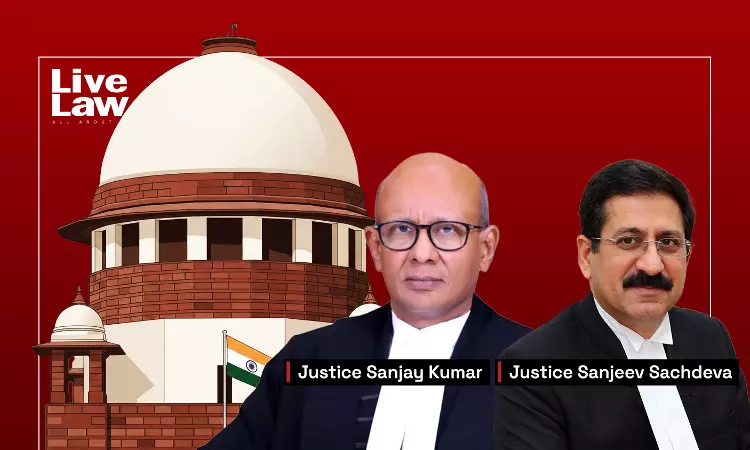
The Supreme Court on Tuesday (October 6) has held that daily-wage skilled workers who were treated as permanent employees under a government resolution and granted regular pay scales and retirement benefits cannot be denied the annual increment falling due after their retirement merely because they were originally engaged as daily wagers. Setting aside the Gujarat High Court's division...
This is a premium content
Available exclusively to
Our subscribers
Subscribe Premium 
INR 1099+GST
Your support helps us to bring you more content at
an affordable subscription scheme !!!
All payment options available
The Supreme Court on Tuesday (October 6) has held that daily-wage skilled workers who were treated as permanent employees under a government resolution and granted regular pay scales and retirement benefits cannot be denied the annual increment falling due after their retirement merely because they were originally engaged as daily wagers.
Setting aside the Gujarat High Court's division bench judgment, a bench of Justice Sanjay Kumar and Justice Sanjeev Sachdeva rejected the Gujarat government's contention that the appellants were not entitled to the increment because of their original appointment as a daily-wage worker.
The Court relied on the 1988 state government's resolution under which daily-wage skilled workers completing the prescribed service of ten years were treated as permanent employees and granted regular pay scales, allowances, pension and other retiral benefits.
“The learned Additional Solicitor General, appearing for the State and its authorities, does not dispute the fact that all the petitioners in the writ petition fell in the aforestated category of daily-wage skilled workers… the contention advanced before the Division Bench of the High Court that they were not entitled to grant of the increment only on the ground that they were daily wagers cannot be countenanced. This argument seems to have been made, ignoring the Government Resolution dated 17.10.1988 and the benefits that flowed therefrom.”, the Court observed.
The Case
The appellants had served in the Gujarat Irrigation Department for more than 30 years and had retired on June 30 in different years.
The dispute concerned the annual increment that would have fallen due on July 1, immediately after their retirement.
The Gujarat High Court's Single Judge had accepted their claim, relying on the Supreme Court's decision in Director (Administration and Human Resources), KPTCL v. C.P. Mundinamani, 2023 LiveLaw (SC) 296, where it was held that government employees cannot be denied the annual increment merely because they are to retire on the very next day of earning the increment.
The Single Judge had also directed payment of arrears and consequential revision of pension and retiral benefits.
However, the State challenged the decision before a Division Bench and, for the first time, contended that the employees were daily wagers and therefore could not claim the benefit recognised in C.P. Mundinamani.
The Division Bench accepted this argument and set aside the Single Judge's order, following which the retired employees approached the Supreme Court.
Decision
Allowing the appeal, the judgment authored by Justice Sanjay Kumar observed that the right of the Appellants-employees to claim the increment to be earned by them after one day of their retirement is no longer res integra as per C.P. Mundinamani, which was later followed in Union of India and another vs. M. Siddaraj (2023) governing the extent to which the benefit of the increment could be claimed by different categories of retired employees.
In essence, while C.P. Mundinamani and M. Siddaraj established the entitlement of June 30 retirees to the annual increment for pensionary purposes, the Supreme Court's subsequent order in Feb. 2025 in the M. Siddaraj proceedings restricted the retrospective monetary benefit, with Clause (d) ultimately allowing three years' enhanced pension preceding the filing of the employee's court proceeding.
Clause (d) says “In case any retired employee has filed an application for intervention/impleadment/writ petition/original application before the Central Administrative Tribunal/High Courts/this Court, the enhanced pension by including one increment will be payable for the period of three years prior to the month in which the application for intervention/impleadment/writ petition/original application was filed.”
Since the appellants had approached the High Court in 2022, they fell within the benefit of the Supreme Court's modified directions permitting enhanced pension, including the increment, for the specified three-year period preceding the filing of the proceedings.
“As it is an admitted fact that the appellants filed their writ petition in the year 2022 itself, they would be covered by the modified clause (d), which provided that enhanced pension, by including one increment, would be payable for the period of 3 years prior to the month in which the writ petition was filed. Therefore, the appellants would be entitled to the benefit of the increment and the pension payable, taking into account the said increment, in terms of the modified clause (d).”, the Court said.
The authorities were directed to calculate and release the amounts within 30 days. Failure to do so would attract 6% interest from the date of default.
The appeal was allowed.
Appearance:
For Petitioner(s) : Mr. C.B. Gururaj, Adv. Ms. Pragya Smriti, Adv. Mr. Hari Abishek P., Adv. Ms. Srishti, Adv. Mr. Naveen Chandrashekar, Adv. Mr. K.P. Singh, Adv. M/s. Gururaj & Nayak- 3630, AOR
For Respondent(s) : Ms. Archana Pathak Dave, A.S.G. Ms. Deepanwita Priyanka- 2618, AOR Ms. Priyal Sheth, Adv.
Tags

Yash Mittal
Yash Mittal is a Correspondent with LiveLaw, covering the Supreme Court of India

