



- Home
- /
- Supreme court
- /
- Para-Teachers' Claim For...
Para-Teachers' Claim For Regularisation Subject To Educational Standards Set By State : Supreme Court
Yash Mittal
7 May 2026 7:29 PM IST
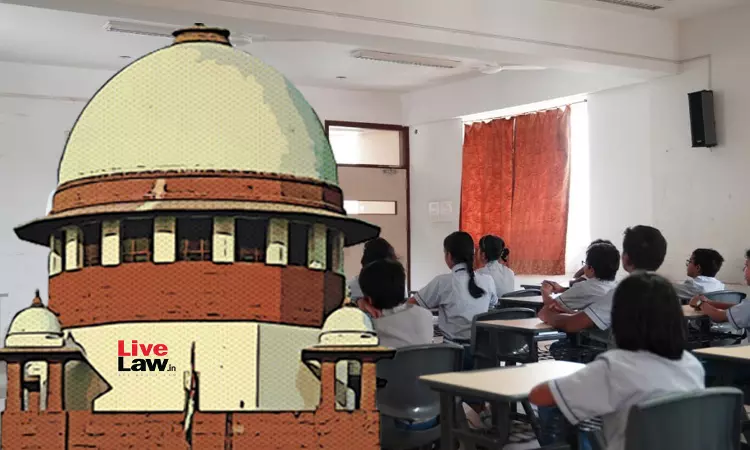
While the para-teachers desire that they be made Assistant Teachers, their desirability is tested by the Government to provide the best teachers in the field.
The Supreme Court has observed that a contractually employed teacher cannot claim regularization through a judicial order as a matter of right merely on account of their long-term service, as it leads to creating a parallel mode of public recruitment outside statutory rules. A bench of Justice Pankaj Mithal and Justice SVN Bhatti said that while it is reasonable for the ad hoc teacher...
This is a premium content
Available exclusively to
Our subscribers
Subscribe Premium 
INR 1099+GST
Your support helps us to bring you more content at
an affordable subscription scheme !!!
All payment options available
The Supreme Court has observed that a contractually employed teacher cannot claim regularization through a judicial order as a matter of right merely on account of their long-term service, as it leads to creating a parallel mode of public recruitment outside statutory rules.
A bench of Justice Pankaj Mithal and Justice SVN Bhatti said that while it is reasonable for the ad hoc teacher to “desire” to be a government teacher, it is also the State's duty to assess the “desirability” of candidates for ensuring quality education.
The Court effectively held that while para-teachers may legitimately aspire for regular government posts, the State retains the constitutional authority under Article 309 of the Constitution to determine who is suitable and qualified to hold teaching positions through statutory recruitment processes.
“With the parateachers' long-stated experience, the claim for regularisation is certainly a legitimate expectation. However, whether the para-teachers deserve a regular government post, is subsumed by the educational standards expected by the State from its teachers and the short-term and long-term goals that the State has set for itself in imparting education to its wards.”, the court observed, stressing upon the need of the hour to strengthen education, particularly at the primary and secondary levels, rather than subsidising it with ad hoc measures.
The case arose from a batch of appeals filed by para-teachers engaged under the Sarva Shiksha Abhiyan (SSA) in Jharkhand. The appellants had been working for periods ranging from 5 to 15 years on fixed honorariums of around Rs. 7,400 to Rs. 8,400 per month. They sought regularisation as Assistant Teachers/Sahayak Acharyas, pay parity with regular government teachers, and a declaration that the Jharkhand Primary School Recruitment Rules, 2012 were unconstitutional to the extent they failed to provide automatic absorption.
The para-teachers argued that they had effectively performed the same teaching functions as regular teachers and had been selected through processes substantially similar to those applicable to permanent appointments. They also highlighted the vast salary disparity between para-teachers and regular government teachers.
The State opposed the petitions, contending that para-teachers were engaged only on contractual terms under a centrally sponsored scheme and had no right to automatic regularisation. It further argued that regularisation through judicial orders would violate constitutional requirements governing public employment under Articles 14 and 16.
The Jharkhand High Court dismissed the writ petitions, leading to the batch of appeals before the Supreme Court.
Refusing to interfere with the High Court's decision, the judgment authored by Justice Bhatti acknowledged the long years of service rendered by para-teachers and the economic vulnerabilities associated with contractual employment. However, it held that such factors alone cannot justify wholesale regularisation in violation of constitutional recruitment norms laid down in Secretary, State of Karnataka v. Umadevi (2006) 4 SCC 1.
The Court noted that the State had already created a statutory mechanism reserving 50% of vacancies in regular teacher recruitment for para-teachers under the 2012 Rules as well as the Jharkhand Elementary School Sahayak Acharya Cadre Rules, 2022. However, it faulted the State for not periodically honouring the Rules to enable regular recruitment of para-teachers.
“The State of Jharkhand ought not to delay in issuing a notification exclusively for para-teachers for their appointment as Assistant Teachers/Sahayak Acharya. For policy and practical reasons, and given the financial implications for the exchequer, the State of Jharkhand must explore the option of notifying exclusively the 50 per cent of vacant posts marked as Assistant Teachers under the 2012 and 2022 Rules. The sense of security of employment is a sine qua non for enhancing efficiency in any service, and education is no different. The teacher-student bond is not temporary but spans the academic years. Expecting a para-teacher, without a guarantee of their employment, to guarantee a child's future and education is fallacious. The time has come for the executive to conduct periodic performance audits and eliminate ad hocism in public employment.”, the court observed.
In terms of the aforesaid, the appeals were disposed of, with the aforesaid direction to implement the Rules for periodical regularisation of the para teachers regularly.
While concluding the judgment, the Court observed :
"Dr. Sarvepalli Radhakrishnan believed that the relationship between teachers and students is of a sacred character. He further stated that “the kind of education that we provide for our youth is determined overwhelmingly by the kind of men and women we secure as teachers.” It is in the light of this elevated ideal that the present case must be understood.
With the para- teachers' long-stated experience, the claim for regularisation is certainly a legitimate expectation. However, whether the para-teachers deserve a regular government post, is subsumed by the educational standards expected by the State from its teachers and the short-term and long-term goals that the State has set for itself in imparting education to its wards. The need of the hour is to strengthen education, particularly at the primary and secondary levels, rather than subsidising it with ad hoc measures.
Providing education itself is not the objective, but providing comprehensive, high-quality education is. While the para-teachers desire that they be made Assistant Teachers, their desirability is tested by the Government to provide the best teachers in the field. In brief, the State examines the individual's desire to determine whether the individual deserves to hold the post. Whether this balance has been correctly struck within the framework of Articles 14, 16, and 309 of the Constitution of India is the central question we have answered in these Appeals."
Headnote
Public Employment — Regularisation of Para-Teachers / Contractual Employees — Scheme-based appointments vs. Cadre posts — Para-teachers engaged on a contractual basis under the Sarva Shiksha Abhiyan ("SSA") sought blanket regularisation as permanent Assistant Teachers/Sahayak Acharyas bypassing the statutory recruitment rules — Held that a prayer for regularisation from a scheme post to a State cadre post changes the character of the appointment - A scheme post under the SSA is jointly funded and continues until the scheme ceases, whereas a cadre post is governed by Article 309 of the Constitution of India creating public employment via constitutionally aligned recruitment processes - A direct leap from one to the other, bypassing statutory rules, creates an unsanctioned mode of recruitment which is prohibited - Para-teachers have a right to participation and consideration under the statutory rules, but do not possess an absolute right to blanket regularisation. [Paras 19 - 21]
Constitution of India — Articles 14, 16, 226, 142 and 309 — Mandamus for Regularisation contrary to Statutory Rules — High Court dismissed writ petitions filed by contractual para-teachers seeking regularisation — Held that Courts exercising powers under Articles 226 or 142 cannot issue a mandamus to regularise services contrary to the statutory scheme or rules made under Article 309 - Adherence to statutory rules must be insisted upon to protect the rights of open-market candidates and preserve the constitutional guarantees of equal opportunity in public employment. [Paras 11 - 21]
Equal Pay for Equal Work — Principle Explained — Claim for pay parity by contractual para-teachers with regular Assistant Teachers—Held: Equal pay for equal work is not an automatic entitlement. The claimant must demonstrate that their duties, responsibilities, qualifications, accountability, and conditions of service are qualitatively and substantially identical to those of regular employees. Contractual para-teachers, though performing similar classroom functions, are not assigned the full range of responsibilities attached to regular Assistant Teachers. [Para 20-25]
Moulding of Relief — Elimination of Ad-hocism & Timely Recruitment — Though blanket regularisation was denied, the State of Jharkhand had earmarked a 50% horizontal quota for para-teachers in its 2012 and 2022 Recruitment Rules — Held: The State cannot resist the prayer for regularisation while simultaneously failing to give effect to its own statutory mechanism for absorbing para teachers. To ensure security of employment and eliminate perpetual ad-hocism, the Court molded the relief by issuing a strict time-bound calendar (Immediate and Annual Recurring Schedules) directing the State to notify and fill the 50% earmarked vacancies exclusively from eligible para-teachers every academic year. [Relied on State of Karnataka v. Umadevi (3), (2006) 4 SCC 1; State of Punjab v. Jagjit Singh, (2017) 1 SCC 148; Vinod Kumar v. Union of India, (2024) 9 SCC 327; Union of India v. Ilmo Devi, (2021) 20 SCC 290; Paras 23, 24]
Cause Title: SUNIL KUMAR YADAV AND OTHERS VERSUS THE STATE OF JHARKHAND AND OTHERS (With connected matters)
Citation : 2026 LiveLaw (SC) 470
Click here to download judgment
Appearance:
For Petitioner(s)/ Mr. Colin Gonsalves, Sr. Adv.(argued by) Ms. Tanya Agarwal, Adv. Mr. Krishna Kumar Keshav, Adv. Mrs. Shubhangi Tuli, AOR Mr. Gopal Sankaranarayanan, Sr. Adv.(argued by) Dr. Rajiv Nanda, Sr. Adv.(argued by) Mr. Brajesh Pandey, Adv. Mr. Shashank Ratnoo, Adv.(argued by) Mr. Shantanu Lakhotia, Adv. Mr. Divyaveer Singh, Adv. Mr. Kanchan Kumar Jha, Adv. Mr. Paramhans Sahani, Adv. M/s. Brajesh Pandey & Associates, AOR Mr. Anilendra Pandey, AOR Mr. Prashant Bhushan, AOR (argued by) Ms. Alice Raj, Adv. Mr. Narendra Kumar, Adv.(argued by) Mr. Santosh Kumar Vishwakarma, Adv. Mr. Santosh Kumar Pandey, AOR Mr. Rajiv Ranjan Dwivedi, AOR Mr. Sanjay Kumar Mishra, Adv. Mr. Vishal, Adv. Mrs. Subhadra Dwivedi, Adv. Mr. Amitabh Singh, Adv. Mr. Binay Kumar Das, AOR Mr. Sandeep Jha, Adv. Mr. Ram Ekbal Roy, Adv. Ms. Priyanka Das, Adv. Ms. Neha Das, Adv. Mr. Aman Nihal, Adv. Mr. Sanjay Kumar Singh, Adv. Ms. Tanya Agarwal, AOR Mr. Krishna Kumar Keshav, Adv.
For Respondent(s)/ Mr. Arunab Choudhary, Sr. A.A.G. (Argued by) For State Mr. Vishnu Sharma, Adv. Ms. Madhusmita Bora, AOR Mr. Pawan Kishore Singh, Adv. Mr. Dipankar Singh, Adv. Ms. Pavithra V., Adv. Mr. Krishna Murari, Adv. (argued by) Mr. Satya Mitra, AOR Mr. Gurmeet Singh Makker, AOR Mr. Satyajeet Kumar, AOR Mr. Abhishek Tiwari, Adv. Mr. Goutam Prasad, Adv. Mr. S.D.Sanjay, A.S.G. Mr. Ashok Panigrahi, Adv. Mr. Shantanu Sharma, Adv. Mr. Priyanka Terdal, Adv. Mr. Krishna Kant Dubey, Adv. Mr. Akshay Amritanshu, Adv. Mr. Arun Kumar Yadav, Adv. Mr. Raj Bahadur Yadav, AOR Ms. Tanya Agarwal, AOR Mr. Krishna Kumar Keshav, Adv.
Tags

Yash Mittal
Yash Mittal is a Correspondent with LiveLaw, covering the Supreme Court of India

