



- Home
- /
- Supreme court
- /
- Passport Renewal Can't Be Denied...
Passport Renewal Can't Be Denied Due To Pendency Of Criminal Case When Trial Court Has Permitted Renewal : Supreme Court
Yash Mittal
20 Dec 2025 9:26 AM IST
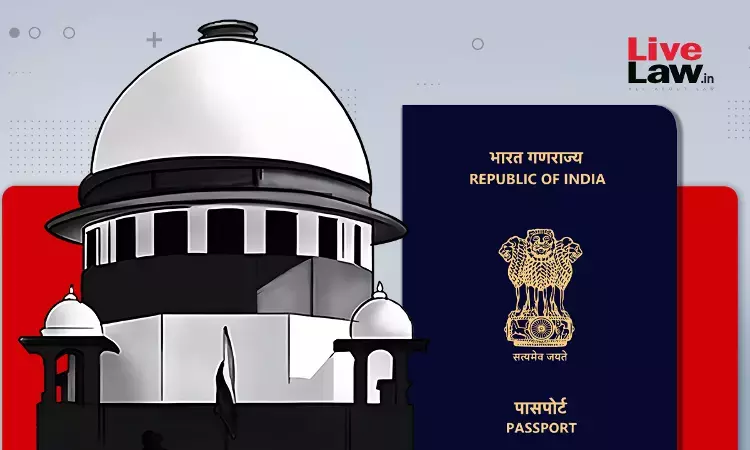
The Court stressed that the freedom of a citizen to travel, subject to law, is an essential part of the guarantee under Article 21.
The Supreme Court of India has held that pendency of criminal proceedings cannot be used to impose an indefinite bar on renewal of a passport, particularly where competent criminal courts have permitted such renewal while retaining control over any foreign travel.A Bench of Justice Vikram Nath and Justice Augustine George Masih allowed an appeal filed by businessman Mahesh Kumar Agarwal,...
This is a premium content
Available exclusively to
Our subscribers
Subscribe Premium 
INR 1099+GST
Your support helps us to bring you more content at
an affordable subscription scheme !!!
All payment options available
The Supreme Court of India has held that pendency of criminal proceedings cannot be used to impose an indefinite bar on renewal of a passport, particularly where competent criminal courts have permitted such renewal while retaining control over any foreign travel.
A Bench of Justice Vikram Nath and Justice Augustine George Masih allowed an appeal filed by businessman Mahesh Kumar Agarwal, and directed the Ministry of External Affairs and the Regional Passport Office, Kolkata, to re issue his ordinary passport for the normal period of ten years.
“This Court has repeatedly held in a catena of judgements that the right to travel abroad and the right to hold a passport are facets of the right to personal liberty under Article 21 of the Constitution of India. Any restriction on that right must be fair, just and reasonable, and must bear a rational nexus with a legitimate purpose.”, observed the bench, while setting aside the Calcutta High Court's decision which denied renewal of the Appellant's passport, merely on account of a criminal proceedings under NIA Act and UAPA being pending against him.
Liberty Is The Rule, Restriction The Exception
Writing for the Bench, Justice Vikram Nath underscored that liberty under Article 21 is not a gift of the State but its first obligation.
“The freedom of a citizen to move, to travel, to pursue livelihood and opportunity is an essential part of Article 21. Any restraint must be narrowly confined, proportionate and clearly anchored in law,” the Court observed.
The Court cautioned that procedural safeguards should not be converted into rigid barriers, or temporary disabilities allowed to harden into indefinite exclusions.
Liberty, in our constitutional scheme, is not a gift of the State but its first obligation. The freedom of a citizen to move, to travel, to pursue livelihood and opportunity, subject to law, is an essential part of the guarantee under Article 21 of the Constitution of India. The State may, where statute so provides, regulate or restrain that freedom in the interests of justice, security or public order but such restraint must be narrowly confined to what is necessary, proportionate to the object sought to be achieved, and clearly anchored in law. When procedural safeguards are converted into rigid barriers, or temporary disabilities are allowed to harden into indefinite exclusions, the balance between the power of the State and the dignity of the individual is disturbed, and the promise of the Constitution is put at risk.
Background
The Appellant's passport had expired in August 2023. While both the NIA Court in Ranchi and the Delhi High Court (where his appeal against a CBI conviction is pending) had granted “no objection” for renewal, they imposed strict conditions: he could not travel abroad without prior court permission, and the Ranchi court ordered the renewed passport to be re-deposited with it.
Despite these judicial permissions, the Passport Authority refused renewal, citing the embargo under Section 6(2)(f) of the Passports Act, 1967, which mandates refusal if criminal proceedings are pending. The Calcutta High Court upheld this refusal, interpreting the law to mean that unless the criminal court's order specified permission for a particular foreign trip, the bar was absolute.
Finding the High Court's approach to be erroneous, the judgment authored by Justice Nath that the sole purpose of Section 6(2)(f) of the Passports Act, 1967 is to ensure an accused's availability before the court, not to impose a permanent disability.
The Supreme Court held that Section 6(2)(f) of the Passports Act is not an absolute bar and must be read along with Section 22 and the exemption notification GSR 570(E).
“Both have treated Section 6(2)(f) as an absolute bar so long as any criminal proceeding is pending, without giving full effect to the statutory exemption mechanism under Section 22 and GSR 570(E), and without adequately appreciating that the criminal courts actually dealing with the appellant's cases have consciously permitted renewal while retaining stringent control over any foreign travel. They have, in effect, converted a qualified restriction, designed to secure the presence of an accused, into a near-permanent disability to hold a valid passport, even where the criminal courts themselves do not consider such a disability necessary.”, the court observed.
“The legitimate purpose behind Section 6(2)(f) and Section 10(3)(e) is to ensure that a person facing criminal proceedings remains amenable to the jurisdiction of the criminal court. That purpose is fully served in the present case by the conditions imposed by the NIA Court, Ranchi, and the Delhi High Court, which require the appellant to seek prior permission before any foreign travel and, in the NIA case, to re-deposit the passport immediately after renewal. To add to these safeguards an indefinite denial of even a renewed passport, when both criminal courts have consciously permitted renewal, would be a disproportionate and unreasonable restriction on the appellant's liberty.” the court observed, adding that “To refuse renewal on the speculative apprehension that the appellant might misuse the passport is, in effect, to second-guess the criminal courts' assessment of risk and to assume for the passport authority a supervisory role which the statute does not envisage.”
Accordingly, the appeal was allowed.
Cause Title: MAHESH KUMAR AGARWAL VERSUS UNION OF INDIA & ANR.
Citation : 2025 LiveLaw (SC) 1238
Click here to download judgment
Appearance:
For Petitioner(s) : Mr. Gopal Subramanium, Sr. Adv. Mr. Anup Kumar, AOR Ms. Gauri Subramanium, Adv. Mrs. Shruti Singh, Adv. Mrs. Neha Jaiswal, Adv. Mr. Shivam Kumar, Adv. Mr. Abhisek Kumar, Adv. Ms. Vartika Vaishnavi, Adv. Mr. Raghav Kohli, Adv. Mr. Adnam Yousaf, Adv.
For Respondent(s) : Mrs. Aishwarya Bhati, A.S.G. Mr. Raj Bahadur Yadav, AOR Ms. Chitrangda Rastravara, Adv. Mr. Gopi Chand, Adv. Mr. Ashok Kumar B, Adv. Mr. Arun Kumar Yadav, Adv. Mr. Raghav Sharma, Adv.
Tags

Yash Mittal
Yash Mittal is a Correspondent with LiveLaw, covering the Supreme Court of India

