



- Home
- /
- Supreme court
- /
- Pendency Of Criminal Case No Ground...
Pendency Of Criminal Case No Ground To Discharge Public Servant: Supreme Court
Yash Mittal
22 Aug 2026 6:05 PM IST
The Court also observed that release on probation does not bar disciplinary proceedings against the officer.
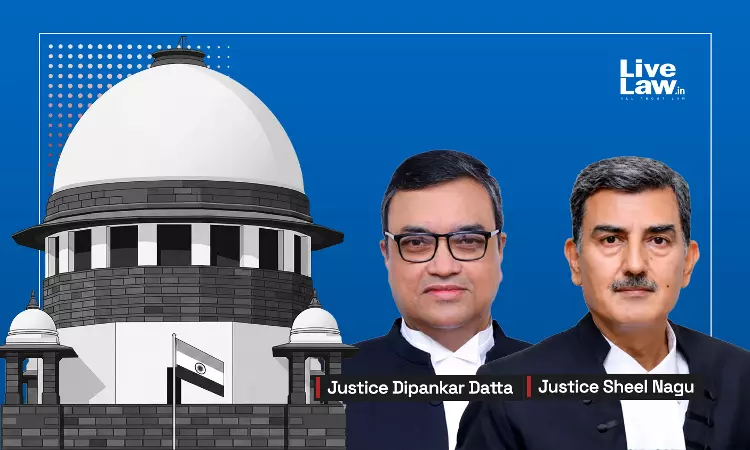
The Supreme Court has held that a public employer cannot discharge an employee merely because a criminal case is pending against him, particularly when the employee has not been allowed to defend himself. A bench of Justice Dipankar Datta and Justice Sheel Nagu held that the discharge of a police constable was illegal because, at the time of his removal, there was no conviction against him...
This is a premium content
Available exclusively to
Our subscribers
Subscribe Premium 
INR 1099+GST
Your support helps us to bring you more content at
an affordable subscription scheme !!!
All payment options available
The Supreme Court has held that a public employer cannot discharge an employee merely because a criminal case is pending against him, particularly when the employee has not been allowed to defend himself.
A bench of Justice Dipankar Datta and Justice Sheel Nagu held that the discharge of a police constable was illegal because, at the time of his removal, there was no conviction against him and the order was based solely on the pendency of the criminal case.
“Appellant was discharged from service not because of his conviction on a criminal charge but merely on the ground of pendency of the criminal case. He was not given an opportunity of raising his defence. We have not been shown any law which authorises a public employer to either dismiss or remove an employee serving the police for more 12 than a decade solely on the ground of pendency of a criminal case. The act of termination of service, in the circumstances, cannot be justified.”, the Court said.
The Court, however, declined to order reinstatement after more than two decades and, exercising its powers under Article 142 of the Constitution, directed the State to pay the appellant ₹5 lakh as compensation.
Background
The appellant had initially been appointed as a Special Police Officer in the Punjab Police in 1991 and was subsequently selected for appointment as a Constable in the First Indian Reserve Battalion, Patiala.
Although he was selected for the post in August 2002, he was denied joining when he reported for duty on August 30, 2002.
The reason cited was the pendency of an FIR registered against him under Sections 324, 326 and 34 of the Indian Penal Code.
On January 14, 2003, the appellant was discharged from service while the criminal case was still pending; however, no conviction order was recorded against him.
Later, the appellate court subsequently maintained his conviction under Section 324 IPC but set aside the conviction under Section 326 IPC and released him on probation under the Probation of Offenders Act, 1958.
The appellate court had also observed that the conviction would not affect his service career. Aggrieved by the Respondent's decision refusing to reinstate him to the service, the Appellant filed an appeal before the Supreme Court.
While agreeing with the Appellant's contention that the discharge was wrong at the time when only a criminal case was pending against him, the Court disagreed with the Appellant's contention regarding the reinstatement to the services owing to his release under the probation, saying that probation doesn't erase the conviction, which doesn't bar the removal from service solely based on the conviction.
“...mere release of a convict on probation under the 1958 Act does not wash away the conviction and even though benefit is given under the 1958 Act, the convicted person can be removed from service solely based on his conviction.”, the Court said.
Mere release on probation does not bar dismissal from service based on employee's conduct in crime
“Release on probation does not obliterate the conviction. Primary object of releasing a convict on probation is his reformation and rehabilitation as a useful and self-reliant member of society without subjecting him to the deleterious effects of prison life. However, on the ground of conduct which has led to his conviction on a criminal charge notwithstanding release on probation, the holder of a civil post under the State can be proceeded against in view of the second proviso to clause (2) of Article 311 and be dismissed or removed from service or reduced in rank without any enquiry.”, the Court said.
However, noting that since the Appellant was not convicted at the time of his discharge, therefore, finding the discharge order to be illegal, the Court, instead of reinstating the Appellant, has invoked its inherent jurisdiction under Article 142 of the Constitution, directing the respondents to pay ₹5,00,000 to the appellant within three months.
The appeal was disposed of in the aforesaid terms.
Headnote
Probation of Offenders Act, 1958 – Section 12 – Removal of disqualification attaching to conviction – Effect on Public Employment – Termination/Dismissal based on conviction – Scope of non-obstante clause - Section 12 of the Probation of Offenders Act, 1958 does not obliterate or wash away a criminal conviction, nor does it preclude the employer from taking disciplinary action or removing a public servant based on the conduct leading to conviction - Release of a convict on probation is primarily intended for reformation and rehabilitation, but does not confer a right to continue in service - The words "shall not suffer disqualification, if any, attaching to a conviction of an offence under such law" in Section 12 refer to statutory disqualifications under other general or special enactments and do not override constitutional provisions, including the second proviso to Article 311(2) of the Constitution - an employee cannot claim reinstatement merely because the criminal court released them on probation or directed that the conviction would not affect their service career. [Paras 17-21]
Service Law – Termination/Discharge based solely on Pendency of Criminal Case – Illegality and Violation of Natural Justice – Subsequent conviction does not cure initial invalidity - Discharge or termination of an employee serving the police force for over a decade solely on the ground of the pendency of a criminal case, without affording an opportunity of hearing or conducting an enquiry, is arbitrary, unlawful, and unsustainable in law - A subsequent conviction recorded against the employee at a later date cannot cure or validate the fundamental illegality that vitiated the discharge order at the time it was passed. [Paras 24-26]
Specific Relief Act, 1963 – Section 14 – Civil Suit for Reinstatement – Constitution of India – Article 142 – Compensation in lieu of Reinstatement - A civil court, bound by the procedural rigours of the Code of Civil Procedure, 1908, cannot grant a decree for reinstatement in service in view of the bar contained in Section 14 of the Specific Relief Act, 1963; the remedy lies only in claiming damages - where a public servant was subjected to an illegal discharge solely due to pending criminal proceedings and denied procedural justice, the Supreme Court exercised its plenary jurisdiction under Article 142 of the Constitution to do complete justice by directing the State to pay lump-sum compensation of Rs. 5,00,000/- (Rupees Five Lakh) in lieu of reinstatement. [Relied on Sushil Kumar Singhal v. Punjab National Bank, (2010) 8 SCC 573; Punjab Water Supply Sewerage Board v. Ram Sajivan, (2007) 9 SCC 86; DIG of Police v. P.R.K. Mohan, (1997) 11 SCC 571; Paras 24-27]
Cause Title: SPO/CONSTABLE IRB SATPAL SINGH VERSUS STATE OF PUNJAB & ORS.
Citation : 2026 LiveLaw (SC) 845
Appearance:
For Appellant(s) : Mr. Pardeep Gupta, Adv. Mr. Parinav Gupta, Adv. Mrs. Mansi Gupta, Adv. Mr. Rakshit Rathi, Adv. Ms. Nandani Gupta, Adv. Dr. Mrs. Vipin Gupta, AOR Mr. Krishna Kumar, Adv.
For Respondent(s) :Mr. Karan Sharma, AOR Mr. Mohit Siwach, Adv.
Tags

Yash Mittal
Yash Mittal is a Correspondent with LiveLaw, covering the Supreme Court of India

