



- Home
- /
- Supreme court
- /
- Personal Hearing Of Borrower Not...
Personal Hearing Of Borrower Not Necessary Before Banks Declare Account 'Fraud' : Supreme Court Clarifies 'Rajesh Agarwal' Verdict
Yash Mittal
7 April 2026 6:31 PM IST
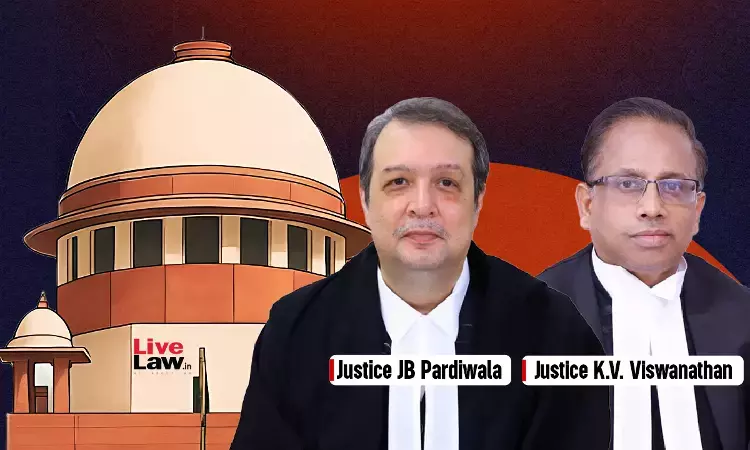
Opportunity of hearing doesn't mean oral hearing of the borrower, the Court said.
The Supreme Court on Tuesday (April 7) held that borrowers have no legal right to a personal (oral) hearing before their account is classified as "fraud" by banks under the guidelines of the Reserve Bank of India(RBI). However, the court said that defaulters must be given the full forensic audit report to respond effectively. A bench of Justices J.B. Pardiwala and K.V. Viswanathan set aside...
This is a premium content
Available exclusively to
Our subscribers
Subscribe Premium 
INR 1099+GST
Your support helps us to bring you more content at
an affordable subscription scheme !!!
All payment options available
The Supreme Court on Tuesday (April 7) held that borrowers have no legal right to a personal (oral) hearing before their account is classified as "fraud" by banks under the guidelines of the Reserve Bank of India(RBI). However, the court said that defaulters must be given the full forensic audit report to respond effectively.
A bench of Justices J.B. Pardiwala and K.V. Viswanathan set aside the Calcutta High Court's ruling, which had relied on the Supreme Court's 2023 ruling in State Bank of India v. Rajesh Agarwal to direct the appellant bank to grant the respondent a personal oral hearing before declaring his account as fraud.
The bench was hearing appeals filed by State Bank of India and Bank of India against the rulings of various High Courts requiring banks to grant borrowers a personal (oral) hearing and to provide the entire forensic audit report before declaring accounts as fraud.
The banks argued that such requirements were not mandated under law and would delay fraud detection. The Reserve Bank of India also supported the banks' stand.
Finding force in the bank's arguments, the Court clarified that Rajesh Agarwal (supra) did not grant borrowers any right to a personal hearing before their accounts are classified as fraud. It explained that the judgment only required that borrowers be given a notice and an opportunity to respond to the findings of the forensic audit report. No requirement of a personal hearing was laid down. The Court noted that a misinterpretation of this judgment had led banks to withdraw 783 fraud cases involving about ₹1.12 lakh crore.
The Court agreed with the banks' argument that granting a personal oral hearing in fraud cases could hinder justice. Instead, it held that issuing a show cause notice, providing the relevant evidence, allowing the borrower to respond in writing, and passing a reasoned order is sufficient to ensure fairness and prevent any miscarriage of justice. The bench reasoned that fraud classification proceedings are largely based on documentary evidence and requiring personal hearings in thousands of such cases would delay the process, burden banks, and risk dissipation of assets.
“We are persuaded to accept the stand of the RBI that the procedure of issuing a show cause notice, furnishing of the evidentiary material, eliciting a reply and the obligation to pass a reasoned order will meet the requirements of fairness and also thwart mis-carriage of justice.”, the court observed.
The Court clarified that the absence of a personal hearing does not invalidate the process.
“The RBI considering the fact that frauds in accounts are of various hues has opined that granting a right of personal hearing to each and every borrower would be practically inexpedient considering a large volume of cases that have already arisen. Independent of this, as rightly contended by the RBI, the classification of fraud is predominantly based on documentary evidence such as financial statements, transaction records, stock statements and security valuations and other documentary evidence. Oral hearing is bound to convert an administrative process which was intended to be swift, into a protracted one, defeating the very purpose of the exercise. It would also cause significant logistical and infrastructural burden apart from providing opportunity to recalcitrant borrowers who are in possession of the money of the depositors to dissipate assets, destroy evidence or even abscond causing enormous prejudice to public interest. It will also put public money in jeopardy as borrowers will continue to enjoy exposures from banks. Logistically also, it will seriously encumber the working hours of the bank officials. While consideration of the representation and the making of a reasoned order could be made by the committee even beyond banking hours, a personal hearing would mean that it will have to be held during office hours. This will also cause enormous inconvenience to public interest.”, the court observed.
Forensic Audit Report Must Be Supplied To Defaulter
The Court, however, held that banks must provide the complete forensic audit report, not just a summary. It observed that without access to the full report, borrowers cannot properly defend themselves. However, the Court allowed limited redaction of sensitive third-party information if justified.
“Wherever audit reports are available, including forensic audit reports, the same shall be furnished to the borrower and their representation on the report, including on the findings and conclusions be elicited, in case the banks consider the audit report relevant for classifying the account as fraud account. In view of the same, disclosure by furnishing copies of the audit report, including the forensic audit report to the borrower is mandatory. Supply of reports in digital form will be valid compliance...”, the court observed.
Accordingly, the appeal was partly allowed, with a direction to the banks to provide borrowers with the full forensic audit report, allow them to submit a written reply, and accordingly pass a fresh, reasoned order.
The requirement of a personal oral hearing was dispensed with in terms of the aforesaid judgment.
Headnote
Banking Law — Reserve Bank of India (Fraud Risk Management in Commercial Banks) Directions, 2024 — Master Directions on Frauds, 2016 — Classification of Accounts as "Fraud" — Principles of Natural Justice — Right to Personal Hearing — Disclosure of Forensic Audit Reports - Right to Personal Hearing - Whether the principle of audi alteram partem mandates the grant of a personal/oral hearing to a borrower before their account is classified as a "fraud account" under the RBI Master Directions - Held: No, The Supreme Court clarified that the decision in State Bank of India v. Rajesh Agarwal (2023) 6 SCC 1 did not recognize an inherent right to a personal hearing - Natural justice is a flexible concept adapted to administrative realities - In the context of fraud classification an internal administrative process for risk mitigation the requirements of fairness are satisfied by the issuance of a detailed Show Cause Notice (SCN), providing the relied-upon evidentiary material, considering the borrower's written representation, and passing a reasoned order - Granting a mandatory oral hearing would defeat the objective of swift detection, encumber banking operations, and provide recalcitrant borrowers opportunities to dissipate assets or abscond. [Paras 74 - 93, 126]
Disclosure of Forensic Audit Reports - Whether banks are obligated to furnish the entire Forensic Audit Report (FAR) to the borrower before declaring an account as "fraud." - Held: Yes, Consistent with Rajesh Agarwal case and T. Takano v. SEBI (2022) 8 SCC 162, held that the disclosure of the FAR is the rule - Findings and conclusions alone are insufficient, as reasons for such findings are contained in the body of the report - Relevant material must be disclosed to allow the borrower to identify errors or omissions – Exception - Banks may redact or withhold portions of the report if they establish that disclosure would affect third-party privacy or rights, provided the reasons for such withholding are recorded. [Relied on State Bank of India v. Rajesh Agarwal (2023) 6 SCC 1; T. Takano v. Securities and Exchange Board of India (2022) 8 SCC 162; Paras 118 - 126]
Cause Title: State Bank of India Versus Amit Iron Private Limited & Ors. (with connected case)
Citation : 2026 LiveLaw (SC) 337
Click here to download judgment
Appearance:
For Petitioner(s) :Mr. Tushar Mehta, Solicitor General Mr. Chandrashekhar A. Chakalabbi, AOR Mr. S.k. Pandey, Adv. Mr. Awanish Kumar, Adv. Mr. Anshul Rai, Adv. Mr. Jatin Kumar, Adv. Mr. Rahul Singh Latwal, Adv. Mr. Tushar Mehta, Solicitor General Mr. Sanjay Kapur, AOR Mr. Surya Prakash, Adv. Ms. Shubhra Kapur, Adv. Mr. Abhishek Tiwari, Adv. Mr. Anuraj Mishra, Adv. Mr. Aman Mehta, Adv.
For Respondent(s) :Mr. Parag P. Tripathi, Sr. Adv. Mr. Nakul Mohta, Adv. Ms. Misha Rohatgi, AOR Mr. Ayush Kashyap, Adv. Mr. Amulya Upadhyay, Adv. Ms. Aparajito Sen, Adv. Ms. Rini Mehra, Adv. Mr. Rajat Nair, AOR Mr. K. Parmeshwar, Sr. Adv. Mr. Suryaksh Manot, Adv. Mr. Randeep Sachdeva, Adv. Mr. Shivang Gupta, Adv. Mr. Dhruv Pande, Adv. Mr. Akshaja Singh, Adv. Mr. Alok Dubey, Adv. Ms. Veda Singh, Adv. Mr. Prasad Hegde, Adv. Mr. N Sai Kaushal, Adv. Mr. Pallav Pal, Adv. Mr. Venkatesh Dhond, Sr. Adv. Mr. Ramesh Babu M. R., AOR Ms. Nisha Sharma, Adv. Mr. Prasad Shenoy, Adv. Mr. Rohan Kelkar, Adv.
For Intervenor Ms. Purti Gupta, AOR Ms. Henna George, Adv. Ms. Sunidhi Sah, Adv. Ms. Pooja, Adv. Ms. Khushi Sharma, Adv.
Tags

Yash Mittal
Yash Mittal is a Correspondent with LiveLaw, covering the Supreme Court of India

