Prisoner Transferred To Indian Court As Per Indo-UK Agreement Can Seek Remission : Supreme Court
Yash Mittal
2 Nov 2026 6:44 PM IST
The Supreme Court has held that a prisoner transferred to India from the United Kingdom to serve their sentence can seek remission under the applicable Indian remission policy, as the power to grant remission is covered by the expression “other laws” under Article 10(2) of the Indo-UK Agreement on Transfer of Sentenced Persons.
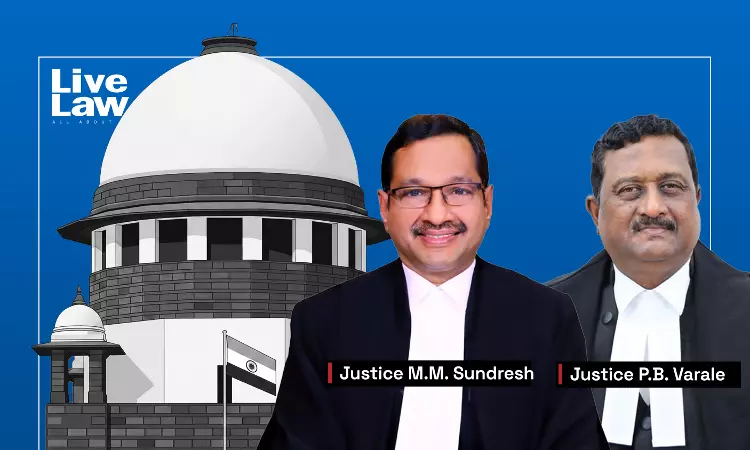
A bench of Justice M.M. Sundresh and Justice Prasanna B. Varale set aside the Punjab and Haryana High Court's order which had denied the premature release to the Appellant, Gurmej Singh, who was convicted of murder in the United Kingdom in 2012 and sentenced to life imprisonment with a minimum tariff of 35 years.
The UK Court convicted the Appellant and subsequently sought transfer to India under the Indo-UK Agreement on Transfer of Sentenced Persons. He was transferred to India in May 2015 and was made to serve the remainder of his sentence in Punjab.
After completing 14 years of imprisonment, the Appellant applied for premature release. However, the Union Govt. rejected his application citing the bar under the bilateral agreement.


The Punjab and Haryana High Court upheld the rejection, holding that he was required to undergo the remaining period of sentence imposed by the UK court, following which an appeal was preferred before the Supreme Court.
Before the Supreme Court, the Appellant relied on Harjeet Singh v. State of Punjab & Ors. to contend that the benefit of remission under Indian laws is not barred to an individual convicted and sentenced by a foreign court.
Allowing the appeal, the Supreme Court found force in the Appellant's contention, noting that Article 10(2) vests power with the Union Govt. to grant pardon, amnesty or commutation of sentence in accordance with the laws prevailing in India.
“A reading of Article 10(2) of the Indo-UK Agreement would clearly indicate that either of the contracting States may grant pardon, amnesty and commutation, in accordance with the Constitution or other laws. The words “other laws” would certainly include the laws governing remission of sentence…It is not as if the conviction per se is modified, but it is only the sentence that stands reduced, by way of a policy decision in the form of remission. So long as the said power exists with the State, it assumes the trapping of "other laws", as mentioned in Article 10 of the Indo-UK Agreement.”, the Court said.
As a result, the appeal was allowed, directing the Union Government to reconsider the Appellant's case in accordance with the applicable remission policy within eight weeks.
Appearance:
For Petitioner(s) Mr. Rajiv Kataria, Adv. Mrs. Sunita Punia, Adv. Mrs. Priyanka Tomar, Adv. Mrs. Dolly Shivani, Adv. M/S. Delhi Law Chambers- 1508, AOR
For Respondent(s) Mr. Rajat Bhardwaj, A.A.G. Ms. Baani Khanna, AOR Mr. Robin Singh, Adv. Mr. Kapil Balwani, Adv. Ms. Komal Thakkar, Adv. Ms. Tejal Tapaswani Nagauri, Adv.