Procedural Defect In Informing Arrest Grounds Won't Lead To Bail If No Prejudice Caused To Accused : Supreme Court
Yash Mittal
28 Oct 2026 7:52 PM IST
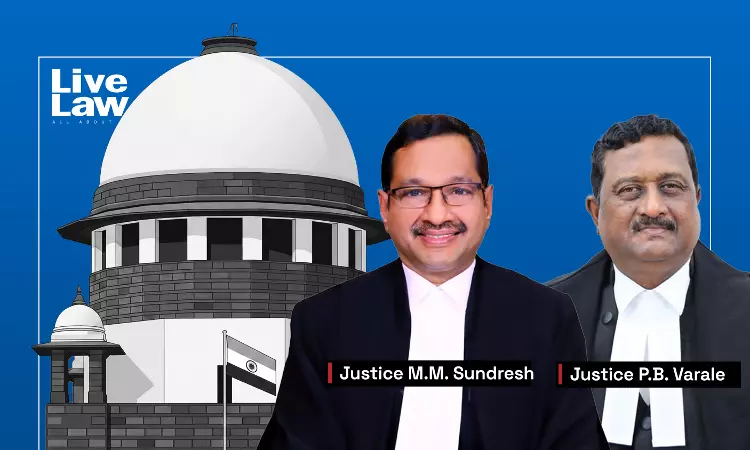
The Court noted that if there is substantial compliance with Article 22 mandate, arrest should be sustained.
The Supreme Court on Wednesday (October 28) has cancelled the bail granted to a man accused of spying for Pakistani intelligence handlers, holding that an alleged procedural lapse in communicating the grounds of arrest cannot automatically justify bail in the absence of demonstrable prejudice.
“In the absence of demonstrable prejudice or denial of an opportunity to defend, an alleged procedural defect in the mode of service cannot ipso facto invalidate detention or entitle an accused to regular bail, more so in cases involving grave allegations of espionage affecting national security and sovereign integrity.”, observed a bench of Justice M.M. Sundresh and Justice Prasanna B. Varale while setting aside the Rajasthan High Court's order granting bail to a man accused under the Official Secrets Act of transmitting sensitive military photographs, videos and troop movement details to Pakistani intelligence handlers in exchange for money.
The High Court had granted bail on the ground that written grounds of arrest were not furnished to the accused, relying on the Supreme Court's decision in Mihir Rajesh Shah v. State of Maharashtra 2025 LiveLaw (SC) 1066.
Departing from the approach adopted by the High Court, the judgment authored by Justice Varale held that the record established substantial and effective compliance with Article 22(1) of the Constitution and Section 47 of the Bharatiya Nagarik Suraksha Sanhita (BNSS), 2023.


Prior to formal arrest, statutory notices under Section 8(1) of the OSA, 192334 were served upon the respondent, putting him on notice regarding the ongoing investigation. Immediately upon arrest, the basis for it was informed to the accused, and the case diary recorded this.
The Court noted that the arrest memo detailed the allegations against the accused and bore his signature. He had been informed of the reasons for his arrest, while his brother was also notified. Further, the accused was represented by a lawyer during remand proceedings, but no objection regarding non-communication of the grounds of arrest was raised.
According to the Court, “a hyper-technical objection regarding the form or mode of communicating grounds of arrest cannot be treated as a self-executing, blanket key to unlock regular bail, bypassing the core parameters governing bail jurisprudence.”
Noting that the respondent-accused was fully cognizant of the grounds for his apprehension and was effectively represented by counsel at the stage of remand, the Court said that therefore “the substantive mandate of Article 22(1) thus stands meaningfully fulfilled, with no demonstrable prejudice having been suffered.”
Relying on State of Karnataka v. Sri Darshan and Kasireddy Upender Reddy v. State of Andhra Pradesh, the Court reiterated that an alleged procedural defect must be examined in light of whether it caused demonstrable prejudice to the accused. It held that the requirement of communicating grounds of arrest does not insist upon written communication as an indispensable formality in every circumstance.
As a result, the appeal was allowed.
Appearance:
For Petitioner(s) Mr. Rajkumar Bhaskar Thakare, ASG Mr. Padmesh Mishra, A.A.G. Mr. Shivam Shukla, Adv. Mr. Yashwardhan Rai, Adv. Mr. Rohit Khare, Adv. Mr. S. Udaya Kumar Sagar, AOR
For Respondent(s) Mr. Saurabh Soni, Adv. Mr. Anupam Singh , AOR Mr. Chandra Prakash, Adv.