Procedural Violation Will Not Vitiate Seizure But Can Affect Evidentiary Value : Supreme Court
Yash Mittal
8 Oct 2026 7:46 PM IST
"The burden of proving a valid seizure of the articles is on the prosecution"
The Supreme Court on Thursday (October 8) held that a failure of the accused to furnish an explanation regarding the seizure made at his place cannot be regarded as incriminating material against him, and the burden of proving the valid seizure remains with the prosecution.
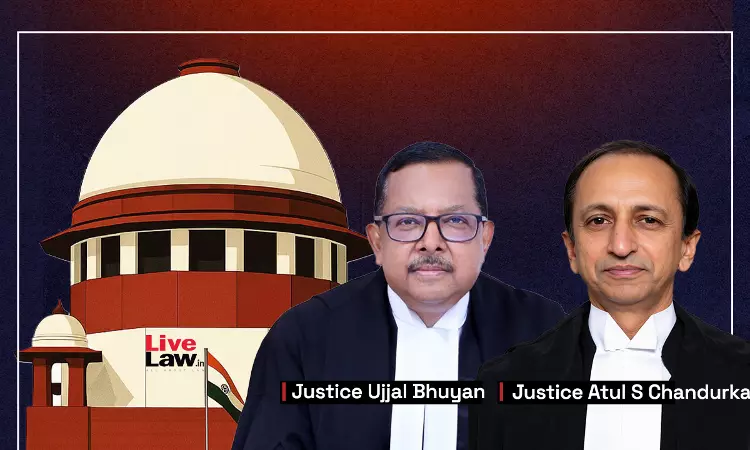
A bench of Justice Ujjal Bhuyan and Justice Atul S. Chandurkar heard the case where the accused's acquittal in an alleged offence of criminal breach of trust (under Section 409 IPC) was reversed by the Bombay High Court Aurangabad Bench, where the High Court gave credence to the seizure of documents made at his house, despite being made in defiance of Section 100 of the Cr.P.C., particularly, the failure of the prosecution to supply the list of seized items to the accused, and the panch witnesses going hostile.
Initially, the trial court found that the procedure prescribed under Section 100(7) Cr.P.C. was not followed during the search and seizure. However, the High Court relied on the testimony of the Investigating Officer (“IO”) without any further corroboration to deem the seizure to be valid. Moreover, the High Court held that the absence of the appellant's signature on the seizure panchnama was not significant and relied on the IO's testimony. It reasoned that there was no reason for the police officer to falsely depose about the seizure.


Setting aside the High Court's decision, the judgment authored by Justice Chandurkar refused to give credence to the seizure process, noting “there was infraction of the requirements of Sections 100(4) and 100(7) of the Code due to its non-compliance.”
“In this scenario, the seizure could not be held to be duly proved solely on the basis of deposition of the IO without any further corroboration. There is no explanation given by the IO as to why a list of the articles seized from the appellant's house was not furnished to him.”, the Court observed.
The Court specifically rejected the High Court's approach of treating the allegedly seized documents as an incriminating circumstance which the appellant was required to explain.
“We, therefore, find that the High Court erred in relying upon the seizure of the said articles and further observing that the same was an incriminating circumstance against the appellant, for which he had not furnished any explanation. The burden of proving a valid seizure of the articles was on the prosecution, but it failed to prove the same, in accordance with law.”, the Court said.
It further observed that the High Court had erred in relying upon the alleged seizure and then drawing an adverse inference from the appellant's failure to explain the documents.
Non-compliance with Section 100 CrPC not automatically fatal, but may affect evidentiary weight
The Court nevertheless clarified that every violation of Section 100 CrPC does not automatically invalidate a search or seizure.
"Non-compliance of the requirements of Section 100 of the Code by itself would not vitiate a seizure and the same would be an irregularity in the investigation," the Court said, emphasising that the non-compliance had to be considered cumulatively with other factors that contribute to doubting the prosecution case, the same would weigh in favour of the appellant.
Since the fact that the two seizure witnesses did not support the prosecution, the IO himself had admitted several shortcomings, and the prosecution's documentary case suffered from other serious deficiencies, the Court refused to sustain the conviction based on the seizure.
“It is true that non-compliance of the requirements of Section 100 of the Code by itself would not vitiate a seizure and the same would be an irregularity in the investigation. However, when this factor is considered cumulatively with other factors that contribute to doubting the prosecution case, the same would weigh in favour of the appellant, especially in an appeal against acquittal.”, the Court observed.
Noting that the prosecution also failed to establish both entrustment of property and dishonest intention, which were essential ingredients of the offence under Section 409 IPC, the Court restored the trial court's decision of acquittal.
As a result, the Appeal was allowed.
Appearance:
For Appellant(s) : Mr. B.H. Marlapalle, Sr. Adv. Mr. Sudhanshu S Choudhari, Sr. Adv. Mr. Vatsalya Vigya, AOR Mr. Ajit Wagh, Adv. Ms. Aanchal Rathore, Adv. Mr. Avinish Kumar Saurabh, Adv. Ms. Gautami Yadav, Adv. Ms. Pranjal Chapalgaonkar, Adv. Mr. Yash Singhania, Adv.
For Respondent(s) :Mr. Shrirang B. Varma, Adv. Mr. Siddharth Dharmadhikari, Adv. Mr. Aaditya Aniruddha Pande, AOR Mr. Harshavardhan V. Ghadge, Adv.