



Prolonged Litigation Cannot Defeat Legitimate Need Of Landlord: Supreme Court Restores Eviction Order After 40 Years
Saima Anjum
5 Nov 2026 12:44 PM IST
The Supreme Court has observed that “prolonged litigation cannot defeat the legitimate need of the landlord,” while restoring an eviction order in a dispute where a tenant had continued to occupy the premises for nearly four decades despite the landlord's bona fide requirement
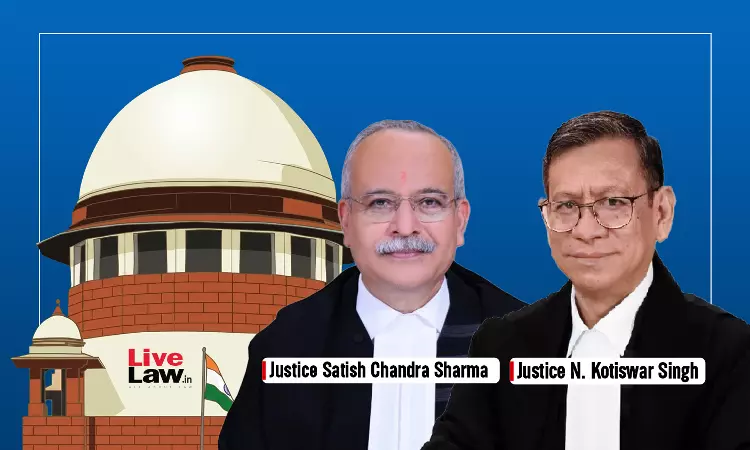
A bench of Justice Satish Chandra Sharma and Justice Nongmeikapam Kotiswar Singh set aside the Allahabad High Court's order which had favoured the tenant and restored the eviction order passed by the Prescribed Authority and affirmed by the Appellate Authority.
Relying on Ravi Khandelwal v Taluka Stores, the bench held that the passage of time in long-drawn litigation washes away initial technical impediments.
The landlord acquired ownership of the property in July 1984. He then issued a statutory notice under Section 21(1)(a) of the Uttar Pradesh Urban Buildings (Regulation of Letting, Rent and Eviction) Act, 1972, requiring the tenant to vacate on the expiry of three years.


Despite the notice and assurances given before the Prescribed Authority as far back as in 1988, the tenant did not vacate. The landlord then initiated proceedings in 2010, pleading bona fide need to establish a medical clinic for his son, a neurosurgeon.
The Prescribed Authority found in the landlord's favour on a bona fide requirement and passed an eviction order in December 2012. The tenant's appeal later was dismissed by the Appellate Authority pursuant to which he approached the High Court under Article 227, which had allowed his petition in March 2025.
Aggrieved landlord challenged the order allowing the 227 petition before the Supreme Court.
Perusing the facts of the case, the Supreme Court observed that the appellant (landlord) has acquired the premises in the year 1984 and filed a civil suit in the year 1986 and since then, the tenant has been enjoying the property. The son of the landlord is a neurosurgeon and wanted to establish his clinic, however has not been able to do the same as the premises have not been vacated for the last 40 years.
The bench then referred to Section 21 of the 1972 Act and the principles laid down in Khandelwal, and reproduced paragraph 16 of the judgment which reads as:
“We cannot lose sight of the fact that we stare at a factual scenario where the vagaries of litigation have prolonged the suit proceedings for a period of 38 years.The plea of the respondent is that the appellant should be asked to file a fresh suit – perhaps their confidence stems from the fact that if the tenant has already been able to prolong the proceedings for 38 years, a similar scenario would again follow. We are not able to countenance such an interpretation which would defeat the very purpose of creating an initial restriction on the filing of the suit. To say that the landlord should now, once again, restart the proceedings because the initial period of five years had not elapsed, even as now 38 years have elapsed, would be a travesty of justice.”
Explaining the precedent, the bench stated that where litigation has dragged on for several decades (38 years in Khandelwal), “the passage of time washes away initial technical impediments, and prolonged litigation cannot defeat the legitimate need of the landlord.”
Applying the aforesaid, the Supreme Court set aside the High Court's order and upheld the eviction order of the Prescribed Authority, as confirmed by the Appellate Authority.
“Applying the aforesaid principles, this Court is of the considered opinion that the interests of justice would be subserved by setting aside the impugned order of the High Court and restoring the concurrent findings and orders of eviction passed by the courts below.”
It further directed the tenant to hand over vacant and peaceful possession of the premises to the landlord within 30 days from the date of the order; and to pay all outstanding arrears of rent, as well as current rent due, if any, within the same 30 days.
Appearances:
For Appellants: Ms. Prachi Mishra, Adv.; Mr. Chaitanya, AOR; Mr. Nishakant Pandey, Adv.; Mr. Kartik Pant, Adv.; Ms. Kirtika Goyal, Adv.; Mr. Anand Kumar Singh, Adv.
For Respondent: Dr. Vinod Kumar Tewari, AOR; Mr. Raunak Parekh, Adv.; Ms. Toshi Khandelwal, Adv.; Mr. Pramod Tiwari, Adv.; Mr. Vivek Tiwari, Adv.; Mr. Bhoopesh Pandey, Adv.; Ms. Priyanka Dubey, Adv.; Mr. Abhishek Tiwari, Adv.; Mr. Laxmikant Upadhayay, Adv.; Mr. Amit Bhardwaj, Adv.


