



- Home
- /
- Supreme court
- /
- Proof Of Attestation Not Proof Of...
Proof Of Attestation Not Proof Of Will's Genuineness When There Are Suspicious Circumstances: Supreme Court
Yash Mittal
7 July 2026 1:00 PM IST
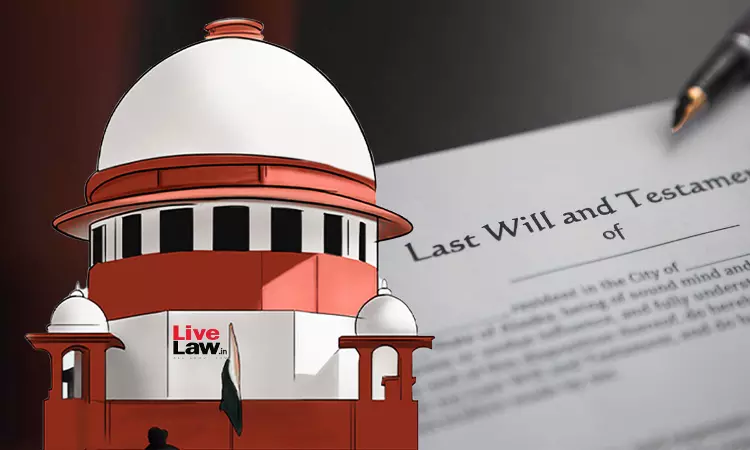
The Supreme Court on Monday (July 6) held that where a Will is surrounded by suspicious circumstances, mere examination of an attesting witness(es) is not enough. The Court added that, in such circumstances, the propounder bears the additional burden of dispelling those doubts and satisfying the judicial conscience that the document truly represents the free and informed wishes of...
This is a premium content
Available exclusively to
Our subscribers
Subscribe Premium 
INR 1099+GST
Your support helps us to bring you more content at
an affordable subscription scheme !!!
All payment options available
The Supreme Court on Monday (July 6) held that where a Will is surrounded by suspicious circumstances, mere examination of an attesting witness(es) is not enough. The Court added that, in such circumstances, the propounder bears the additional burden of dispelling those doubts and satisfying the judicial conscience that the document truly represents the free and informed wishes of the testator.
Overturning the Himachal Pradesh High Court's judgment, a bench of Justice Manoj Misra and Justice KV Viswanathan set aside the bequeathing of the subject property based on a 1974 Will executed by a testator, who was an illiterate agriculturist and could just thumbmark a document. The Court found that the Will was disputed and the Respondent-defendants failed to dispel several legitimate doubts surrounding the Will.
The High Court held that when attestation of the Will is duly proved by the attesting witness, the execution of the Will would stand proved, and the Will, being a registered document, ought not to have been discarded.
Disagreeing with the High Court's view, the Court observed:
“Proof of will is not just an exercise to prove the signature of the testator on the Will and its attestation in terms of Section 63 of the Succession Act; rather it is an exercise to satisfy the Court's conscience that the testator had signed the Will with free will being aware of its contents and after understanding the nature and effect of the dispositions in the Will. Where there are suspicious circumstances regarding the execution of the Will, the propounder must explain those circumstances and dispel all reasonable doubts regarding its execution. Judicial pronouncements have left the phrase 'suspicious circumstances' open-ended so as to encompass any circumstance which creates doubt about the Will being expression of the free will of the testator, though it would not include a figment of imagination or fantasy of a doubting mind. Such doubt may arise from a shaky or doubtful signature of the testator; a feeble or uncertain mind of the testator; an unfair disposition of property; an unjust exclusion of the legal heirs, particularly the dependents; active or leading part played by the beneficiary in making of the will etcetera.”
The dispute arose after Bhambo Devi, widow of Chhajju Ram, instituted a suit claiming ownership and possession of her late husband's properties, asserting that he had died intestate, making her his sole Class I heir.
The defendants, however, relied on a registered Will dated November 6, 1974, under which the entire movable and immovable estate was bequeathed to them. They claimed that the testator had executed the Will in their favour because they had looked after him.
The Trial Court and the First Appellate Court discarded the Will after finding several suspicious circumstances surrounding its execution. The High Court reversed those concurrent findings in the second appeal and upheld the Will. Aggrieved, the widow's legal representative approached the Supreme Court.
Amongst other grounds on which the Court found the Will to be doubtful, the plea of the Respondent-defendant regarding the examination of the attesting witness remained the core issue, which was dealt with extensively in the judgment.
The judgment authored by Justice Misra said that where suspicious circumstances surround the execution of the Will, the propounder must remove those suspicions before the Court can accept the document as genuine.
Examining the facts of the case, the Court found that the defendants failed to dispel several legitimate doubts surrounding the Will, such as:
a. Will completely excluded the testator's wife, who was his sole Class I heir, while conferring the entire estate upon persons who were not even close relatives.
b. the beneficiaries had been described as the testator's nephews although no such relationship had been established in evidence.
c. There were alterations made on the reverse side of the registered Will, where the name "Laxmi Kant" appearing in the registration endorsement had been struck off and replaced by "Chhajju" at multiple places. However, none of these alterations bore the initials or authentication of the Sub-Registrar.
Relying on this unexplained doubt, the Court held that an examination of an attesting witness is not an empty procedural formality; the propounder bears an onus to dispel the suspicious circumstance surrounding the genuineness and authenticity of the Will.
Resultantly, the appeal was allowed, whereby the First Appellate Court and Trial Court decision was restored, declaring the widow to be the owner of the suit property and discarding the disputed Will.
Headnote
Chhattisgarh Rajya Suraksha Adhiniyam, 1990 — Section 9 — Limitation Act, 1963 — Section 5 and Section 29(2) — Applicability of Section 5 of the Limitation Act to statutory appeals under the Adhiniyam — Condonation of delay — Held: Section 5 of the Limitation Act, 1963 is not excluded either expressly or by necessary implication from proceedings under Section 9 of the Chhattisgarh Rajya Suraksha Adhiniyam, 1990 - The appellate authority retains the discretion to condone delay in appropriate cases upon sufficient cause being shown. [Paras 25, 26]
Interpretation of Statutes — Special or Local Law vis-à-vis General Law of Limitation — Exclusion of Section 5, Limitation Act — Principles restated — Held: While a special statute may prescribe a distinct period of limitation, that by itself does not automatically exclude the operation of Sections 4 to 24 of the Limitation Act - The exclusion must be founded on clear statutory language or a legislative scheme indicating that the prescribed limitation is absolute and incapable of enlargement - Section 9 of the Adhiniyam merely provides a thirty-day limitation period but lacks restrictive expressions such as "but not thereafter" or "not exceeding", nor does it provide a specific, limited grace period - The absence of such prohibitive language demonstrates that the legislature did not intend to insulate the enactment from the general law of limitation. [Paras 23-24]
Right of Appeal — Nature of Remedy — Fair Procedure — Externment Orders — Civil and Criminal Consequences — Held: A right of appeal is a substantive right and an integral component of fair procedure, particularly where the impugned orders (such as externment) entail serious civil and criminal consequences affecting the liberty, movement, livelihood, and reputation of a person - In the absence of an express legislative command to the contrary, an interpretation that preserves the appellate remedy and advances substantial justice must be preferred over a technicality that defeats it. [Relied on Garikapati Veeraya v. N. Subbiah Choudhry, AIR 1957 SC 540; Hukumdev Narain Yadav v. Lalit Narain Mishra, (1974) 2 SCC 13; Commissioner of Customs and Central Excise v. Hongo India Private Limited, (2009) 5 SCC 791; Paras 20-27]
Cause Title: Sardari Lal v. Bishan Dass & Ors.
Citation : 2026 LiveLaw (SC) 655
Click here to download judgment
Appearance:
For Appellant(s) : Ms. Radhika Gautam, AOR Ms. Anjali Dubey, Adv.
For Respondent(s) :Mr. Rajesh Gupta, Adv. Mr. Harpreet Singh, Adv. Mr. Sumit R. Sharma, AOR
Tags

Yash Mittal
Yash Mittal is a Correspondent with LiveLaw, covering the Supreme Court of India

