



- Home
- /
- Supreme court
- /
- Properties Acquired By 'Karta'...
Properties Acquired By 'Karta' Presumed To Be Joint Hindu Family Assets Unless Contrary Proved: Supreme Court
Yash Mittal
5 Feb 2026 7:03 PM IST
The Supreme Court on Thursday (February 5) observed that once the existence of an ancestral, income-yielding property is established, any subsequent acquisition made by the Karta during the subsistence of a joint Hindu family is presumed to be joint family property, unless the person claiming self-acquisition discharges the burden of proof with cogent evidence. “Where acquisitions are...
This is a premium content
Available exclusively to
Our subscribers
Subscribe Premium 
INR 1099+GST
Your support helps us to bring you more content at
an affordable subscription scheme !!!
All payment options available
The Supreme Court on Thursday (February 5) observed that once the existence of an ancestral, income-yielding property is established, any subsequent acquisition made by the Karta during the subsistence of a joint Hindu family is presumed to be joint family property, unless the person claiming self-acquisition discharges the burden of proof with cogent evidence.
“Where acquisitions are made during the subsistence of the joint family, and where ancestral properties yielding income are shown to exist, properties acquired in the name of the Karta are ordinarily regarded as joint family properties unless the contrary is proved.”, the court said.
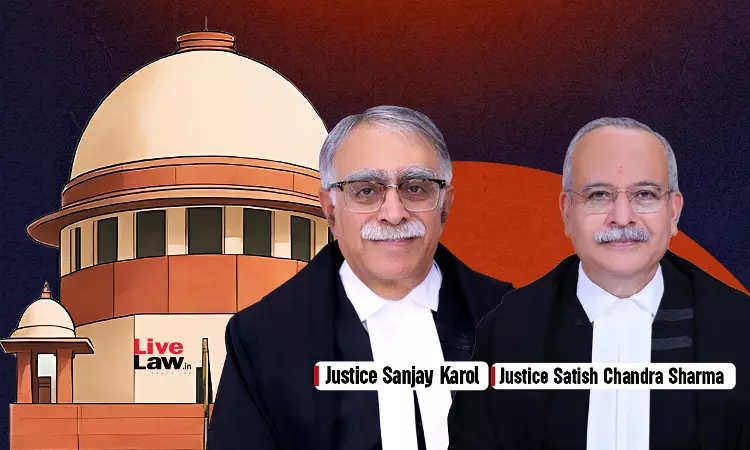
A bench of Justices Sanjay Karol and Satish Chandra Sharma heard the case where a dispute arose between two brothers regarding the partition of a joint Hindu family property.
Background Of The Dispute
The litigation stemmed from a partition suit filed in 1987 by Duraisamy against his father Sengan and brother Dorairaj, relating to 79 items of immovable properties, largely agricultural lands situated in Perambalur Taluk, Tiruchirappalli District. The plaintiff claimed that the properties were joint Hindu family properties traceable to ancestral lands and income generated therefrom.
Dorairaj, the appellant before the Supreme Court, asserted that several properties were either the self-acquisitions of his father Sengan or purchases made by him from his own independent income earned as a contractor and businessman. He also relied on multiple sale deeds executed in his favour by Sengan and an unregistered Will dated November 24, 1989, allegedly executed shortly before Sengan's death.
The Appellant, one of the brothers/coparceners in the joint Hindu family property, resisted another brother-plaintiff's suit for partition seeking his share in the joint property.
It was pleaded in the plaint that the family remained joint in residence, cultivation, enjoyment, and management, and that there had never been any partition, either oral or written. As per the plaint, properties purchased in Karta's name or in the names of other family members were, in substance, were acquisitions made for and on behalf of the family, thereby constituting joint family property.
The Appellant opposed the plaintiff's claim of partition, contending that several properties were his self-acquired property and acquired by their father from his non-ancestral income.
The trial court dismissed the plaintiff's suit; however, the First Appellate Court and High Court decreed the suit, granting the plaintiff a 5/16th share in the joint property that was inducted by the Karta, while excluding only Items 66, 74, and part of Item 36, which were proved to be the Appellant's self-acquisitions from third parties.
Aggrieved by this decision, the Appellant appealed to the Supreme Court.
Upholding the concurrent findings of the High Court and First Appellate Court, the judgment authored by Justice SC Sharma observed that once the existence of ancestral properties capable of yielding income is established, the onus shifted to the Appellant to prove that subsequent acquisitions were made from independent sources. [Refer Shrinivas Krishnarao Kango v. Narayan Devji Kango and Ors, (1954) 1 SCC 544]
“the High Court recognised that separate enjoyment of portions, installation of irrigation facilities, or even obtaining borrowings individually, do not by themselves establish partition in law. What is required is a clear and unequivocal intention to sever the joint status. The High Court correctly emphasized that all relevant conveyances described the interests conveyed as undivided shares, that there was no mutation evidencing division, and that there was no separate payment towards borrowings. In the absence of any declaration or conduct evidencing an intention to divide, the inference of continued joint family status was inevitable.”, the court observed.
Resultantly, the appeal was dismissed.
While dismissing the appeals, the Supreme Court noted that the High Court had already granted limited relief to Dorairaj by excluding specific properties that were demonstrably purchased from non-coparceners. Barring these exclusions, the Court found no reason to interfere with the concurrent findings.
Headnote
Hindu Law – Joint Family Property – Burden of Proof - Supreme Court affirmed that while the mere existence of a joint family does not render all properties joint, once it is established that ancestral properties yielding income existed and acquisitions were made during the subsistence of the joint family, the burden shifts to the person asserting self-acquisition to prove the same - noted that Hindu law does not require coparceners to establish the exact source of funds for every acquisition made by the Karta if a sufficient nucleus is shown. [Relied On Shrinivas Krishnarao Kango v. Narayan Devji Kango and Ors. (1954) 1 SCC 544; Pattusami Padayachi v. Mullaiammal and others MLJ (II) 1976 225; Paras 29, 30]
Alienation – Legal Necessity – Karta's Power - held that alienations by a Karta in favor of a single coparcener must be strictly proved to be for legal necessity - Vague or general recitals in sale deeds regarding "family needs" or "debts" are insufficient to bind the interests of other coparceners - upheld the item-wise scrutiny performed by the lower courts to distinguish between proved legal necessity and impermissible alienations. [Para 33]
Wills – Suspicious Circumstances - upheld the rejection of an unregistered Will executed 72 hours prior to the testator's death - Key suspicious circumstances included the use of a thumb impression by a testator who was literate and habitually signed documents, the involvement of a close relative as a scribe instead of a professional, and the exclusion of natural heirs - since the Appellant did not challenge the Trial Court's rejection of the Will at the First Appeal stage, the finding attained finality - The Supreme Court dismissed the appeals, finding no ground to interfere with the High Court's judgment, which had correctly applied principles of Hindu Law regarding coparcenary property and legal necessity – Appeals dismissed.
Cause Title: DORAIRAJ VERSUS DORAISAMY (DEAD) THROUGH LRs & ORS.
Citation : 2026 LiveLaw (SC) 119
Click here to download the judgment
Appearance:
For Appellant(s) Mr. V. Giri, Sr. Adv. Mr. V.raghavachari, Sr. Adv. Mr. Anant Palli, Sr. Adv. Mr. G. Balaji, AOR Mr. Mukesh Kumar Singh, Adv. Mr. Rajeev M.roy, Adv. Mr. Anand Selvam, Adv. Mr. P.srinivasan, Adv. Mr. Dr.d.jayaprakash, Adv. Mr. Atchaya Gopal, Adv. Ms. R.shase, Adv. Mr. V.puneedhan, Adv. Ms. D.naveena, Adv.
For Respondent(s) Mr. Nishit Agrawal, AOR Ms. Kanishka Mittal, Adv. Ms. Deepti Rathi, Adv. Mr. P. V. Yogeswaran, AOR Mr. Balaji Srinivasan, AOR Mr. Vishwaditya Sharma, Adv. Ms. Kanishka Singh, Adv. Mr. D Mohan, Adv. Mr. S Raju, Adv. Mr. Harish Tripathi, Adv. Mr. Subhornadeep Bhattacharjee, Adv. Mr. K. Shiva, Adv. Mr. Rohan Dewan, Adv. Ms. Aakriti Priya, Adv. Mr. Rajesh R. Pandian, Adv. Mr. D.V.S. Santil, Adv. 2 Mr. Hitesh Kumar Sharma, Adv. Mr. Akhileshwar Jha, Adv. Mr. Anupam Kumar, Adv. Mr. Jogendra Kumar, Adv. Dr. Mrs. Vipin Gupta, AOR Mr. Rajeev Singh, Adv. Mr. Samant Singh, Adv. Ms. Anu H Kirutthika, Adv. Mr. Rajeev Singh, AOR Mr. M.C. Dhingra, Sr. Adv. Mr. Gaurav Dhingra, AOR Mr. Shashank Singh, Adv. Mr. A.k. Singh, Adv. Mr. Mahendra Ram, Adv. Mr. Raghvendra Shukla, Adv. Mr. Piyush Kant Roy, Adv. Mr. Ravishankar Ra, Adv. Mr. G Ilamurugu, Adv. Ms. Aswathi M.k., AOR Mr. Amrendra Kumar Singh, Adv. Mr. Anand Mishra, AOR

Yash Mittal
Yash Mittal is a Correspondent with LiveLaw, covering the Supreme Court of India

